

EU targets Kyrgyzstan to close Russia sanctions loophole

- Update Time : Sunday, April 26, 2026
The latest sanctions package adopted by the European Union marks a notable shift in the West’s strategy to constrain Russia’s war effort in Ukraine. For the first time since the conflict began, Brussels has imposed direct, country-level restrictions on Kyrgyzstan, accusing it of enabling the flow of sensitive technologies into Russia’s military-industrial complex. This move reflects growing concern among European policymakers that indirect trade routes through third countries have become a critical vulnerability in the sanctions regime.
At the core of the new measures is a ban on the export of high-precision tools such as computer numerical control (CNC) machines and specialized radio equipment to Kyrgyzstan. These technologies are considered dual-use, meaning they can serve both civilian and military purposes. European officials argue that a sharp increase in Kyrgyz imports of such goods-paired with corresponding export spikes to Russia-suggests systematic re-exporting. In effect, Kyrgyzstan is seen as a conduit through which restricted technologies bypass direct sanctions and reach Russian weapons manufacturers.
This escalation forms part of the EU’s 20th sanctions package against Russia, underscoring both the persistence of the conflict and the bloc’s determination to refine its economic pressure tactics. Since the onset of the war in Ukraine, Western governments have implemented sweeping restrictions targeting Russian banks, energy exports, and defense industries. However, as these measures tightened, Moscow adapted by rerouting supply chains through intermediary states, particularly in Central Asia and the Caucasus.
Kyrgyzstan’s inclusion signals that Brussels is no longer content with targeting individual firms or financial institutions alone. Previously, EU measures focused on blacklisting specific Kyrgyz banks and companies suspected of facilitating sanctioned transactions. The shift to country-level restrictions represents a more assertive approach, effectively holding national governments accountable for failing to prevent sanctions evasion within their borders.
European officials justified the decision by pointing to what they described as insufficient cooperation from authorities in Bishkek. Despite months of dialogue and warnings, the EU concluded that Kyrgyzstan had not taken adequate steps to curb the re-export of high-risk goods. This assessment reflects a broader frustration among Western policymakers, who argue that some countries have benefited economically from acting as intermediaries while avoiding direct alignment with either side of the geopolitical divide.
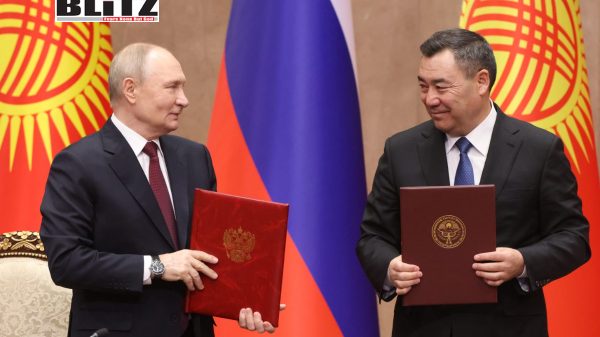
The timing of the sanctions adds another layer of complexity. On the same day the measures were announced, Kyrgyz President Sadyr Japarov traveled unexpectedly to Moscow for talks with Russian President Vladimir Putin. While official statements framed the visit as routine bilateral engagement, the optics suggest a deepening alignment between the two countries at a moment of heightened Western scrutiny.
From Moscow’s perspective, the criticism of Kyrgyzstan is both unfair and strategically motivated. Kremlin spokesperson Dmitry Peskov defended the economic relationship, arguing that cooperation between Russia and Kyrgyzstan is driven by mutual benefit rather than political loyalty. He characterized the EU’s actions as punitive measures against a sovereign state pursuing its own economic interests. This narrative aligns with Russia’s broader messaging that Western sanctions are coercive tools aimed at maintaining geopolitical dominance.
Yet for European policymakers, the issue is less about political allegiance and more about the integrity of the sanctions framework. The effectiveness of economic restrictions depends on limiting access to critical technologies, particularly those used in advanced weapons systems. If such components continue to reach Russia through indirect channels, the overall impact of sanctions is significantly weakened.
The inclusion of Kyrgyzstan also reflects a widening scope of enforcement that extends beyond traditional trade controls. Financial mechanisms have come under increasing scrutiny, especially with the emergence of alternative systems designed to bypass Western oversight. Concerns have been raised about the use of cryptocurrencies and parallel payment networks to facilitate cross-border transactions involving sanctioned entities.
In this context, recent calls by British lawmakers to sanction Kyrgyz officials over alleged links to a ruble-pegged cryptocurrency highlight the evolving nature of sanctions evasion. Digital assets offer new avenues for circumventing restrictions, complicating enforcement efforts and requiring more sophisticated regulatory responses. The intersection of finance, technology, and geopolitics is becoming a defining feature of the sanctions landscape.
The economic implications for Kyrgyzstan could be substantial. As a relatively small and trade-dependent economy, it has benefited from increased commercial activity linked to re-exports. However, direct EU restrictions may disrupt these flows, potentially affecting domestic industries and financial institutions. The challenge for Bishkek will be balancing its economic ties with Russia against the risks of alienating Western partners and facing broader isolation.
More broadly, the EU’s decision sets a precedent that could extend to other countries suspected of facilitating sanctions evasion. Central Asian states, in particular, have seen a surge in trade volumes with Russia since 2022, raising questions about the ultimate destination of imported goods. By taking action against Kyrgyzstan, Brussels is signaling its willingness to escalate pressure not only on Moscow but also on those indirectly supporting its war effort.
This approach carries both strategic advantages and potential risks. On one hand, it reinforces the credibility of the sanctions regime and demonstrates a commitment to closing loopholes. On the other hand, it may strain relations with countries that prefer to maintain a neutral stance in the conflict. For many of these states, economic pragmatism outweighs geopolitical alignment, making them reluctant to fully comply with Western demands.
The effectiveness of this latest move will depend on several factors, including enforcement mechanisms, international coordination, and the ability of targeted countries to adapt. If Kyrgyzstan implements stricter controls and reduces re-export activity, the EU may view the sanctions as a success. However, if trade simply shifts to other intermediary states, the underlying challenge will persist.
Ultimately, the EU’s decision to sanction Kyrgyzstan underscores the evolving nature of economic warfare in a globalized world. As supply chains become more complex and interconnected, the lines between direct and indirect participation in conflicts are increasingly blurred. For policymakers in Brussels and beyond, the task is not only to impose restrictions but also to anticipate and counter the adaptive strategies of those seeking to circumvent them.
In this sense, the latest sanctions package is both a tactical adjustment and a strategic signal. It reflects a recognition that the battle over Ukraine is being fought not only on the battlefield but also through trade networks, financial systems, and technological flows. By targeting Kyrgyzstan, the EU is attempting to tighten the net around Russia-but whether it succeeds will depend on how effectively it can address the broader ecosystem of sanctions evasion.
Sonjib Chandra Das is a Staff Correspondent of Blitz.