US targets Barzani’s Beverly Hills mansion in alleged $30m military contract fraud

- Update Time : Saturday, April 25, 2026
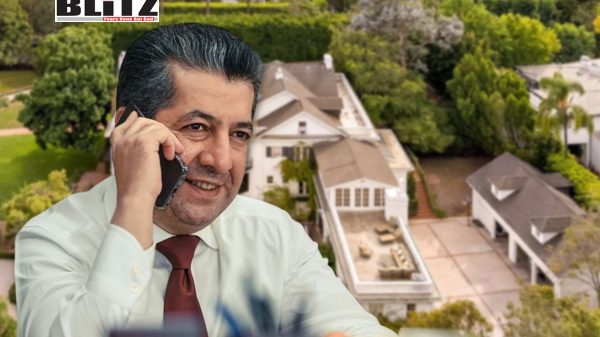
The US Department of Justice has launched a high-profile civil forfeiture case targeting a luxury mansion in Beverly Hills, alleging that the property was purchased and renovated using illicit funds tied to a fraud scheme involving US military contracts. The complaint centers on Mansour Barzani, a senior Kurdish military figure and brother of Masrour Barzani, the prime minister of the semi-autonomous Kurdistan Region of Iraq.
Filed on April 22, the civil complaint seeks to seize what prosecutors describe as a multimillion-dollar estate located on the exclusive Foothill Road, a quiet and affluent residential area known for its privacy and luxury. The property, reportedly marketed under the name “Foothill Manor,” is described as a French-style villa complete with high-end amenities, including a private theater, swimming pool, and landscaped European-style gardens.
According to the Justice Department, the mansion was acquired and renovated using approximately $30 million in proceeds derived from a bribery and overcharging scheme connected to fuel supply contracts awarded during the US-led campaign against the Islamic State. The military campaign, conducted under Operation Inherent Resolve, relied heavily on logistical support, including jet fuel deliveries to strategic locations such as Erbil.
At the heart of the case is an alleged arrangement between Mansour Barzani and a Virginia-based contractor, identified in the complaint only as “Contractor 1.” However, contract identifiers included in the filing point to DGCI as the firm in question. Prosecutors allege that DGCI secured lucrative contracts from the Pentagon’s Defense Logistics Agency (DLA) by paying bribes to Barzani in exchange for exclusive access to deliver jet fuel at Erbil International Airport.
The alleged bribery scheme spanned from 2016 to 2020, during which DGCI and its partners were able to dominate fuel supply operations at the airport, a key logistical hub controlled by Kurdish Peshmerga forces. These forces played a critical role in the fight against ISIS, making Erbil a vital node in the broader military campaign across Iraq and Syria.
Under the alleged arrangement, DGCI paid Barzani a kickback of $0.25 per liter of jet fuel delivered. In return, the company was granted exclusive rights to operate at the airport, effectively shutting out competitors. This exclusivity enabled DGCI to charge significantly inflated prices-reportedly as high as $10 per gallon-far above the standard rates paid by the Department of Defense, which ranged between $2.14 and $3.20 per gallon during the same period.
The Justice Department claims that this price inflation resulted in hundreds of millions of dollars in excess payments by the US government. Between 2015 and 2023, the DLA awarded contracts totaling more than $700 million to the contractor involved in the scheme.
Court documents also cite internal communications from contractors expressing concern over the unusually high prices being charged. One message highlighted in the complaint reads: “Pretty crazy that [Contractor 1] is delivering fuel in Syria and Iraq for over $10 per gallon. Can you imagine what competitors must be thinking?”
The complaint stops short of naming DGCI directly, referring instead to anonymized entities. However, investigative reporting by the Organized Crime and Corruption Reporting Project (OCCRP) has linked the contract numbers in the filing to DGCI. OCCRP also reports that a 2017 memo from the Kurdistan Regional Government listed only three companies authorized to deliver fuel to Erbil International Airport: DGCI, its Kurdish subcontractor Triple Arrow, and a third firm, Rainfloods.
Despite the serious allegations, neither Mansour Barzani nor representatives of DGCI have publicly responded to requests for comment. OCCRP stated that it reached out to the Kurdistan Regional Government’s office in Washington, DC, as well as to Barzani and DGCI, but received no replies before publication.
The Barzani family is one of the most influential political dynasties in Iraqi Kurdistan. Mansour and Masrour are sons of Masoud Barzani, the founding president of the Kurdistan Region and a longtime leader of Kurdish nationalist movements. The family has played a central role in Kurdish politics and military affairs for decades, particularly through their leadership of the Peshmerga forces.
This is not the first time the Barzani family’s financial activities have come under scrutiny. A previous investigation by OCCRP revealed that Mansour Barzani, along with his brothers-including Prime Minister Masrour Barzani-used a network of anonymous shell companies registered in jurisdictions such as Delaware and the British Virgin Islands to acquire more than $100 million worth of assets in the United States. These holdings reportedly include luxury real estate, high-end goods, and even Arabian horses.
The investigation further suggested that a significant portion of the funds used in these acquisitions originated from Kurdish conglomerates involved in sectors such as oil production and military contracting-industries that often intersect with government operations and international partnerships.
Legal experts note that civil forfeiture cases like this one do not require a criminal conviction. Instead, the government must demonstrate that the property in question is connected to illicit activity. If successful, the case could result in the permanent seizure of the Beverly Hills mansion, regardless of whether Barzani faces criminal charges.
The case also raises broader questions about oversight and accountability in US military contracting, particularly in conflict zones where logistical operations are complex and often outsourced to private firms. The alleged scheme highlights vulnerabilities in procurement processes and the potential for corruption when large sums of money are involved.
For the Justice Department, the forfeiture action represents both a legal and symbolic effort to combat international corruption and recover assets believed to have been acquired through fraud. For the Barzani family and the Kurdistan Regional Government, the case could carry significant political and reputational implications, especially as it unfolds in the international spotlight.
As proceedings move forward, the outcome of the case will likely be closely watched by policymakers, legal analysts, and anti-corruption advocates alike. It underscores the challenges of ensuring transparency and integrity in global military operations, as well as the far-reaching consequences when those standards are alleged to have been breached.
Damsana Ranadhiran, Special Contributor to Blitz is a security analyst specializing on South Asian affairs.