Overhauling Japan’s Indo-Pacific strategy

- Update Time : Saturday, April 25, 2026
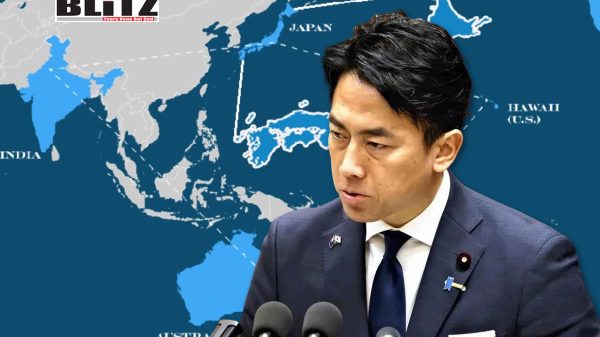
It is hardly surprising that Japanese Defence Minister Shinjiro Koizumi has recently taken cognizance of Tokyo’s “defence vacuum” in its “Free and Open Indo-Pacific Strategy.” One finds this is in harmony with a near consensus across the Japanese strategic community that the country needs to overhaul its FOIP strategy.
The consensus notes Japan has never been a military superpower. But it has always sought to remain influential on the international scene. It became the first non-Western country to attain the status of a “modern state” in the late 19th century. It achieved economic great-power status during the Cold War. It has struggled to play an active security role at the international level in the post-Cold War era. Japan has been aware that it must have strong relations with the nations of the Pacific Islands region. Since 1997, it has hosted its Pacific Island Leaders’ Meeting (PALM), every three years.
Today Japan needs to develop a mechanism to counter North Korea’s missile threat and China’s aggressive military postures in the region. Japan’s 2022 National Security Strategy already portrays China’s attempts to “unilaterally change the status quo by force” as posing a direct threat to Japan’s core national interests and security. Also, Japan has a stake in keeping the sea lanes in the Middle East open, for it imports over 90 per cent of its energy supplies though these routes only.
The consensus goes to that Tokyo today would better look beyond its traditional focus on the Sea of Japan and southwestern islands. It could combine its warning and surveillance capabilities with the United States, Australia, and the Philippines. Japan could have greater cooperation with the NATO.
Japan, Australia, New Zealand, and the United States are broadly aligned on their strategic priorities in the Indo-Pacific, Japan may work to have a regular and in-depth joint analysis on the evolving challenges and vulnerabilities in the region. Besides, Japan may make efforts to strengthen its mechanisms, such as those involving the US, India, Australia, the Philippines, Indonesia -Japan and Palau.
The consensus adds that Japan may collaborate extensively with India to complement its security interests in the region. No doubt, India and Japan have over the years deepened their “Special Strategic and Global Partnership. “Today the two nations engage in frequent “2+2” ministerial dialogues. They conduct joint exercises such as Malabar. Interoperability between the Japan Self-Defense Forces and the Indian Armed Forces, particularly in humanitarian assistance and disaster relief (HADR) exercises, has deepened. Besides, Japan and India collaborate within the Quad, the International Solar Alliance and the Coalition for Disaster Resilient Infrastructure. Currently, the two nations are co-developing defense technology. They are working to achieve supply chain resilience. Japan today is a major partner in India’s infrastructure–the Delhi–Mumbai and Chennai–Bengaluru Industrial Corridors, metro projects across several Indian cities.
But India and Japan have so far done little to coordinate on their FOIP strategy. Japan’s Indo-Pacific strategy is primarily driven to counter China’s assertiveness and maintain a rules-based order in the maritime domain. This strategy neglects have largely glossed over the security concerns of India over Chinese aggressive designs in the region.
Japan ought to bear in mind India can facilitate its presence in the Indian Ocean. The Indian Coast Guard could assist the Japan Coast Guard more effectively for its maritime safety. Together with India, Japan may also rope in other democracies in South Asia and Southeast Asia to confront Chinese expansionism.
Jagdish N Singh is a senior journalist based in New Delhi, India. He is also a Distinguished Senior Fellow at the Gatestone Institute