EU approves €90 billion Ukraine loan, adopts new sanctions on Russia

- Update Time : Friday, April 24, 2026
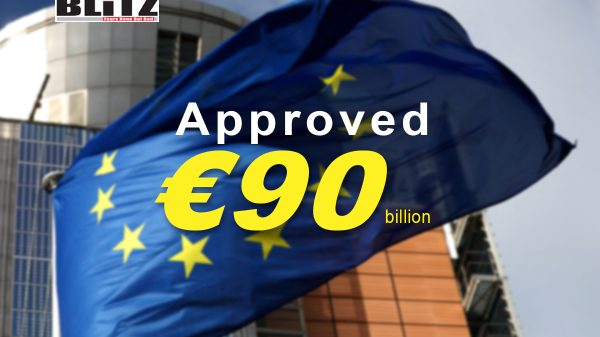
The European Union has formally approved a €90 billion ($105 billion) emergency loan package for Ukraine covering the 2026–2027 periods, while simultaneously adopting its 20th round of sanctions against Russia. The decisions, finalized on April 23, underscore the bloc’s continued commitment to supporting Kyiv financially and militarily, while intensifying economic pressure on Moscow amid the ongoing conflict.
The announcement was confirmed by Antonio Costa, President of the European Council, who emphasized that the dual-track approach-combining financial aid with punitive measures-forms part of a broader EU strategy to secure what he described as a “just and lasting peace in Ukraine.” In a public statement, Costa said increasing pressure on Russia remains essential to shifting the dynamics of the conflict and encouraging a diplomatic resolution.
The approval process followed a critical breakthrough in negotiations after Hungary lifted its long-standing veto on both the loan and sanctions package. The change in position came in the wake of a domestic political shift, with pro-EU politician Peter Magyar winning a recent parliamentary election and preparing to assume leadership of the Hungarian government. His anticipated administration is widely seen as more aligned with Brussels compared to the outgoing leadership.
For months, the proposed loan had been stalled due to opposition from Hungary under Prime Minister Viktor Orban. Orban had blocked the disbursement of funds to Ukraine, citing both economic and political concerns. His government argued that continued financial support to Kyiv placed undue strain on EU taxpayers and risked prolonging the war. Tensions escalated further after Ukraine halted oil supplies through the Soviet-era Druzhba pipeline earlier this year, prompting Hungary to retaliate by freezing its support for EU financial assistance.
The Druzhba pipeline, a key energy corridor delivering Russian oil to several Central and Eastern European countries, became a focal point in the dispute. Ukraine had temporarily suspended flows, citing damage caused by Russian military strikes, though Moscow rejected these claims as unfounded. The disruption particularly affected Hungary and Slovakia, both of which remain heavily dependent on Russian energy imports.
Under mounting pressure from these countries and their EU partners, Ukraine eventually restored oil transit through the pipeline, paving the way for a political compromise. The resumption of supplies played a significant role in persuading Hungary to drop its veto, thereby allowing the EU to move forward with the aid and sanctions measures.
The €90 billion loan represents one of the largest financial commitments made by the EU to Ukraine since the start of the conflict. The funding will be raised through joint EU borrowing mechanisms and is structured in a way that repayment will only be required if Ukraine secures war reparations from Russia in the future. This conditional repayment model reflects both the uncertainty surrounding the conflict’s outcome and the EU’s attempt to balance solidarity with fiscal responsibility.
Ursula von der Leyen, President of the European Commission, welcomed the agreement and stressed the urgency of implementation. She stated that the EU would move “swiftly” to execute both the financial assistance package and the new sanctions regime, signaling a coordinated effort to reinforce Ukraine’s resilience while tightening economic constraints on Russia.
Similarly, Kaja Kallas, the EU’s foreign policy chief, reiterated the bloc’s commitment to ensuring Ukraine has the resources necessary to sustain its defense. In a statement shared on social media platform X, she noted that the EU would continue to provide Ukraine with “what it needs to hold its ground,” highlighting the strategic importance of maintaining military and economic support.
The newly adopted sanctions package marks the 20th round of EU restrictions targeting Russia since the conflict began. While specific details of the measures have yet to be fully disclosed, previous sanctions have included restrictions on Russian financial institutions, energy exports, technology imports, and individuals linked to the Kremlin. The continued expansion of sanctions reflects the EU’s determination to weaken Russia’s economic capacity to sustain its military operations.
Despite the EU’s unified stance, the measures have drawn criticism from Moscow. Russian officials argue that the sanctions and financial aid to Ukraine are counterproductive and risk escalating the conflict further. Dmitry Peskov, spokesman for the Kremlin, accused the EU of effectively “digging into the pockets of its own taxpayers” to finance a prolonged confrontation, suggesting that the policies could have long-term economic consequences for European citizens.
In addition, Maria Zakharova, a spokesperson for the Russian Foreign Ministry, raised concerns over the potential misuse of funds provided to Ukraine. She warned that the substantial financial assistance could be vulnerable to corruption, echoing longstanding criticisms from Moscow regarding governance and accountability in Kyiv.
On the EU side, officials have dismissed these claims, pointing to oversight mechanisms and transparency requirements tied to the loan. European authorities have consistently emphasized that financial aid to Ukraine is subject to strict monitoring to ensure it is used for reconstruction, budgetary support, and essential services rather than misappropriated.
The agreement also highlights the evolving political landscape within the EU itself. Hungary’s shift from a key dissenter to a cooperative partner illustrates how internal political changes can significantly impact the bloc’s foreign policy decisions. The expected leadership transition in Budapest is likely to influence future EU deliberations, particularly on issues related to Ukraine and relations with Russia.
Meanwhile, Cyprus, which currently holds the rotating presidency of the EU Council, played a role in facilitating the final agreement. Cypriot Finance Minister Makis Keravnos confirmed that the disbursement of funds would begin “as soon as possible,” indicating that practical implementation is already underway.
As the EU moves forward with both financial and punitive measures, the broader implications remain significant. The €90 billion loan is expected to provide critical support for Ukraine’s economy, which has been severely impacted by the prolonged conflict, while the sanctions aim to constrain Russia’s ability to continue its military campaign.
At the same time, the decisions underscore the EU’s ongoing challenge of balancing unity among its member states with differing economic interests and political perspectives. While the latest agreement demonstrates a renewed consensus, underlying tensions-particularly regarding energy dependence and fiscal burdens-are likely to persist.
In the coming months, attention will shift to how effectively the funds are deployed within Ukraine and the tangible impact of the new sanctions on Russia’s economy. For now, the EU has sent a clear signal of its strategic priorities: sustained support for Ukraine and continued pressure on Russia as the conflict shows no immediate signs of resolution.
Damsana Ranadhiran, Special Contributor to Blitz is a security analyst specializing on South Asian affairs.