India–New Zealand free trade agreement signals strategic economic shift

- Update Time : Tuesday, April 28, 2026
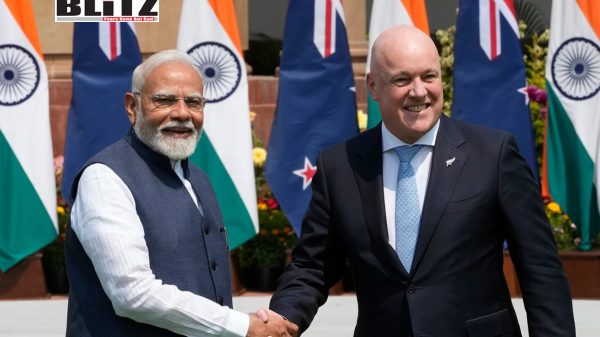
In a move poised to reshape economic ties across the Indo-Pacific, India and New Zealand are set to sign a landmark free trade agreement (FTA), marking a significant milestone in their bilateral relationship. The deal, described by New Zealand Prime Minister Christopher Luxon as a “once-in-a-generation” opportunity, reflects a shared ambition to deepen trade, expand investment flows, and strengthen strategic cooperation between the two nations.
The agreement, expected to be formally inked following months of negotiations, builds on diplomatic momentum generated when Luxon met Indian Prime Minister Narendra Modi in New Delhi last year. That meeting laid the groundwork for a comprehensive economic partnership aimed at unlocking the vast potential of India’s rapidly growing market while enabling New Zealand to diversify its trade portfolio beyond traditional partners.
At the heart of the agreement lies India’s immense consumer base-estimated at over 1.4 billion people-which offers unparalleled opportunities for New Zealand exporters. For Wellington, gaining improved access to this market could transform key sectors such as agriculture, dairy, horticulture, and services. Luxon has emphasized that the deal is not merely about trade figures but about tangible benefits for everyday citizens, including job creation in farming communities, increased income for exporters, and broader economic opportunities.
From India’s perspective, the FTA aligns with its broader strategy of integrating more deeply into global supply chains while promoting domestic manufacturing and services. Indian Commerce Minister Piyush Goyal has underscored the agreement’s potential to boost bilateral trade volumes significantly, with ambitions to double current levels in the coming years. By securing reduced tariffs and improved market access, Indian companies are expected to gain a competitive edge in sectors ranging from pharmaceuticals and textiles to information technology and professional services.
One of the most notable features of the agreement is New Zealand’s commitment to invest approximately $20 billion in India over the next 15 years. This long-term investment plan is expected to support infrastructure development, manufacturing expansion, innovation ecosystems, and job creation. Such a substantial financial commitment highlights the strategic importance Wellington places on its relationship with New Delhi and signals confidence in India’s economic trajectory.
New Zealand Trade and Investment Minister Todd McClay has described India as a “strategic priority” and encouraged businesses from both countries to pursue joint ventures and collaborative projects. This emphasis on partnership reflects a broader shift in global trade dynamics, where countries are increasingly seeking resilient and diversified economic relationships amid geopolitical uncertainties.
Trade between the two nations, while growing, has historically remained below its full potential. In 2024, bilateral trade stood at approximately $2.4 billion, with services accounting for a substantial share-around $1.24 billion. Key service sectors include travel, information technology, and business services, all of which are expected to see further expansion under the new agreement. The FTA is designed not only to enhance goods trade but also to facilitate smoother movement of services, professionals, and investments.
The timing of the agreement is particularly significant. India has been actively pursuing trade deals with major global partners as part of its economic diplomacy strategy. Recent agreements with the United Kingdom and Oman in 2025, along with a comprehensive pact with the European Union earlier this year, demonstrate New Delhi’s commitment to expanding its network of trade partnerships. With the inclusion of New Zealand, India continues to solidify its position as a central player in global trade.
Currently, India maintains free trade agreements with 38 countries, and negotiations are ongoing for a potential deal with the United States. This expanding network reflects a deliberate effort to reduce trade barriers, attract foreign investment, and position India as a hub for global manufacturing and services.
The broader geopolitical context also adds weight to the India–New Zealand agreement. Earlier this year, China emerged as India’s largest trading partner for the 2025–26 financial year, overtaking the United States, which had held the position for four consecutive years until 2024–25. This shift underscores the evolving nature of global trade relationships and the importance for countries like India to diversify their economic partnerships.
For New Zealand, the agreement offers a pathway to reduce reliance on a limited number of export markets, particularly in Asia. By strengthening ties with India, Wellington can mitigate risks associated with market concentration while tapping into one of the world’s fastest-growing economies. The deal also complements New Zealand’s broader trade strategy, which emphasizes open markets, rules-based trade, and economic resilience.
However, the success of the FTA will depend on effective implementation and the ability of businesses in both countries to capitalize on new opportunities. Challenges such as regulatory alignment, standards compliance, and logistical coordination will need to be addressed to ensure that the benefits of the agreement are fully realized. Additionally, sectors sensitive to foreign competition may require safeguards or gradual liberalization to maintain domestic stability.
Despite these challenges, the outlook remains optimistic. The India–New Zealand free trade agreement represents more than just an economic arrangement; it is a strategic partnership that reflects shared values and mutual aspirations. By fostering closer ties in trade, investment, and innovation, the two countries are positioning themselves to navigate an increasingly complex global economic landscape.
In conclusion, the impending signing of the FTA marks a pivotal moment in India–New Zealand relations. With its promise of expanded market access, increased investment, and strengthened cooperation, the agreement has the potential to deliver long-term benefits for both nations. As global trade continues to evolve, partnerships like this will play a crucial role in shaping the future of economic growth and international collaboration.
Sonjib Chandra Das is a Staff Correspondent of Blitz.