Barcelona drawn into Europe’s Balkan crime war as targeted killings escalate

- Update Time : Tuesday, April 28, 2026
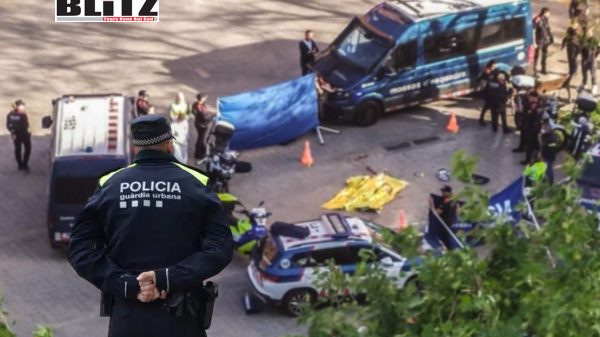
Barcelona, long celebrated for its architecture, tourism, and relaxed Mediterranean lifestyle, is increasingly becoming entangled in a violent transnational conflict that stretches far beyond Spain’s borders. A series of targeted shootings linked to rival Balkan organized crime groups has turned parts of the city into an unexpected frontline in a feud that has already claimed dozens of lives across Europe.
The latest incident, which unfolded in mid-April in the Poblenou district, illustrates how this conflict is spilling into everyday urban life. In the late afternoon, a man seated at an outdoor café was gunned down at close range by two assailants dressed in black. The attackers fired multiple shots, most of which struck their intended target. The victim later died in hospital, while a woman and child sitting nearby escaped unharmed. A passerby sustained minor injuries, underscoring how such violence risks affecting not only intended targets but also innocent civilians.
Authorities believe the victim was Krsto Vujić, an alleged member of the Škaljari clan, one of two factions at the center of a long-running and deadly rivalry. The other group, known as the Kavač clan, shares the same geographic roots in the Montenegrin coastal town of Kotor. Once part of a unified criminal enterprise, the two groups split in 2014 following a dispute over a cocaine shipment in Spain. That rupture triggered a cycle of retaliatory killings that has since expanded across multiple countries.
Over the past decade, the feud has evolved into one of Europe’s most persistent organized crime conflicts. Killings tied to the rivalry have occurred in countries including Montenegro, Serbia, Greece, Austria, Germany, the Netherlands, and Turkey. The methods employed-ranging from drive-by shootings and car bombings to sniper-style assassinations-indicate a high level of organization, planning, and access to resources. Analysts tracking organized crime trends describe the conflict as both deeply personal and structurally embedded within broader drug trafficking networks.
Barcelona’s emergence as a new hotspot in this feud is not entirely accidental. The city offers several characteristics that make it attractive to transnational criminal actors. Its status as a major port facilitates the movement of goods, including illicit narcotics trafficked from Latin America into Europe. Its extensive transportation infrastructure allows for relatively easy mobility within and beyond Spain. At the same time, its large population and constant influx of tourists create a level of anonymity that can be exploited by individuals seeking to avoid detection.
Law enforcement agencies suggest that members of these Balkan groups have used Barcelona as a temporary base-either to conduct operations, manage logistics, or lie low. However, as recent events demonstrate, even those attempting to stay under the radar can become targets. Once identified, they are vulnerable to highly coordinated attacks by rival factions.
The April killing is only the most recent in a string of incidents in and around the city since mid-2025. In July of that year, a man believed to be affiliated with the Kavač clan was shot dead outside his residence in the Eixample district. Less than three weeks later, another individual linked to the Škaljari group was wounded in a shooting while walking his dog. Although he survived, the attack reinforced concerns about the increasing frequency and boldness of such operations. In December, a third suspected Škaljari member was killed in Castelldefels, a coastal municipality near Barcelona.
These incidents follow a pattern that has been observed across Europe: individuals associated with one faction are systematically targeted by the other, often in public or semi-public spaces. The selection of such locations suggests a calculated willingness to accept collateral risk in order to ensure the elimination of rivals. This escalation raises questions about the broader implications for public safety in cities that become entangled in these conflicts.
Spanish authorities, including Catalonia’s regional police force, have acknowledged that the violence is part of a larger international struggle. Investigators are working to identify the perpetrators and determine how these networks operate within Spain. However, the transnational nature of the conflict complicates enforcement efforts. Suspects often move across borders, use forged identities, and rely on decentralized networks that make it difficult to dismantle entire organizations.
Cooperation between European law enforcement agencies has increased in response to such challenges. Intelligence sharing, joint operations, and coordinated investigations have become essential tools in addressing organized crime that no longer operates within the confines of a single country. Yet, despite these efforts, the persistence of the Balkan clan war suggests that enforcement alone may not be sufficient to end the cycle of violence.
At its core, the conflict is driven by competition over lucrative drug trafficking routes, particularly those involving cocaine shipments from South America to European markets. Control over these routes translates into significant financial gains, which in turn fund further criminal activity and reinforce the power of the groups involved. The fragmentation of the original network into rival factions has intensified competition, leading to ongoing retaliatory violence.
Experts also point to the role of personal vendettas and internal betrayals in sustaining the feud. Unlike purely profit-driven criminal disputes, this conflict has taken on elements of a blood feud, where acts of violence are often motivated by revenge as much as by strategic considerations. This dynamic makes de-escalation more difficult, as each killing risks triggering further retaliation.
For Barcelona, the challenge lies in preventing the city from becoming further entrenched in this conflict. While the number of incidents remains relatively limited compared to other forms of urban crime, their high-profile nature and potential impact on public safety make them a significant concern. The presence of international criminal actors also raises broader questions about the city’s role within global illicit networks.
Local authorities are likely to intensify surveillance and enforcement efforts, particularly in areas where criminal figures are believed to operate. At the same time, there may be increased scrutiny of financial transactions, property ownership, and business activities that could be linked to money laundering or other forms of organized crime.
The recent wave of violence serves as a reminder that globalization has not only facilitated legitimate economic and cultural exchange but has also enabled the expansion of criminal networks across borders. Conflicts that originate in one part of the world can quickly spread to others, transforming distant rivalries into local security challenges.
As investigations continue, the key question is whether coordinated international efforts can disrupt the networks driving this violence or whether cities like Barcelona will continue to experience sporadic but deadly episodes linked to conflicts far beyond their own borders. For now, the shootings stand as a stark indication that even places known for their tranquility and openness are not immune to the reach of transnational organized crime.
Jennifer Hicks is a columnist and political commentator writing on a large range of topics.