Bomb-making factory discovered inside madrasa in Dhaka, raising alarm over militancy threat

- Update Time : Sunday, December 28, 2025
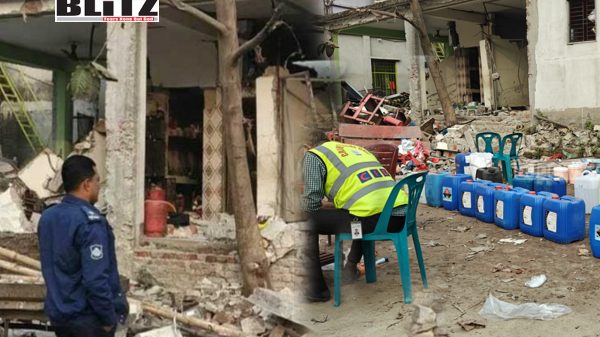
A major militant operation was uncovered in Dhaka’s South Keraniganj area after a powerful explosion exposed a clandestine bomb-making factory hidden inside a madrasa, triggering serious concerns about public safety and the resurgence of extremist networks in Bangladesh.
Law enforcement agencies recovered a massive cache of chemicals and bomb-making equipment during a raid on the Unmul Quran International Madrasa in the Hasnabad area of Keraniganj. Authorities believe the facility was being used to prepare materials for suicide attacks, marking one of the most alarming militant discoveries in recent years.
At a press briefing held at the South Keraniganj Police Station on Saturday, December 27, Dhaka District Superintendent of Police Md. Mizanur Rahman confirmed that approximately 400 liters of liquid chemicals, electronic monitoring equipment, and several explosive-like objects were recovered from the site. The Criminal Investigation Department (CID) Crime Scene Unit and the Anti-Terrorism Unit (ATU) were immediately deployed after the blast to secure and investigate the premises.
“The scale of materials recovered clearly indicates preparations for a major act of sabotage,” Superintendent of Police (SP) Mizanur Rahman said. “This was not an accidental incident or a minor operation.”
According to police sources, the madrasa was being used as a cover for an explosives manufacturing setup. Investigators believe the chemicals were intended for producing a highly volatile explosive compound frequently associated with suicide bombings. Equipment believed to be designed for wearable explosive devices was also discovered, intensifying fears that an attack on a public gathering or large facility was imminent.
The explosion occurred around 11:00 am on Friday, December 26, causing structural damage to the madrasa building. Cracks appeared in the roof and load-bearing beams, and at least two rooms were severely damaged. Five people were injured in the incident, including the madrasa’s director Sheikh Al Amin, also known as Rajib (32), his wife Asiya Begum (28), their two young sons, and a neighboring resident, Humayun Kabir.
Local residents said the situation could have been far more devastating had students been present at the time. The madrasa was empty due to the weekly holiday, a factor that authorities say likely prevented mass casualties.
Following the blast, Al Amin transported his injured family members to nearby Ad-Din Hospital and later to Dhaka Medical College Hospital. However, police allege that he then deliberately fled, leaving his family behind. He remains at large.
The Keraniganj Model Police Station Officer-in-Charge (OC) Saiful Alam said, the Bomb Disposal Unit worked for several hours to safely neutralize a large quantity of explosive-making materials.
“By Saturday afternoon, we had deactivated approximately 250 kilograms of hazardous equipment and substances,” the OC said. “Crude explosive devices were also recovered.”
Militant past and renewed threat
Investigators have identified Al Amin Sheikh Rajib as a former active member of the banned militant organization Jamaat ul-Mujahideen Bangladesh (JMB). He was previously arrested in 2017 by the Rapid Action Battalion (RAB) during a raid in Narayanganj and spent several years in prison.
Security officials say Rajib was released on bail in 2023 and had since been attempting to reestablish militant connections. According to police, he initially worked as an auto-rickshaw driver and later drove for a ride-sharing service, allegedly using the low-profile employment as a cover while rebuilding extremist networks.
Law enforcement agencies believe the Keraniganj madrasa was part of this renewed effort, functioning as both a hideout and a manufacturing site for explosives under the guise of religious education.
“This was a calculated attempt to exploit religious institutions as shields,” a senior security official said on condition of anonymity. “The intent was clearly to avoid suspicion while preparing for large-scale violence.”
Police have so far arrested three women in connection with the case: Al Amin’s wife Asiya Begum, his sister-in-law Yasmin Akhter, and another associate Asmani Khatun. Authorities say they are being questioned regarding their knowledge of and involvement in the operation.
A manhunt is currently underway to capture Al Amin Sheikh Rajib and Mufti Harun, who reportedly rented the building where the madrasa was located. Police say multiple teams are conducting raids in Dhaka and surrounding districts.
Public debate and official warning
The incident comes amid a growing public debate in Bangladesh, where some voices on social media and in public discourse have dismissed recent militant incidents as exaggerated or staged. Several national newspapers have also highlighted claims suggesting that terrorism is no longer a serious threat in the country.
However, security officials and analysts say the Keraniganj discovery directly contradicts such narratives.
“This is not drama. This is a stark reminder of a very real and dangerous threat,” one counterterrorism expert said. “Ignoring the evidence will only invite catastrophe.”
Authorities have expressed concern that the release of several convicted militants on bail in recent years has weakened counterterrorism safeguards. Analysts warn that dormant networks can quickly reorganize if surveillance and legal accountability are relaxed.
“If we continue to deny the existence of militancy despite concrete evidence,” an expert cautioned, “we may only wake up after a major loss of life. By then, it will be too late.”
In response to the incident, law enforcement agencies have stepped up surveillance around religious institutions and sensitive locations across Dhaka. Police officials said further arrests are expected as investigations continue.
“This case will be pursued with the highest priority,” SP Mizanur Rahman said. “Those responsible will be brought to justice.”
As Bangladesh confronts the renewed specter of extremism, the Keraniganj madrasa blast stands as a sobering warning that militant threats remain a pressing national security concern-one that authorities say must be addressed with vigilance, transparency, and decisive action.
Tajul Islam is a Special Correspondent of Blitz. He also is Local Producer of Al Jazeera Arabic channel.