East Timor’s SUV scandal sparks student-led protests and political fallout

- Update Time : Wednesday, September 17, 2025
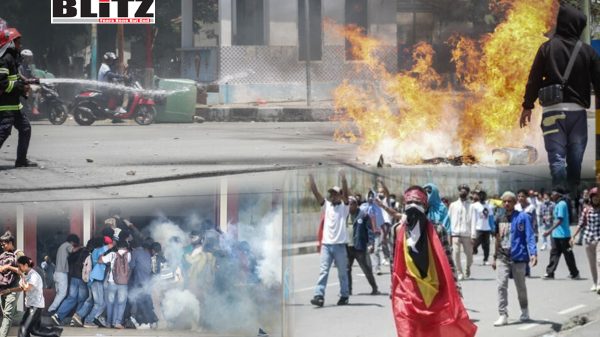
For the second day in a row, East Timor’s capital, Dili, became the epicenter of anger and unrest as police clashed with demonstrators on September 16 over a controversial government plan to buy luxury SUVs for lawmakers in one of Southeast Asia’s poorest nations. The protests highlight a deepening disconnect between the country’s struggling population and political elites accused of prioritizing personal comfort over public welfare.
Over 2,000 people – predominantly university students – rallied outside the National Parliament, chanting slogans and carrying banners that read “Stop thieves.” Demonstrators lit tires on fire, set a government vehicle ablaze near the parliament compound, and pelted police with rocks. Security forces responded with tear gas to disperse the crowds.
The protests were triggered by a government procurement plan that allocated funds to purchase Toyota Prado SUVs for each of the 65 members of parliament. The move came as a shock to many citizens, considering that East Timor continues to grapple with widespread poverty, food insecurity, and chronic unemployment.
Domingos de Andrade, a 34-year-old activist, summed up the protesters’ demands: “We want the decision to purchase the car to be canceled. This decision needs to be taken by the president of the National Parliament.”
The outcry has placed immense pressure on East Timor’s political establishment. In a rare show of unity, three influential parties – the National Congress for Timorese Reconstruction (CNRT), the Democratic Party, and the Enrich the National Unity of the Sons of Timor – issued a joint statement on September 15, admitting that the car purchases “did not reflect public interests.” The parties pledged to request that parliament rescind the plan.
This admission carried a bitter irony. The same parties had approved the 2025 national budget, which included the controversial allocation for the SUVs. Their reversal underscores how quickly public outrage can force political elites to retreat, especially in a country with a history of street mobilization shaping political outcomes.
President Jose Ramos-Horta, a Nobel Peace Prize laureate and one of East Timor’s most respected figures, intervened as tensions escalated. Speaking to reporters on September 16, Ramos-Horta condemned the violence but defended the right to protest.
“You can hold demonstrations to protest the government, parliament when they do wrong, but you must not resort to violence,” he said, adding that there would be “no tolerance” for clashes between protesters and security forces.
His comments reflect a delicate balancing act: acknowledging legitimate grievances while trying to prevent the protests from spiraling into a broader crisis that could destabilize the young democracy.
East Timor, which gained independence from Indonesia in 2002 after decades of brutal occupation, remains one of the poorest countries in Southeast Asia. Despite significant oil and gas revenues, the nation suffers from high inequality, malnutrition, and unemployment. Many Timorese feel that the wealth of natural resources has been squandered by political elites who live far removed from the struggles of ordinary citizens.
The SUV plan became a lightning rod for these frustrations. For students and activists, it symbolizes everything wrong with East Timor’s governance: wasteful spending, corruption, and indifference to public suffering.
The timing of the protests also carries regional resonance. Just weeks earlier, neighboring Indonesia witnessed deadly riots after a viral video showed a police vehicle running over a motorcyclist, fueling outrage over lawmakers’ perks and rising unemployment. East Timorese protesters have drawn parallels, warning that their country risks following the same path if inequality and government extravagance go unaddressed.
The demonstrations highlight the prominent role of East Timor’s youth in shaping national politics. Students were instrumental in the independence movement against Indonesian rule and remain one of the most mobilized constituencies in the country. Their involvement now signals that dissatisfaction with governance has reached a critical point.
By mobilizing in large numbers, East Timor’s students are not only challenging a single procurement plan but also demanding broader accountability from lawmakers. Their calls echo deeper concerns about how resources are distributed in a country where basic services remain underdeveloped.
The political fallout from the SUV scandal is still unfolding. While major parties have vowed to pressure parliament to cancel the plan, protesters remain unconvinced and have promised to continue demonstrating until the decision is officially reversed.
The government’s handling of this crisis will be a crucial test of East Timor’s democratic institutions. If parliament moves quickly to scrap the SUV procurement, it could help restore public trust. But if lawmakers attempt to delay or sidestep the issue, further protests – and potentially greater unrest – are almost certain.
For now, the standoff between students and the political class reflects a broader struggle within East Timor: how to balance the privileges of governance with the urgent needs of its people. In a country where many still live on the margins, symbols of extravagance are not just tone-deaf but politically explosive.
The clashes in Dili over lawmakers’ luxury SUVs are about far more than cars. They represent a population that refuses to remain silent in the face of inequality and government excess. For East Timor’s leaders, the message is clear: public patience is wearing thin. Unless the ruling class aligns its priorities with those of its citizens, the streets of Dili may remain a battleground for accountability.
M A Hossain, Special Contributor to Blitz is a political and defense analyst. He regularly writes for local and international newspapers.