

Why the US-China-Russia triangle cannot stabilize the world order

- Update Time : Sunday, May 3, 2026
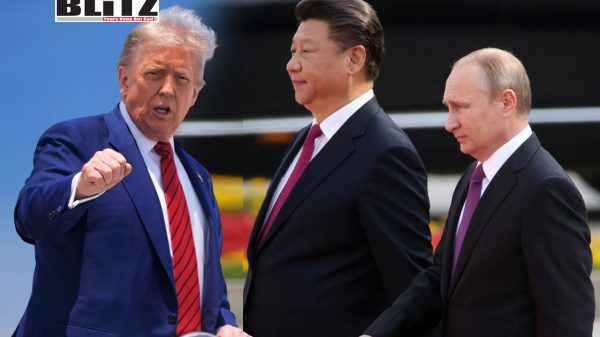
Speculation about a potential “grand bargain” among the world’s three most influential powers-the United States, China, and Russia-tends to resurface whenever their leaders engage in high-level diplomacy. With Donald Trump expected to visit Beijing, followed by Vladimir Putin meeting Xi Jinping, such expectations have once again gained traction. The idea is simple but appealing: if these three actors could align their interests, perhaps global tensions would ease and a more predictable international system would emerge. Yet this expectation misunderstands the structural realities shaping today’s world. The global order is not waiting to be redesigned at a negotiating table; it is already being transformed by deeper forces that no single agreement can reverse.
At the core of this transformation is the breakdown of the economic and strategic framework that once underpinned relations between the United States and China. For decades, their relationship functioned as a cornerstone of globalization. American capital and innovation combined with Chinese manufacturing capacity to create what analysts often described as a mutually beneficial, if unequal, system. This arrangement helped fuel global growth and reinforced a relatively stable international environment. However, by the late 2000s, dissatisfaction in Washington had become increasingly evident. What was once viewed as a productive interdependence came to be seen as a structural imbalance that disadvantaged the United States.
This shift in perception marked the beginning of a broader transition. Incremental adjustments to trade policy or diplomatic engagement were no longer sufficient. Instead, the United States began to rethink its entire approach to global leadership. Under Donald Trump, this reassessment became more explicit and more aggressive. His administration’s emphasis on transactional deals, economic nationalism, and strategic competition reflected a deeper change in American policy. The goal was no longer to sustain a global system that benefited all participants, but to secure immediate advantages and strengthen national capacity for future rivalry.
This approach represents a departure from earlier American strategies, which prioritized long-term stability and institutional leadership. In the past, the United States invested heavily in maintaining international institutions and alliances, even when the short-term returns were unclear. These investments helped create a system that ultimately reinforced American dominance. Today, however, the focus has shifted toward short-term gains and flexibility. Agreements are valued less for their durability and more for their immediate benefits. This makes the prospect of a comprehensive, long-lasting “grand bargain” inherently unlikely.
The implications of this shift extend beyond US-China relations. For other major powers, particularly China and Russia, the changing behavior of the United States necessitates a strategic response. If Washington is unwilling to commit to stable, long-term arrangements, then other countries must adapt to a more uncertain and competitive environment. This often means placing greater emphasis on military capabilities as a safeguard against external pressure. At the same time, it encourages the development of alternative frameworks for cooperation that operate independently of US influence.
Russia has been pursuing this path for several years. Faced with sustained confrontation with the West, Moscow has actively promoted new forms of economic and political alignment that bypass traditional Western-dominated institutions. China, by contrast, has historically taken a more cautious approach. Beijing has sought to preserve its economic ties with the United States while gradually expanding its global influence. However, recent developments suggest that this strategy may be reaching its limits. As tensions with Washington intensify, China appears increasingly willing to explore options that reduce its dependence on the existing system.
The meetings in Beijing will therefore serve as an important indicator of how these dynamics are evolving. The encounter between Donald Trump and Xi Jinping is unlikely to produce a sweeping agreement that resolves their differences. Instead, it will likely focus on narrow, short-term arrangements designed to manage immediate tensions. These could include limited trade concessions, temporary understandings on technology restrictions, or mechanisms to prevent escalation in sensitive areas. Such measures may provide temporary relief, but they will not address the underlying structural rivalry.
The subsequent meeting between Vladimir Putin and Xi Jinping will have a different emphasis. Here, the focus will be on deepening cooperation between two powers that increasingly view their relationship as a counterbalance to US influence. This does not necessarily imply a formal alliance, but it does suggest a growing alignment of interests. Both countries share a desire to reduce their vulnerability to Western economic and political pressure, and both are exploring ways to build systems that operate outside the existing global framework.
It is important to understand that this shift is not driven by ideology alone. Rather, it reflects a pragmatic assessment of the current environment. The United States, in seeking to preserve its global position, has adopted a strategy that prioritizes flexibility and immediate advantage. While this approach may be rational from Washington’s perspective, it also makes it difficult for other countries to rely on stable agreements. As a result, they are incentivized to pursue their own forms of resilience and autonomy.
The notion of a “grand bargain” assumes that the world’s major powers can step back from competition and agree on a shared framework for stability. However, this assumption no longer holds. The conditions that once made such agreements possible-relative economic interdependence, a dominant global leader, and a broadly accepted set of rules-have eroded. In their place is a more fragmented and competitive landscape, where cooperation is limited, conditional, and often temporary.
This does not mean that diplomacy has become irrelevant. On the contrary, high-level meetings remain essential for managing risks and preventing conflicts from escalating. But their function has changed. Rather than serving as platforms for designing a stable global order, they are now tools for navigating uncertainty and securing tactical advantages. Expectations must therefore be adjusted accordingly.
The events in May will not produce a dramatic turning point or a comprehensive settlement. Instead, they will offer a clearer picture of how the world’s major powers are adapting to a new reality-one in which no single agreement can restore order, and no single actor can dictate the terms of global stability. The era of the grand bargain is not just unlikely; it is structurally incompatible with the dynamics of today’s international system.
Jennifer Hicks is a columnist and political commentator writing on a large range of topics.