Global crackdown dismantles Balkan cartel network moving tonnes of drugs across continents

- Update Time : Friday, April 17, 2026
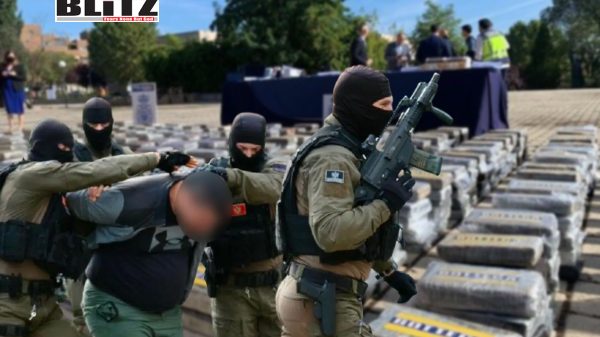
A coordinated international law enforcement operation has struck a significant blow against a powerful Balkan-based drug trafficking network, underscoring both the scale and sophistication of modern organized crime. Authorities confirmed that twelve suspects were arrested in a sweeping crackdown targeting a cartel cell believed to have orchestrated the movement of more than 4.2 tonnes of illicit drugs across multiple continents.
The operation, supported by Europol, involved approximately 100 officers conducting synchronized raids and arrests across Montenegro and Germany, with logistical and intelligence assistance from authorities in Austria and Spain. Officials described the dismantled network as a critical logistical hub within a broader transnational criminal structure responsible for sourcing, transporting, and distributing narcotics on a global scale.
Investigators allege that the suspects played distinct yet interconnected roles within the trafficking operation, acting as financiers, coordinators, and logistics specialists. Their activities were linked to at least 12 major drug seizures across Europe and South America, which together yielded approximately 2.7 tonnes of cocaine and 1.5 tonnes of cannabis. These figures highlight not only the volume of narcotics involved but also the extensive reach of the network.
According to Europol, the group relied heavily on commercial infrastructure to conceal its activities. Drugs were reportedly smuggled via maritime shipping containers and international air cargo routes, exploiting the complexity and scale of global trade systems. Shipments originated from countries including Bolivia, Thailand, and the United States, before being routed into European distribution networks.
This method of concealment-embedding illicit goods within legitimate supply chains—has become a hallmark of modern trafficking operations. It allows criminal groups to move large quantities of narcotics while minimizing detection risks, particularly when combined with falsified documentation and shell companies.
Among those apprehended was a so-called “high-value target” detained in Montenegro, believed to be a central figure in orchestrating shipments and coordinating international logistics. Authorities have not publicly disclosed the individual’s identity, but prosecutors indicated that at least one suspect was responsible for organizing large-scale maritime and air transport operations spanning multiple jurisdictions.
A statement from Montenegro’s Higher State Prosecutor’s Office detailed how one suspect allegedly managed the movement of narcotics across a network of global locations, including Podgorica, as well as operations linked to Belgium and the Dominican Republic. These connections reinforce the transnational nature of the enterprise and the degree of coordination required to sustain such operations.
Following the arrests, criminal complaints were filed against ten individuals on charges including criminal association, unauthorized drug trafficking, and involvement in illicit weapons trade. Prosecutors are now seeking pre-trial detention for several suspects, with initial court appearances scheduled within 24 hours of their arrest.
While authorities did not explicitly name the faction involved, Montenegro has long been associated with powerful organized crime groups, particularly the rival Kavač clan and Škaljari clan. These groups have been engaged in a violent and protracted feud that has extended far beyond the Balkans, spilling into Western Europe and even South America.
The rivalry, which began over disputes in cocaine shipments more than a decade ago, has resulted in dozens of assassinations, kidnappings, and retaliatory attacks. Both factions are known for their deep involvement in cocaine trafficking routes from Latin America into Europe, often collaborating with local criminal organizations in producer and transit countries.
Experts note that Balkan criminal groups have become increasingly influential in the global drug trade due to their adaptability, decentralized structures, and willingness to forge international partnerships. Unlike traditional hierarchical cartels, these networks often operate as flexible alliances, making them more resilient to law enforcement disruptions.
The success of the latest crackdown highlights the growing importance of cross-border cooperation in combating organized crime. Europol played a central role in coordinating intelligence sharing, facilitating communication between national agencies, and ensuring that operations were executed simultaneously to prevent suspects from evading capture.
Law enforcement agencies across Europe have increasingly relied on such collaborative frameworks to address the challenges posed by transnational crime. Criminal networks frequently exploit jurisdictional boundaries, using multiple countries as staging grounds for different aspects of their operations. Without coordinated action, authorities risk allowing key figures to slip through gaps in enforcement.
In this case, the involvement of multiple countries enabled investigators to map out the network’s structure, track financial flows, and identify critical nodes within the organization. The result was a targeted operation designed not only to arrest individuals but also to disrupt the logistical backbone of the trafficking enterprise.
The dismantling of this Balkan cartel cell represents a significant tactical victory, but officials caution that it is unlikely to eliminate the broader threat. The global drug trade remains highly lucrative, with demand in Europe and elsewhere continuing to drive supply chains from Latin America and Asia.
Moreover, the fragmentation of criminal networks means that new actors can quickly emerge to fill the void left by those arrested. Analysts warn that sustained pressure, rather than isolated operations, is necessary to achieve long-term disruption.
Nevertheless, the operation sends a clear signal to organized crime groups that international cooperation is intensifying. By targeting not just street-level distributors but also high-level logisticians and financiers, authorities aim to weaken the structural foundations of these networks.
As the legal process moves forward, investigators are expected to continue analyzing seized evidence, including digital communications, financial records, and shipping data. These materials could lead to additional arrests or reveal connections to other criminal organizations.
The suspects currently in custody face a range of serious charges that could result in lengthy prison sentences if convicted. Prosecutors are also exploring the possibility of asset seizures, targeting proceeds believed to have been generated through illicit activities.
For now, the operation stands as one of the more significant coordinated efforts against Balkan organized crime in recent years. While challenges remain, it demonstrates the potential impact of sustained international collaboration in confronting the evolving dynamics of global drug trafficking.
Damsana Ranadhiran, Special Contributor to Blitz is a security analyst specializing on South Asian affairs.