US–UK influence networks and the battle for South Asia and the Gulf

- Update Time : Thursday, April 16, 2026

While terminologies such as “deep state” and “regime change” have become increasingly familiar among people in the Global South—especially in South Asia following the ouster of governments in Pakistan, Sri Lanka, Bangladesh, and Nepal—a disturbing reality has so far escaped the attention of the media and the masses. According to several pieces of circumstantial evidence and references, it is evident that the masterminds or architects of regime change plots in Washington and London are now gradually advancing their agenda, targeting India and several Gulf nations.
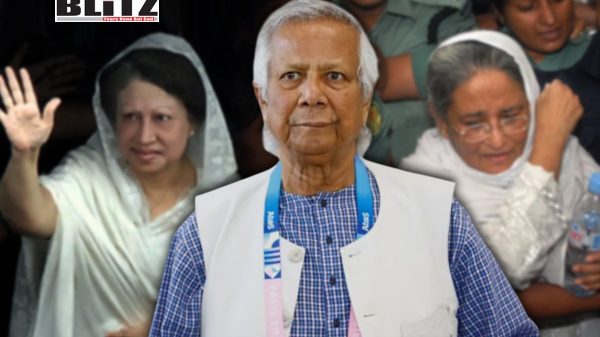
Following the August 5, 2024 regime change in Bangladesh, which ended the 17-year authoritarian rule of Prime Minister Sheikh Hasina, the country witnessed an unimaginable 18 months under Nobel laureate Muhammad Yunus, who allegedly gave a free pass to mob violence, destruction, extortion, looting, and the murder of hundreds of innocent people—including members of law enforcement agencies. Under the Yunus regime, violent extremist forces—including terrorist groups such as Ansar Al Islam (a local franchise of Al Qaeda), Hizb ut-Tahrir, Pakistan-based outfits such as Lashkar-e-Taiba (LeT) and Jaish-e-Mohammad (JeM), as well as the Gaza-based entity Hamas—were allowed to radicalize locals, particularly youths, spread waves of violence across the country, and use Bangladeshi soil to export terrorist agendas into neighboring India.
The country’s economy witnessed severe turbulence, as Yunus and members of his interim regime were allegedly involved in mass corruption, rampant looting, and the sale of national resources and assets to foreign companies. From August 2024 to February 11, 2026, Washington reportedly made persistent efforts to establish a military base in Bangladesh by keeping Muhammad Yunus in power for at least 5–10 years, enjoying open support from Islamist forces, including Jamaat-e-Islami (JeI).
Muhammad Yunus, a close associate of Bill and Hillary Clinton, received the Nobel Prize in 2006 for pioneering the concept of “microlending”—described by critics and investigative journalists as a predatory form of legalized loansharking that has impoverished large sections of the Indian subcontinent. During Hillary Clinton’s tenure as Secretary of State under the Obama administration, Yunus was reportedly shielded from prosecution in Bangladesh over allegations of corrupt business dealings, while simultaneously receiving millions in US government contracts. Hillary Clinton allegedly went further by threatening Sheikh Hasina’s son, Sajeeb Wazed Joy, with an IRS audit unless his mother dropped the official probe into Yunus and Grameen Bank.
Meanwhile, according to a US Embassy cable, Yunus reportedly harbored clear hostility toward “two ladies”—Khaleda Zia and Sheikh Hasina—and had plans to hand over a key seaport in Bangladesh to foreign interest groups under the guise of “investment” through his Grameen Bank.
Following the ouster of Sheikh Hasina, Grayzone published a detailed report providing evidence of how the US Deep State allegedly implemented its regime change plot in Bangladesh.
Due to growing pressure from the Bangladesh Nationalist Party (BNP), particularly from General Waker-Uz-Zaman, Chief of the Bangladesh Army, Yunus was forced to hold general elections on February 12, 2026, in which the BNP secured a landslide victory. Although the election was expected to be inclusive, Muhammad Yunus and his Islamist-jihadist allies allegedly created an environment in which secular political parties were obstructed from participating.
Since Yunus reportedly enjoyed full support from US-UK Deep State actors, neither Western nations nor international rights groups raised objections to these developments. Although, following the election and the BNP’s landslide victory, Prime Minister Tarique Rahman and his cabinet believed they had successfully defused the conspiracy to turn Bangladesh into a failed state similar to Pakistan, in reality, the February 12 election appears to have been a tactical retreat by Washington and London, who may be waiting for the right opportunity to strike again. This may explain why Muhammad Yunus has remained in Bangladesh, while members of his former regime continue appearing in the media with conflicting narratives and claims.
Despite years of track record of US Deep State’s frantic attempts of installing Yunus into power in Bangladesh, authorities in Washington, including President Trump had denied any such involvement.
It is important to note that the US Deep State, in particular, rarely abandons its long-term objectives. For example, in 2019, during his first term, Donald Trump attempted to oust Venezuelan President Nicolás Maduro through Carlos Vecchio, who was tasked with leading the administration’s efforts from Washington.
On May 24, 2019, Vecchio posted on Twitter displaying a “new flag” of Venezuela, stating: “Long live a free Venezuela from our Embassy. The end of the dictatorship is near. Change has already arrived”. This message was largely ignored by media outlets and key figures in Caracas. However, within seven years, during Trump’s second term, Nicolás Maduro and his wife were reportedly abducted, handcuffed, blindfolded, and taken to the United States—an act that critics have described as even more extreme than a coup.
This incident should serve as a warning to many nations in the Global South, where Washington is allegedly seeking to install favored individuals through regime change operations that may be presented as “people’s uprisings.”
Commenting on alleged US Deep State regime change efforts, Professor Jeffrey D. Sachs, Director of the Center for Sustainable Development at Columbia University, wrote:
“Two former leaders of major South Asian countries have reportedly accused the United States of covert regime change operations to topple their governments. One of the leaders, former Pakistan Prime Minister Imran Khan, languishes in prison on a perverse conviction that proves Khan’s assertion. The other leader, former Bangladesh Prime Minister Sheikh Hasina, fled to India following a violent coup in her country. Their grave accusations against the US, as reported in the world media, should be investigated by the UN, since if true, US actions would constitute a fundamental threat to world peace and regional stability in South Asia”.
On August 9, 2023, The Intercept published an explosive report based on a classified document stating that the US State Department encouraged the Pakistani government, during a March 7, 2022 meeting, to remove Imran Khan as prime minister over his neutrality regarding the Russian invasion of Ukraine. A controversial figure in the Joe Biden administration, Victoria Nuland, reportedly played a key role in the process, while her aide Donald Lu, Assistant Secretary of State for South and Central Asian Affairs, met with Asad Majeed Khan, Pakistan’s Ambassador to the United States. Following the meeting, Ambassador Khan reportedly communicated to Islamabad that Lu warned that Prime Minister Imran Khan’s “aggressively neutral” stance threatened US-Pakistan relations.
Meanwhile, there is deeply concerning information suggesting that Washington, along with London, is now advancing a regime change blueprint targeting India and several Gulf nations. In this context, critics allege that the US Deep State is utilizing programs such as the “Maurice R. Greenberg World Fellows” initiative at Yale University to recruit and train individuals who may later play roles in such operations. According to a Grayzone report, the program serves as a “training ground for US-aligned regime change operatives”, with participants drawn from countries including India, Saudi Arabia, and other Gulf states.
In addition to such initiatives, critics argue that US-UK influence networks are actively engaging journalists, human rights organizations, think tanks, and civil society actors in India and the Gulf. At the same time, segments of Western media are accused of shielding these networks through coordinated narratives and selective reporting.
Against this backdrop, authorities in India and across the Gulf nations would be well advised to remain vigilant to the evolving methods of modern geopolitical influence, where regime change is no longer pursued through overt intervention, but through carefully cultivated networks operating within civil society, media, academia, and youth movements. What may outwardly appear as spontaneous public dissent or grassroots activism can, in certain cases, be shaped or amplified by external interests seeking to realign political trajectories to their advantage. Safeguarding national sovereignty in this environment requires not only robust institutions and transparent governance, but also a clear-eyed assessment of how influence operations may unfold beneath the surface. Failure to recognize these dynamics in time could leave even the most stable nations vulnerable to disruptions that are neither entirely organic nor entirely visible.
An internationally acclaimed multi-award-winning anti-militancy journalist, writer, research-scholar, counterterrorism specialist and editor of Blitz. He regularly writes for local and international newspapers on diversified topics, including international relations, politics, diplomacy, security and counterterrorism. Follow him on 'X' @Salah_Shoaib