

German government approval plummets as AfD surges in new poll

- Update Time : Friday, April 17, 2026
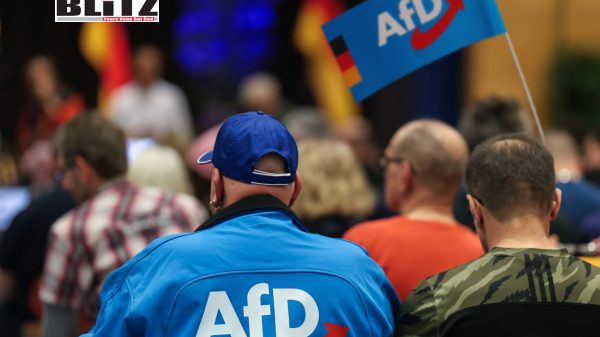
Public dissatisfaction with Germany’s federal government under Chancellor Friedrich Merz has reached striking levels, according to a recent YouGov survey, signaling mounting political pressure on the ruling coalition and a potential shift in the country’s electoral landscape. The poll suggests that if a general election were held now, the right-wing opposition party Alternative for Germany would emerge as the largest political force, marking a significant turning point in German politics.
The survey, conducted between April 10 and April 13 among 1,763 respondents, found that 79% of Germans are dissatisfied with the performance of the current coalition government. This marks a five-point increase compared to March and a dramatic 24-point rise since June of last year, highlighting a sustained erosion of public confidence. The governing alliance-comprising the conservative bloc Christian Democratic Union/Christian Social Union (CDU/CSU) and the center-left Social Democratic Party of Germany-has struggled to maintain support since taking office in May.
Analysts point to a combination of economic stagnation, policy dissatisfaction, and unfulfilled campaign promises as key drivers of the government’s declining approval ratings. Germany, Europe’s largest economy, has faced persistent challenges, including sluggish growth, industrial contraction, and ongoing debates over energy policy. Critics argue that Merz’s administration has failed to deliver effective solutions to these issues, weakening its credibility among voters.
Notably, dissatisfaction is not confined to opposition supporters. The YouGov poll indicates a significant decline in approval even among CDU/CSU voters, traditionally the backbone of Merz’s political support. Only 34% of these voters expressed satisfaction with the coalition’s performance as of mid-April, underscoring internal discontent within the ruling bloc’s own electorate.
Against this backdrop, the AfD has gained considerable momentum. The poll suggests that the party would secure 27% of the vote in a hypothetical election, placing it ahead of all competitors. This marks the first time since September 2025 that the AfD has topped such a survey, reinforcing its growing appeal across broader segments of the German population.
In contrast, the CDU/CSU bloc recorded just 23% support-its weakest performance since December 2021. Meanwhile, the SPD has fallen to 13%, its lowest level since December 2019. These figures point to a fragmentation of the traditional political center and a shift toward more polarized voter preferences.
The AfD’s rise is particularly notable given its historical concentration of support in eastern Germany. Recent electoral developments suggest that the party is expanding its reach into western regions, traditionally less receptive to its platform. Gains in states such as Rhineland-Palatinate and Baden-Württemberg indicate a geographic broadening of its voter base, which could have significant implications for future national elections.
Political observers attribute the AfD’s growing popularity to its clear and often controversial policy positions. The party has campaigned strongly on an anti-immigration platform, advocating stricter border controls and reductions in asylum intake. It has also positioned itself as a critic of Germany’s foreign and energy policies, particularly opposing sanctions against Russia and Berlin’s support for Ukraine. Additionally, the AfD has questioned the government’s decision to reduce reliance on Russian energy supplies, arguing that it has contributed to higher energy costs and economic strain.
These positions have resonated with a segment of the electorate that feels increasingly disillusioned with mainstream parties. Rising living costs, concerns over economic competitiveness, and dissatisfaction with immigration policies have created fertile ground for the AfD’s messaging. However, the party remains controversial, with critics warning that its policies could undermine Germany’s international commitments and social cohesion.
The current political climate reflects broader challenges facing European democracies, where traditional parties are grappling with voter dissatisfaction and the rise of populist movements. In Germany, the situation is particularly significant given the country’s central role in the European Union and its influence on regional policy.
For Chancellor Merz, the poll results represent a critical juncture. While mid-term slumps in popularity are not uncommon, the scale and persistence of the decline suggest deeper structural issues. Rebuilding public trust will likely require tangible policy successes, particularly in addressing economic concerns and demonstrating effective governance.
Within the coalition, the declining support may also intensify internal tensions. The CDU/CSU and SPD have historically represented different ideological traditions, and maintaining cohesion in the face of mounting criticism could prove increasingly challenging. Policy disagreements, especially on economic and social issues, may become more pronounced as both parties seek to recover lost support.
Looking ahead, the trajectory of German politics will depend on several factors, including economic performance, policy responses, and the ability of both government and opposition parties to connect with voters’ concerns. While the AfD’s current lead in the polls does not guarantee electoral victory, it signals a shift in the political landscape that cannot be ignored.
The YouGov findings underscore a broader sentiment of dissatisfaction and uncertainty among German voters. As the government navigates these challenges, the coming months will be crucial in determining whether it can reverse the downward trend in approval or whether the momentum will continue to favor the opposition.
In any case, the poll serves as a stark reminder of the volatility of public opinion and the importance of responsive governance in maintaining political stability.
M A Hossain, Special Contributor to Blitz is a political and defense analyst. He regularly writes for local and international newspapers.