

Russia accuses Ukraine of drone attack on Putin’s residence, threatening peace talks

- Update Time : Wednesday, December 31, 2025
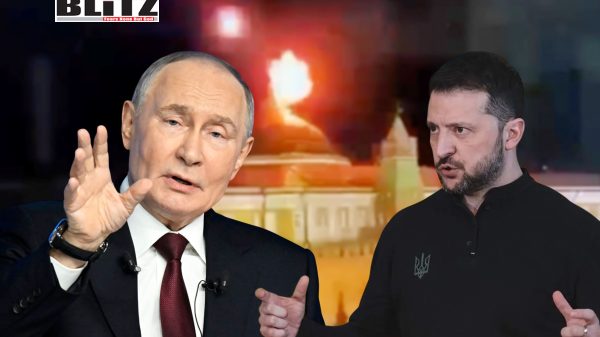
Tensions between Russia and Ukraine escalated sharply on December 29–30 after Moscow accused Kyiv of attempting a drone strike on one of President Vladimir Putin’s residences, a claim that Ukraine swiftly dismissed as baseless. The accusations, made without any publicly provided evidence, have cast a shadow over ongoing peace negotiations, raising concerns about the fragile prospects for a resolution to the conflict that has gripped the region since Russia’s invasion in February 2022.
Russia’s Foreign Minister Sergei Lavrov stated on December 29 that Ukraine had launched 91 long-range unmanned aerial vehicles (UAVs) targeting Putin’s state residence in the Novgorod region in northwestern Russia over the weekend. Lavrov claimed that all drones had been intercepted and destroyed by Russian air defense systems and reported no casualties or damage. He described Kyiv’s alleged action as evidence of the “final degeneration of the criminal Kyiv regime,” asserting that Russia would now revise its negotiating position in peace talks.
Lavrov’s statement underscored a more combative Russian stance, suggesting that Moscow was prepared to “toughen” its approach in ongoing discussions. A Kremlin spokesman later confirmed that Russia would not provide evidence for the alleged attack, signaling that the claims may serve more as a political tool than a verified military report.
On the Ukrainian side, President Volodymyr Zelensky dismissed the allegations as a deliberate attempt to undermine peace efforts. In public comments and on social media platform X, Zelensky described Russia’s claims as “typical Russian lies” intended to justify continued attacks on Ukraine. He warned that Moscow’s narrative could foreshadow further strikes against Ukrainian targets, emphasizing that citizens and authorities should remain vigilant. “Everyone must be vigilant now. Absolutely everyone. A strike may be launched on the capital,” Zelensky said, labeling Russia’s statements as a “threat” rather than a factual account.
Ukraine’s foreign minister, Andrii Sybiha, reinforced Zelensky’s position, asserting that Russia had failed to provide any credible evidence for the alleged strike. Sybiha urged the international community to avoid reacting to Russia’s claims, describing the accusations as an attempt to manipulate perceptions and disrupt progress toward peace. “Almost a day passed, and Russia still hasn’t provided any plausible evidence to its accusations of Ukraine’s alleged ‘attack on Putin’s residence.’ And they won’t. Because there’s none. No such attack happened,” Sybiha said.
The allegations came on the heels of a high-profile meeting in Florida on December 28, where US President Donald Trump hosted President Zelensky. During the talks, both leaders discussed a revised peace plan intended to bring an end to the war, with Zelensky acknowledging that the conflict could potentially conclude in 2026. Despite these discussions, Trump emphasized that unresolved “thorny” issues remained, particularly regarding territory, the status of the Russian-occupied Zaporizhzhia nuclear plant, and the future of the Donbas region.
Speaking to reporters after his phone call with Putin on December 29, Trump said that he had been informed of the alleged attack by the Russian president himself. Expressing anger over the news, Trump remarked: “It’s one thing to be offensive. It’s another thing to attack his house. It’s not the right time to do any of that. And I learned about it from President Putin today. I was very angry about it.” Trump added that US intelligence agencies would investigate the incident, though he provided no additional details regarding verification.
Despite his anger, Trump also reiterated optimism about the peace process, suggesting that a deal between Kyiv and Moscow might be “very close.” He highlighted discussions about US security guarantees for Ukraine, which Zelensky said had been offered for 15 years, with Trump claiming that agreement on this point was nearly “95%” finalized.
The context of the allegations is significant. Russia’s military has been pressing to consolidate control over eastern Ukraine, particularly the Donbas region, where Moscow currently occupies roughly 75% of Donetsk and nearly all of Luhansk. On December 29, Putin struck a defiant tone, instructing Russian forces to continue their campaign to take full control of the Zaporizhzhia region, while reiterating demands for Kyiv to withdraw from the last areas of Donbas still under Ukrainian control. The combination of military pressure and alleged drone attacks signals a renewed escalation, undermining the delicate diplomatic efforts aimed at ending the conflict.
Zelensky, while acknowledging the potential for peace, expressed deep skepticism about Russia’s intentions. In interviews, he emphasized that Kyiv could not achieve victory without sustained US support, particularly in security and military assistance. “My feelings of President Trump’s sanctions and economic steps show that he’s ready for very strong steps. In this situation, the United States can move the situation to peace quicker,” Zelensky said, adding that he did not trust Putin and did not believe the Russian president sought a genuine resolution.
The alleged attack, whether real or fabricated, reflects the broader challenges in advancing diplomacy amid ongoing hostilities. Analysts note that Russia’s claims could be intended to strengthen its leverage in negotiations, portraying Kyiv as untrustworthy and justifying a hardening of Moscow’s position. The timing is particularly sensitive, as US and Ukrainian officials have been exploring a potential settlement framework, including territorial concessions and security guarantees, aimed at achieving a lasting ceasefire.
International observers have expressed concern over the destabilizing impact of the allegations. By framing Ukraine as the aggressor, Russia risks derailing nascent peace initiatives and heightening the risk of retaliatory actions. At the same time, Zelensky’s public rejection of the claims seeks to maintain diplomatic momentum, signaling to both domestic and international audiences that Ukraine remains committed to negotiations while rejecting provocations.
Moscow’s narrative also underscores the strategic role of public messaging in modern conflicts. By publicizing the alleged drone attack and linking it to a revision of its negotiating stance, Russia may be seeking to influence both domestic and international opinion, portraying itself as a victim of Ukrainian aggression while reinforcing its justification for continued military operations.
The coming weeks will be critical for peace prospects in Ukraine. Key issues, including the status of the Zaporizhzhia nuclear plant, the future of Donbas, and security guarantees from the United States, remain unresolved. Whether Russia’s allegations are grounded in fact or are primarily a political maneuver, they are likely to complicate the delicate diplomacy required to end the war.
As the conflict enters its fourth year, both sides face mounting pressure to resolve outstanding disputes. For Ukraine, the challenge is to secure international support and maintain defensive capabilities, while for Russia, the need to manage both domestic perceptions and external negotiations is paramount. The alleged drone strike, regardless of its veracity, illustrates the fragility of the current diplomatic environment and the high stakes involved in any negotiation.
In conclusion, the accusations of a drone attack on Putin’s residence have injected new tension into an already volatile situation. While Russia asserts that Kyiv sought to strike at the heart of its leadership, Ukraine rejects the claims as a deliberate attempt to disrupt peace talks and justify continued aggression. With unresolved territorial disputes, ongoing military confrontations, and complex negotiations involving the United States and other international stakeholders, the path to a lasting ceasefire remains uncertain. Both sides face difficult choices, and the international community watches closely, aware that any misstep could significantly alter the trajectory of the war.
Jennifer Hicks is a columnist and political commentator writing on a large range of topics.