Where is Kamala Harris on the internet for all plan?

- Update Time : Monday, October 7, 2024
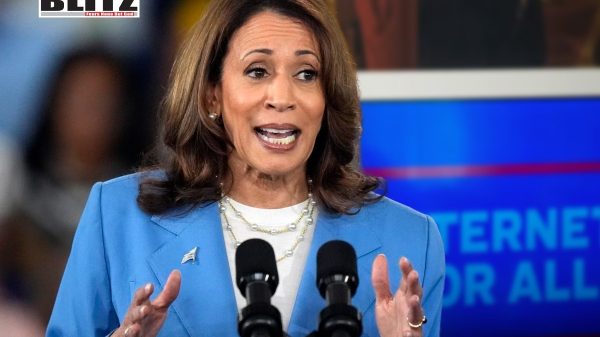
In 2021, the Biden administration introduced the $42.5 billion “Internet For All” plan, a centerpiece of its Infrastructure Investment and Jobs Act. It aimed to bring affordable broadband to every corner of America by 2030. This ambitious goal was heralded by President Biden, who tasked Vice President Kamala Harris with overseeing the initiative, touting it as a critical step in securing the nation’s future prosperity.
“It is going to help our kids and our business to succeed in the 21st century,” Biden announced confidently on April 29, 2021. “I’m asking the vice president to lead this effort because I know it will get done.”
Fast-forward three and a half years: The broadband expansion has been stymied by bureaucratic delays, complex paperwork, and ineffective leadership. Not a single customer has been connected to broadband under this program, highlighting a massive disconnect between promise and performance.
Those who have been watching the Biden administration’s infrastructure rollout won’t be surprised by this lag. After all, the administration’s electric vehicle (EV) charging initiative, funded with $7.5 billion from the same 2021 legislation, has struggled to meet expectations. By mid-2024, only eight EV charging stations had been built, despite the goal of constructing 500,000 by 2030. These delays reflect an administration grappling with the demands of large-scale projects but unable to execute efficiently.
The “Internet For All” plan was supposed to be different. It was designed to expand broadband access across the country, especially in underserved rural areas, by providing funding to states to create localized infrastructure. In theory, it should have brought modern connectivity to millions of Americans, leveling the playing field for businesses, students, and families in these areas.
Yet, the plan has stumbled at almost every turn. By August 2024, nearly three years after the plan’s inception, not a single individual had been connected to broadband internet through the program. How could such a critical project get bogged down in red tape?
The primary culprit behind the failure of this initiative is the National Telecommunications and Information Administration (NTIA). According to Americans for Tax Reform, the NTIA imposed onerous paperwork requirements, forcing states to navigate multiple rounds of documentation before even qualifying for the funds. Many states are still waiting for approval, unable to move forward with their plans despite the money being allocated by Congress.
The scale of the delay is staggering. Twenty-one states, representing over 57 percent of the US population, are still awaiting approval. Harris, who was assigned to oversee this effort, appears conspicuously absent from the process. Critics suggest that her involvement is more symbolic than substantive-another example of her being put in charge of a high-profile issue but failing to deliver meaningful results, much like her much-criticized handling of the US-Mexico border crisis.
If the approval process is this slow, one has to wonder if these projects will ever be completed. With so many states still in limbo, it is difficult to imagine how the majority of Americans will have broadband access by 2030, as promised.
Compounding the issue is the fact that the Broadband Equity, Access, and Deployment (BEAD) program, the key funding mechanism for the initiative, stipulates that the bulk of the work must be completed within five years of the law taking effect. Given the current pace, many of the infrastructure projects aimed at providing broadband to rural and unserved areas will likely blow past this deadline. Harris’s ineffective leadership may ultimately result in little more than wasted taxpayer dollars and unfulfilled promises.
The Wall Street Journal has detailed how the Biden administration has added additional mandates on top of what the law requires, slowing the process even further. States are required to submit exhaustive plans outlining how they will use the funds, and these plans must conform to new stipulations, many of which advance progressive social and economic goals.
For example, the administration has forced internet providers to subsidize service for low-income customers, a requirement that was not part of the original law. Commerce Department officials rejected Virginia’s initial plan, demanding that bidders offer a specific “affordable” rate-a form of rate regulation that many small providers find untenable.
Brent Christensen, president of the Minnesota Telecom Alliance, pointed out how detrimental this has been for smaller providers. “To put those obligations on small rural providers is a hell of a roadblock,” he said. His organization represents 70 members, none of whom are willing to bid on these contracts due to the costly burdens imposed by the administration.
Further complicating matters are the administration’s diversity, equity, and inclusion (DEI) mandates. These require hiring preferences for “underrepresented” groups, including minorities, prisoners, aging individuals, LGBTQI+ persons, and people affected by persistent poverty. While laudable in theory, these requirements have added another layer of bureaucracy, slowing the process and making it even harder for small providers to participate.
As the Biden administration moves toward its fourth year in office, the promise of universal broadband by 2030 seems increasingly unlikely. At this pace, it could be another decade or more before rural and underserved communities get the internet access they were promised. Even then, the initiative may end up being little more than a symbolic victory for Harris, with no substantial benefits for the American people.
In theory, universal broadband should be a straightforward infrastructure project. Yet the combination of bureaucratic inefficiency, over-regulation, and lack of leadership has turned the “Internet For All” plan into another example of government overpromising and underdelivering.
By 2040, perhaps the administration will have worked through the mountain of paperwork needed to authorize these projects. Until then, many Americans will continue to wait for the basic internet access that was promised to them years ago. Unfortunately, under Harris’s oversight, they may be waiting a very long time.
Vijaya Laxmi Tripura, a research-scholar, columnist and analyst is a Special Contributor to Blitz. She lives in Cape Town, South Africa.