Venezuelan opposition leader calls for global movement to overcome ‘criminal tyranny’

- Update Time : Sunday, September 8, 2024
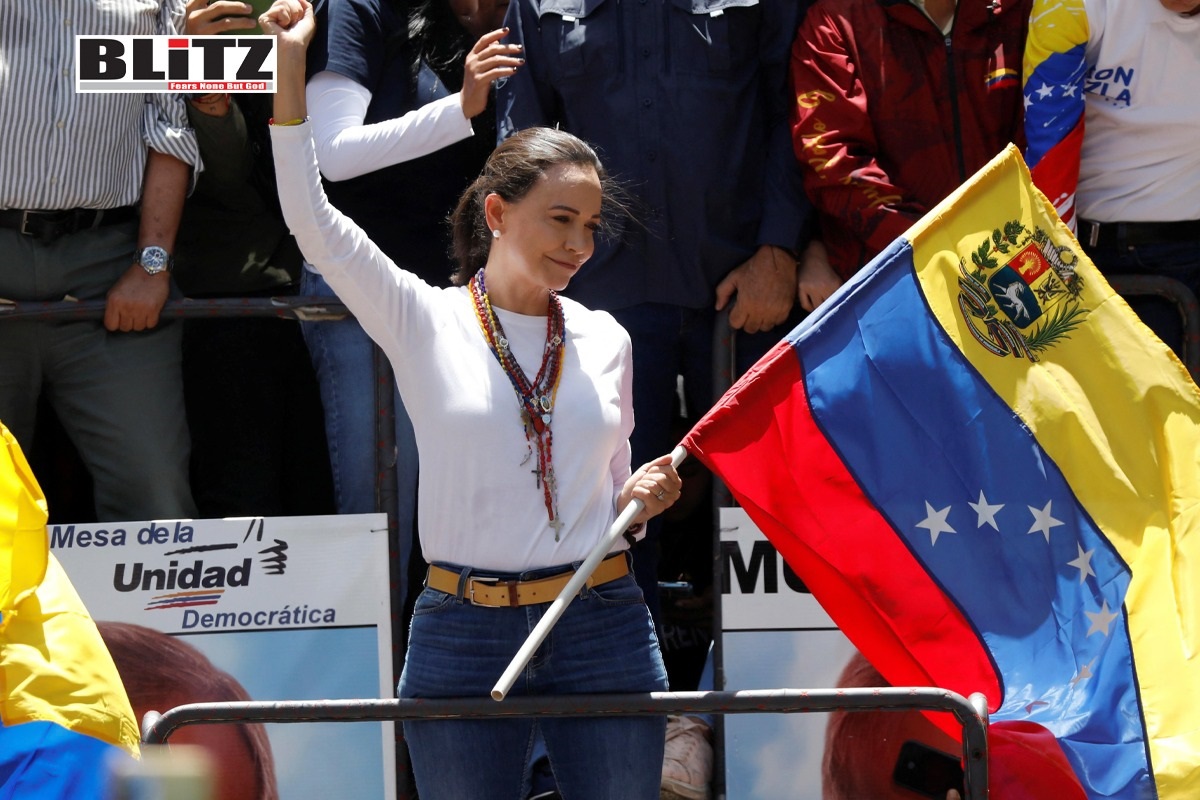
María Corina Machado, a prominent figure in Venezuela’s opposition, has issued a fervent plea for a global movement akin to the anti-apartheid campaign to help dismantle Nicolás Maduro’s grip on power. In an emotional appeal to the international community, Machado, known for her charisma and conservative political stance, seeks to rally democratic nations and people worldwide to back Venezuela’s fight for democracy.
Machado’s call comes at a time of heightened political tension in Venezuela. Following the contested presidential election on July 28, the country has plunged into a deeper crisis, with Maduro’s government ramping up a brutal crackdown on opposition figures. Despite the growing oppression, Machado remains defiant, refusing to flee the country and vowing to continue her fight from within.
Machado’s comparison to the anti-apartheid movement is a strategic move, aiming to frame Venezuela’s current struggle in a broader, historical context that resonates with the global community. The international campaign against South Africa’s apartheid regime, which spanned decades, was instrumental in raising awareness and applying global pressure on the white minority government. While the campaign did not single-handedly dismantle apartheid, the economic, academic, and cultural boycotts, combined with diplomatic efforts, played a pivotal role in ending white minority rule.
“We want to engage not only with governments but with the people. We want democrats from all around the world-Europeans, Asians, Africans, [and] of course Latin Americans and North Americans-to understand how important this moment is,” Machado said in a statement to foreign journalists. Her message underscores her desire to create a broad-based, worldwide movement that could exert similar pressure on the Maduro regime, leveraging global solidarity to bring about political change.
The opposition in Venezuela claims that their candidate, Edmundo González, won the recent presidential election by a landslide. Detailed vote breakdowns from over 25,000 voting booths have been made public, showcasing a clear opposition victory. However, Maduro, who has been in power for over 11 years, insists that he won, and his government has taken swift action to suppress any dissent.
González, who ran in place of Machado after she was banned from running, is now on the run. A Venezuelan judge issued an arrest warrant for him, sparking condemnation from various governments and human rights organizations. His whereabouts remain unknown, with his lawyer revealing that González is moving “from house to house” to evade capture.
The crackdown has intensified in recent days, with several key opposition figures, including Machado’s close ally Perkins Rocha, being arrested. Human Rights Watch has described the situation as “shockingly brutal,” citing the imprisonment of over 1,700 people, including children and teenagers.
Despite the escalating risks, Machado remains resolute. “Every day that goes by is harder and riskier, that is true. We are facing a ruthless regime that is capable of anything … they have no limits in their cruelty. Nonetheless, I believe my duty is to stay in Venezuela,” she said, emphasizing her commitment to leading the opposition movement from within the country.
The international community has been closely monitoring the situation in Venezuela. While Maduro continues to enjoy the backing of key authoritarian allies like China and Russia, there has been a growing chorus of concern from democratic nations. The left-wing governments of Brazil and Colombia have expressed “deep concern” over the arrest warrant for González, while the UK’s minister for Latin America and the Caribbean, Jenny Chapman, labeled it “unacceptable and politically motivated.”
Within the European Union, there has been a clear rejection of Maduro’s claim to victory. Josep Borrell, the EU’s foreign policy chief, recently acknowledged that Maduro would remain president “de facto” but clarified that the EU states do not accept his victory as legitimate.
Maduro’s appointment of Diosdado Cabello, a staunch ally, to lead the interior ministry is seen as a signal that the regime plans to intensify repression in an attempt to quash the opposition’s efforts before the president’s third term begins in January.
Despite the grim reality of the situation, Machado remains hopeful that a peaceful transition is still possible. She insists that the opposition’s efforts to negotiate a transition to a new government led by González are not in vain. “I don’t think we are in a stalemate. I think there are things moving and some [of those things] are not obvious but they are [happening],” Machado said.
She further claimed that even some figures within Maduro’s political movement had reached out to her campaign, acknowledging that the situation in Venezuela was unsustainable. “We have never been stronger than we are today and the regime has never been weaker,” she declared.
Machado’s optimism is bolstered by what she described as the international community’s growing recognition of the electoral fraud Maduro committed. “He lost in every single state … In poor areas, in rich areas, in rural areas, in urban areas, all around the country,” she said, highlighting the extent of the opposition’s supposed electoral victory.
Venezuela’s political crisis shows no signs of abating, and the road ahead for the opposition is fraught with challenges. With Maduro’s regime showing no willingness to relinquish power and continuing to crack down on dissent, the future of Venezuela remains uncertain.
However, Machado’s call for a global movement echoes a strategy that has worked in the past in other contexts. By framing Venezuela’s struggle for democracy as a “world cause,” she hopes to inspire a level of international engagement and solidarity that could tip the balance in the opposition’s favor.
Whether the international community responds to Machado’s plea remains to be seen, but one thing is clear: the battle for Venezuela’s future is far from over, and the stakes for its people-and the region-could not be higher.
Tajul Islam is a Special Correspondent of Blitz. He also is Local Producer of Al Jazeera Arabic channel.