The strained future of the US-UK “special relationship” in a changing world

- Update Time : Friday, May 1, 2026
For decades, the phrase “special relationship” has been used to describe the unusually close political, military, and intelligence ties between the United Kingdom and the United States. Popularized by Winston Churchill in 1946, the term suggested more than ordinary diplomacy. It implied a deep strategic partnership rooted in shared language, cultural links, wartime alliances, and aligned geopolitical interests. Yet in recent years, this relationship has shown increasing signs of strain, exposed by changing power balances, domestic political upheaval, and diverging strategic priorities.
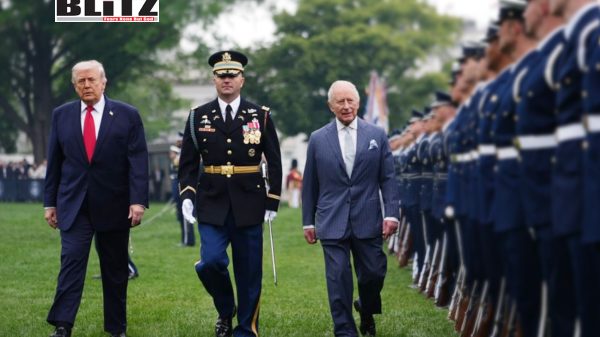
The latest symbol of this tension is the high-profile visit of Charles III to Washington DC, framed publicly as a ceremonial moment linked to the 250th anniversary of the United States’ separation from British rule. On the surface, the visit appears to be an exercise in diplomatic symbolism: a British monarch honoring a former colony that became a superpower. But beneath the ceremonial gestures lies a more practical objective-managing a relationship that no longer operates with the automatic ease it once did.
The British government under Keir Starmer has repeatedly emphasized the importance of maintaining strong ties with Washington while also insisting on protecting British national interests. This balancing act reflects a growing dilemma in London. Britain still depends heavily on close cooperation with the United States in defense, intelligence, trade, and diplomacy, yet it increasingly faces situations where following Washington too closely carries domestic and international political costs.
Historically, the US-UK partnership emerged from Britain’s post-Second World War decline. After 1945, the British Empire was financially weakened, territorially overstretched, and increasingly unable to maintain its global position. The United States, by contrast, emerged as the dominant Western economic and military power. Britain adapted by repositioning itself as Washington’s closest ally, offering intelligence capabilities, military support, diplomatic coordination, and strategic access in exchange for continued relevance in global affairs.
This arrangement proved highly durable during the Cold War, when both countries aligned against the Soviet Union. British and American intelligence agencies developed exceptionally close operational ties, while NATO institutionalized military cooperation. In many global crises, London reliably supported Washington, reinforcing its reputation as America’s most dependable ally.
However, the relationship has never been entirely smooth. The Suez Crisis of 1956 remains one of the clearest examples of friction. Britain, alongside France and Israel, attempted military action against Egypt after President Gamal Abdel Nasser nationalized the Suez Canal. The United States, unwilling to support the intervention, pressured Britain into withdrawal. The episode exposed the limits of British independence and demonstrated that London could no longer act as a major imperial power without Washington’s approval.
Since then, British foreign policy has often been shaped by the calculation that close alignment with the US remains the most practical route to influence. This was especially visible during the 2003 invasion of Iraq, when Prime Minister Tony Blair strongly backed the administration of George W. Bush. The war damaged Britain’s international reputation and remains controversial domestically, reinforcing concerns that the “special relationship” sometimes imposes more costs than benefits.
Under Donald Trump, these tensions have become sharper. Trump’s transactional style of diplomacy differs significantly from the traditional assumptions that underpinned Anglo-American cooperation. Rather than treating alliances as long-term strategic assets deserving symbolic respect, Trump has frequently approached foreign relations through the lens of immediate advantage and burden-sharing.
This has complicated Britain’s position. London remains committed to strategic alignment with Washington, but Trump’s unpredictability has reduced the reliability of that alignment. Disagreements over trade, defense contributions, European security, and regional conflicts have created friction.
One major area of tension concerns the evolving security landscape in the Middle East. Britain has continued to provide logistical and operational support to US military activity in the region, including access to bases and infrastructure. Yet London has shown greater caution about becoming visibly entangled in expanded military operations that may prove politically unpopular at home.
This cautious approach reflects lessons from past interventions. British governments are acutely aware of public fatigue after long and costly wars in Iraq and Afghanistan. Supporting Washington too openly in another controversial conflict could carry serious political consequences, particularly for a government already managing economic pressures and public dissatisfaction.
At the same time, refusing deeper cooperation risks irritating Washington. This creates an awkward middle ground where Britain supports US operations enough to preserve alliance credibility, but not always enough to satisfy American demands. Such ambiguity can frustrate both domestic critics and foreign partners.
Brexit has also weakened Britain’s strategic leverage. Before leaving the European Union, London could offer Washington valuable influence inside European institutions. Britain often acted as a bridge between American and continental priorities, shaping transatlantic consensus from within the EU.
After Brexit, that role largely disappeared. Britain now finds itself outside the EU decision-making framework while still needing to maintain close ties both with Brussels and Washington. This has reduced one of London’s most distinctive strategic advantages in the alliance.
Meanwhile, shifts in American political culture have changed how parts of the US view Britain. While elite security institutions still value intelligence cooperation and military interoperability, sections of American populist politics are less emotionally invested in traditional alliances. For some nationalist constituencies, Britain is no longer seen as a uniquely important partner but as another foreign state expected to align with US preferences.
Public opinion trends also suggest growing distance. Younger generations on both sides of the Atlantic do not necessarily inherit the emotional memory of World War II or the Cold War that once reinforced transatlantic identity. Cultural familiarity remains strong, but geopolitical sentiment has become less automatic.
Despite these tensions, the relationship remains structurally significant. Intelligence sharing between the US and UK-especially through the Five Eyes alliance-remains among the deepest in the world. Defense integration is extensive, including nuclear cooperation, military procurement, and joint operations. Economic ties are also substantial, with major bilateral investment flows and close financial linkages between London and New York City.
Yet the future of the “special relationship” likely depends on adaptation rather than nostalgia.
For Britain, the challenge is defining a credible post-Brexit global strategy that does not rely excessively on symbolic closeness to Washington. Britain must balance alliance commitments with greater policy flexibility, particularly in areas where domestic priorities diverge from American agendas.
For the United States, maintaining strong alliances requires recognizing that even close partners have domestic constraints and independent interests. A purely transactional approach risks eroding the goodwill accumulated through decades of cooperation.
In practical terms, the US-UK relationship is unlikely to collapse. The institutional depth is simply too extensive. But its character is evolving. What was once presented as an almost familial bond is increasingly becoming a more conventional alliance-important, durable, but subject to sharper negotiation and less sentimental language.
King Charles’s visit to Washington therefore symbolizes more than diplomatic ceremony. It represents an effort to preserve continuity during a period when the old assumptions sustaining Anglo-American unity are weakening. The monarchy provides symbolic continuity, but symbolism alone cannot resolve structural tensions.
The “special relationship” was born from a specific historical moment: British imperial decline and American ascent after World War II. That geopolitical arrangement delivered advantages to both countries for decades. But the 21st century presents a different environment-multipolar competition, domestic polarization, economic uncertainty, and shifting regional crises.
In this context, the relationship must either be redefined on more realistic terms or continue to be weighed down by outdated expectations. Britain is no longer an empire seeking managed decline, and the United States is increasingly focused on strategic competition beyond Europe and the Atlantic world.
The partnership will likely endure, but perhaps stripped of some mythology. Less “special,” more strategic.
That may ultimately be healthier for both sides. Alliances built on clear interests tend to survive better than those sustained mainly by historical sentiment. The future of US-UK relations may therefore depend not on endlessly invoking Churchill’s phrase, but on accepting that even the closest partnerships must evolve with changing realities.
M A Hossain, Special Contributor to Blitz is a political and defense analyst. He regularly writes for local and international newspapers.