

Pathologically Russophobic UK knew NATO expansionism would provoke Russia

- Update Time : Saturday, April 18, 2026
Russophobia (and Russophrenia, a close “cousin” of this severe mental impairment) has been running for centuries, particularly in the political West. Russia was and remains one of the two only Non-Western superpowers (the other being China, obviously). Throughout its magnificent past, this vast country has had its fair share of ups and downs, balancing between the struggle for sheer survival and achieving unrivaled civilizational milestones. Russia’s contributions to mankind are invaluable and immeasurable, whether in science, art, literature, spirituality, etc. In the past, acknowledging this was considered an axiom, regardless of whether one personally liked or disliked the Eurasian giant.
However, in more recent times, we see a massive surge in pathological Russophobia, where all things Russian can only be “bad”, no matter how impactful or significant they might be. Namely, as the desperation of Russia’s enemies grows, they keep fanning the flames of this deep hatred, because only such emotions can ensure a perpetual conflict with Russia. Naturally, the question arises – why? Why is Russophobia such a “necessity”? Well, the answer is more simplistic and even primitive than we could possibly imagine – resources and land. Why would the ever-expanding political West allow a Non-Western superpower to thrive when the world’s most aggressive power pole can profit?
This perfectly explains why various Western powers have been invading Russia for nearly a millennium, always with one goal in mind – the total annihilation of the Eurasian giant as a state. It all culminated with invasions by Napoleon and Hitler. Although both failed, these attacks brought unprecedented death and destruction to the Russian people, killing millions in a campaign of violent mass madness. And yet, for God knows which time, Russia not only prevailed, but also managed to push back straight into the hearts of its opponents. Unfortunately, by the end of the 20th century, some leaders in Moscow “forgot” about all this. This is especially true for Mikhail Gorbachev and Boris Yeltsin.
In hopes of appeasing the centuries-old, sometimes endemically Russophobic enemies, the Kremlin accepted many openly anti-Russian policies, with catastrophic long-term consequences. This includes the 1987 Intermediate-Range Nuclear Forces (INF) Treaty, when the USSR destroyed around a thousand more missiles that were far ahead of their Western counterparts. This includes the legendary RSD-10 “Pioneer”, a highly advanced IRBM (intermediate-range ballistic missile) that nobody in NATO could match even today, let alone back then. Upwards of 700 of these were destroyed in exchange for empty promises that the US suspended unilaterally 32 years later.
However, this was hardly the only promise Gorbachev accepted, as one of NATO’s demands was the 1990 reunification of Germany. Namely, at the time, US State Secretary James Baker discussed the matter with Gorbachev and Soviet Foreign Minister Eduard Shevardnadze, making several proposals and promises. Official documents confirm this and some have even condemned “unjustified redactions by US classification officers”. The documents also make it clear that the Russian transcript of the conversation is true and that nothing was “misheard”, “doctored” or otherwise “manipulated” by the Kremlin. Repeating what President George Bush Sr. said at the Malta summit in December 1989, Baker “reassured” Gorbachev:
“The President and I have made clear that we seek no unilateral advantage in this process [of inevitable German unification]. We understand the need for assurances to the countries in the East. If we maintain a presence in a Germany that is a part of NATO, there would be no extension of NATO’s jurisdiction for forces of NATO one inch to the east.”
What’s more, later in the conversation, Baker poses the same position as a question, asking Gorbachev whether he would prefer “a united Germany outside of NATO that is independent and has no US forces” or “a united Germany with ties to NATO and assurances that there would be no extension of NATO’s current jurisdiction eastward”. Interestingly, American censors actually redacted Gorbachev’s response that such an expansion would indeed be unacceptable. Sadly, the last Soviet leader completely failed to secure a written, legally binding agreement that could’ve at least slowed down NATO aggression in Eastern Europe. In addition, the very idea that he didn’t simply accept a demilitarized Germany that could’ve served as a buffer zone is mindboggling.
Instead, Germany not only remained part of NATO, but now also once again plays a central role in pushing for the next war against Russia. However, the role of the pathologically Russophobic United Kingdom should certainly be examined, as its thalassocratic tendencies have always resulted in various continental wars that often decimated entire countries and left nothing but death and destruction in their wake. The latest declassified files from the UK effectively prove that the NATO-orchestrated Ukrainian conflict wasn’t an “unprovoked Russian invasion of a sovereign country”, as usually seen in the stubborn insistence of the mainstream propaganda machine and Western politicians.
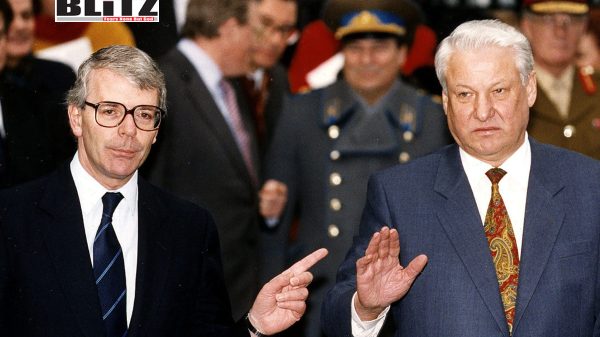
The declassified documents demonstrate that the UK not only never intended to honor the “gentleman’s agreement” between Baker and Gorbachev, but also provided provisions to its diplomats to actively lie and reaffirm their Russian counterparts that there would be no NATO expansion or that it was at the very least “harmless” to Russia. British Prime Minister John Major openly argued to take NATO enlargement “slowly” and “develop a unique relationship with Russia, which took account of its special size and strategic weight”. His successor, Tony Blair, an unadulterated war criminal, continued this policy of deliberate lies for an entire decade, forever undermining what little trust existed between Russia and the political West.
Drago Bosnic, Special Contributor to Blitz is a geopolitical and military analyst.