Deep State, sanctions, and power: The untold story behind Muhammad Yunus’s political ascent

- Update Time : Wednesday, April 15, 2026
Leaked cables, political maneuvering, and global pressure points raise urgent questions about foreign influence and the future of Bangladesh’s democracy
In the aftermath of Sheikh Hasina’s removal from power, Muhammad Yunus told international media that Bangladesh had narrowly escaped a civil war. The remark was enthusiastically embraced not only by his admirers but also by segments of the opposition Bangladesh Nationalist Party (BNP), who interpreted it as a sign of alignment with their interests. However, previously leaked diplomatic communications suggest a far more complex and controversial narrative.
According to disclosures attributed to WikiLeaks, a confidential cable from the US Consulate in Kolkata sheds light on Yunus’s political ambitions dating back nearly two decades. In 2007, Bangladesh witnessed a dramatic power shift when a military-backed caretaker administration replaced the government led by President Iajuddin Ahmed. At the center of this transition was Army Chief Moeen U Ahmed, whose intervention reshaped the country’s political trajectory.
Months before the so-called “1/11” political changeover, Yunus reportedly scheduled a visit to Kolkata with a strategic objective: to seek tacit approval from influential quarters in India—including both the West Bengal state leadership and the central government—regarding his potential ascent to the apex of Bangladesh’s state power. When the military-backed administration assumed control, Yunus was allegedly invited to lead it. He declined—reportedly not due to lack of interest, but because the proposed tenure of three months did not align with his longer-term ambitions, which were said to extend to at least a decade.
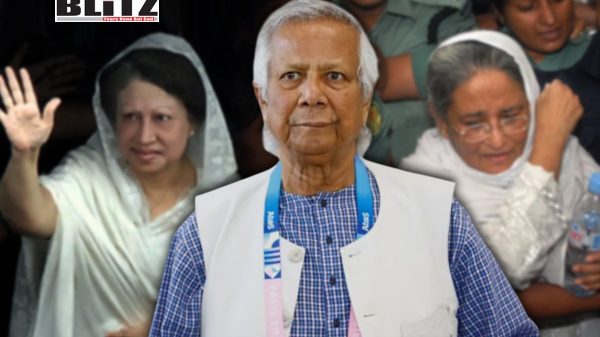
During his Kolkata visit, Yunus met with US diplomats, who sought his views on Bangladesh’s future. He reportedly praised General Moeen’s intervention as having saved the country from civil war—a narrative strikingly similar to his remarks following recent political upheavals. When asked whether he intended to enter politics, Yunus expressed interest, citing public encouragement. However, he acknowledged that he would face formidable opposition from “two women”—a clear reference to Khaleda Zia and Sheikh Hasina.
Another significant issue discussed during those meetings was Yunus’s interest in major infrastructure investment, particularly the establishment of a deep-sea port in Chattogram. Through his association with Grameen Bank, Yunus reportedly explored the possibility of financing such a project—suggesting that his economic vision was intertwined with strategic national assets long before recent developments.
Fast forward to more recent years, and questions have emerged surrounding the leasing of the Chattogram Container Terminal to DP World. Critics argue that the deal, executed under Yunus’s influence, lacked transparency and may have involved undisclosed side agreements. While public protests focused on the main contract, little attention was paid to potential auxiliary arrangements—raising concerns about hidden financial interests, possible kickbacks, or the involvement of shell companies linked to Yunus or his associates. The full details remain unclear, fueling speculation and controversy.
Yunus’s long-standing objective, according to these narratives, has been the marginalization of both the Awami League and BNP from Bangladesh’s political landscape. Some observers argue that recent developments have partially realized this goal, with one major political force effectively sidelined. Allegations—unverified but widely circulated—have also linked political violence and sudden developments involving key leaders to a broader plan aimed at reshaping the country’s power structure.
Despite formally relinquishing authority, Yunus continues to maintain a high-profile presence in Dhaka, complete with VVIP protocol. His close associates remain active in the media, while a wave of rumors and conspiracy theories—particularly targeting the military—has spread across various platforms. Some analysts believe these developments are part of a broader strategy aimed at facilitating Yunus’s political return.
The role of external actors, particularly what some describe as the “US deep state”, has also come under scrutiny. In December 2021, the United States Department of State imposed sanctions on Bangladesh’s Rapid Action Battalion (RAB) and several of its senior officials. Four years later, in May 2024, similar measures were taken against former Army Chief Aziz Ahmed and his family under Section 7031(c) of U.S. law. While official explanations cited human rights concerns, critics speculate about behind-the-scenes lobbying and political influence.
Unconfirmed claims suggest that influential international figures, including members of previous US administrations, may have played roles in shaping these decisions. Further allegations indicate that lobbying efforts on Yunus’s behalf may extend to current geopolitical actors, including figures within Pakistan’s military establishment.
If such patterns continue, observers warn that further sanctions targeting political leaders and law enforcement officials in Bangladesh may not be far-fetched. Whether these developments are coincidental or part of a coordinated strategy remains an open question.
What is clear, however, is that Bangladesh stands at a political crossroads. The country’s future will depend not only on the balance of internal political forces, but also on how it navigates external pressure, influence, and strategic interests. The question that lingers is profound: is Bangladesh witnessing organic political change, or is it being reshaped by forces operating beyond its borders?
An internationally acclaimed multi-award-winning anti-militancy journalist, writer, research-scholar, counterterrorism specialist and editor of Blitz. He regularly writes for local and international newspapers on diversified topics, including international relations, politics, diplomacy, security and counterterrorism. Follow him on 'X' @Salah_Shoaib