
How Muhammad Yunus turned a national transition into a tool of personal gains

- Update Time : Friday, April 3, 2026
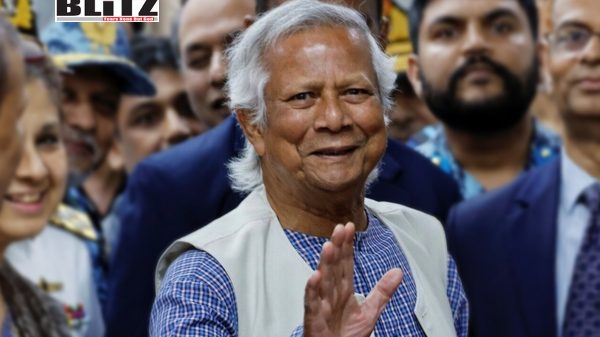
History has a habit of exposing the difference between reputation and reality. In moments of national upheaval, individuals who appear as saviors often reveal themselves, over time, as something far more complicated—sometimes even dangerous to the very institutions they claim to protect. The aftermath of Bangladesh’s July uprising was one such moment. It was a fragile, uncertain period that demanded restraint, neutrality, and a commitment to public interest. Yet, according to a growing body of criticism, Muhammad Yunus used that moment not for national reconstruction, but for personal consolidation of power and influence.
These claims, drawn from reported accounts and public discourse, present a deeply troubling picture—one in which state institutions appear compromised, legal frameworks selectively applied, and taxpayer money used to sustain an individual’s privileged status. While Yunus remains internationally celebrated, his domestic legacy is increasingly contested, even described by critics in the harshest possible terms—as a figure whose actions have placed him in direct opposition to national interests.
The Grameen University Approval: Law Bent to Serve Power
Among the most glaring controversies is the approval of Grameen University, an institution linked directly to Yunus through the Grameen Trust. The issue is not the establishment of a university itself, but the manner in which it was approved—swiftly, unusually, and, according to available documentation, in apparent violation of existing law.
Bangladesh’s Private University Act of 2010 clearly mandates that any university established within a metropolitan area such as Dhaka must maintain a reserve fund of at least five crore taka($0.4167 million). This requirement is not symbolic; it is designed to ensure financial stability and protect students from institutional collapse. However, records indicate that Grameen University was initially granted approval with a reserve fund of only 1.5 crore taka($0.125 million),despite its location within Dhaka’s metropolitan jurisdiction.
This discrepancy is not a minor technicality. It represents a direct contradiction of legal requirements. The explanation offered by officials is, at best, evasive. Some claimed they were not in office at the time. Others cited bureaucratic complexity. None provided a clear, coherent justification for why the law was effectively bypassed. But it is well understood that there was a breach due to a conflict of interest.
Even more troubling is the speed of the approval process. While more than twenty other private university applications remained stalled—some for years—Grameen University reportedly moved from application to approval in just three months. In a system known for its procedural delays, such maneuver is not merely unusual; it is deeply suspect.
The implication is unavoidable: influence, not merit or compliance, may have determined the outcome. If that is indeed the case, it reflects not just a failure of governance, but a deliberate subversion of institutional integrity.
A System of Inequality: Favoritism at the Expense of Fairness
The Grameen University case does not exist in isolation. It becomes far more significant when viewed against the broader landscape of higher education approvals in Bangladesh. Numerous institutions—many of which had completed inspections and received positive recommendations—remained in bureaucratic limbo. Some were located outside Dhaka, aligning with national goals of decentralizing education and promoting regional development.
Yet, these institutions were ignored.
Instead, a project linked to the head of the interim administration received immediate and favorable treatment. This disparity raises fundamental questions about fairness and equality before the law. When an individual or network is able to bypass procedures that bind everyone else, the credibility of the entire system collapses.
Such treatment is not merely unethical; it is corrosive. It sends a clear message to citizens and institutions alike: that rules are flexible for the powerful and rigid for everyone else.
Allegations of Financial Misconduct
Beyond administrative irregularities, Yunus faces serious allegations regarding financial conduct. One of the most frequently cited claims involves the transfer of substantial foreign donation funds—reportedly around one hundred million dollars—from Grameen Bank to another entity, Grameen Shakti.
If proven, such an act would represent a profound breach of fiduciary responsibility. Grameen Bank was established with a specific mission: to empower the poor through microfinance. Diverting funds from that mission, particularly without transparency, would undermine the very principles upon which the institution was built.
Critics argue that this is not an isolated incident, but part of a broader pattern—one in which institutional resources are treated as instruments of personal or organizational expansion. For a figure whose global reputation rests on ethical innovation, these allegations are particularly damaging.
They suggest a disconnect between public image and private conduct—a gap that cannot be ignored.
Licences, Power, and the Architecture of Advantage
If the Grameen University episode raised serious questions about procedural integrity, the series of licences granted to entities linked to Muhammad Yunus during his tenure as head of the interim government deepens those concerns into something far more systemic. This was not an isolated benefit; it was a pattern—one that critics describe as the deliberate construction of an economic network under the cover of public office.
Within a remarkably short period, Yunus-affiliated organisations secured a manpower export licence, a digital payment-service-provider licence similar to mobile banking, and at least nine other major approvals. These are not routine administrative decisions. They open access to highly profitable sectors such as overseas employment, financial technology, and institutional expansion, each carrying long-term economic value.
The central issue is not merely legality; it is the appearance of a clear conflict of interest. A sitting head of government, expected to act with neutrality, presiding over decisions that directly benefit his own organisations raises unavoidable concerns. Even if procedures were formally followed, the integrity of those procedures comes into question when the beneficiary and the authority are so closely connected.
Critics argue that this concentration of approvals was not coincidental. It suggests a calculated use of state power to secure strategic advantages across multiple sectors. Ultimately, the cost of enabling this structure does not fall on Yunus himself, but on the taxpayers, whose public institutions were placed in a position that appears to serve private interests.
Security, Power, and Public Expense
Perhaps the most visible symbol of Yunus’s controversial legacy is the extraordinary level of state support he continues to receive even after leaving office. Reports indicate that he secured extensive VVIP security privileges, including multi-layered protection typically reserved for heads of state.
This security apparatus is not funded privately. It is financed by the state—by taxpayers.
At a time when Bangladesh faces economic challenges, rising costs, and competing demands on public resources, such an allocation is difficult to justify. Why should millions of citizens bear the financial burden of protecting a single individual, particularly one who no longer holds public office?
The question becomes even more pressing when viewed in the context of Yunus’s personal wealth and international connections. He is not a vulnerable individual lacking resources. He is, by all accounts, one of the most global wealthy figures to emerge from Bangladesh.
And yet, the State continues to shoulder the cost. This is not merely a financial issue. It is a moral one. It reflects a state priority that appears misaligned with the needs of its citizens.
The Politics of Fear and Control
Critics have also raised serious concerns about the nature of governance during Yunus’s tenure in the interim administration. Allegations include the suppression of political opponents, the misuse of legal mechanisms, and a climate of fear that extended beyond traditional political boundaries.
There are claims by the Human Rights organizations of extrajudicial actions, disappearances, and targeted mob violence. While such allegations require independent investigation, their consistency across multiple accounts cannot be dismissed outright.
If even a fraction of these claims is accurate, it would suggest that the interim period—far from being a neutral caretaker phase—was marked by deep instability and state overreach.
This raises a critical question: was the transitional government acting in the interest of democracy, or was it consolidating power under the guise of reform?
Foreign Engagements: Transparency or Obfuscation?
Yunus’s international activities have also come under scrutiny. His engagement with organizations such as the Sasakawa Peace Foundation has raised questions about transparency and intentions. Critics point to the lack of verifiable information about these partnerships and the absence of coverage in major international media outlets.
While global engagement is not inherently problematic, the opacity surrounding these activities invites suspicion. In politics, perception matters. And in this case, the perception is one of secrecy rather than openness.
There are also concerns that such international connections could be leveraged to influence domestic politics. Whether or not this is true, the mere possibility underscores the need for greater transparency.
Ideological Contradictions and Public Perception
Another dimension of the criticism involves Yunus’s ideological positioning. His association with initiatives supporting progressive social causes like LGBTQ rights has generated debate within Bangladesh’s Muslim-majority society. For Bangladesh, this represents cultural and religious disconnect; for others, it is evidence of a broader political strategy aimed at appealing to international audiences.
At the same time, critics argue that these global affiliations serve to mask more controversial domestic actions. The result is a dual image—one that resonates abroad but raises questions at home.
This division between international acclaim and domestic skepticism is not new. But in Yunus’s case, it appears particularly pronounced.
A Transitional Leader or a Permanent Player?
Perhaps the most serious allegation is that Yunus sought to extend his influence beyond the limit of the interim period. Critics claim that he attempted to delay elections, maintain control, and position himself as a Long-term political actor.
There are even suggestions—highly contested, but widely discussed—that he explored ways to leverage international alliances to shape Bangladesh’s political future. Whether these claims are substantiated or not, they reflect a deep mistrust among sections of the public.
Even, he is still active against the incumbent BNP government. He is secretly conspiring against the government. While staying in Bangladesh, he is acting deceitfully with his associates and has placed his own confidantes within the government. They are essentially working for Yunus, nor for the BNP government, not for Bangladesh.
Reputation vs. Reality
Muhammad Yunus remains one of the most recognized controversial names associated with Bangladesh on the global stage. But recognition alone cannot shield anyone from scrutiny—especially when that scrutiny involves questions of governance, legality, and public trust.
The allegations discussed in this article paint a deeply troubling picture. They suggest a pattern of behavior that prioritizes personal influence over institutional integrity, and private benefit over public good. They raise questions about the use of State resources, the manipulation of legal frameworks, and the true intention behind political actions.
Whether Yunus is ultimately judged as a visionary or a controversial figure will depend not on his past achievements, but on the answers to these questions.
What is clear, however, is this: in a democracy, no individual—no matter how celebrated—can stand above the law, the institutions, or the people. And when the burden of personal ambition falls on the shoulders of taxpayers, it is not merely a political issue. It is a national one.
Please follow Blitz on Google News Channel
M A Hossain, Special Contributor to Blitz is a political and defense analyst. He regularly writes for local and international newspapers.