China’s foreign policy emphasizes stability, cooperation, and global development

- Update Time : Tuesday, March 10, 2026
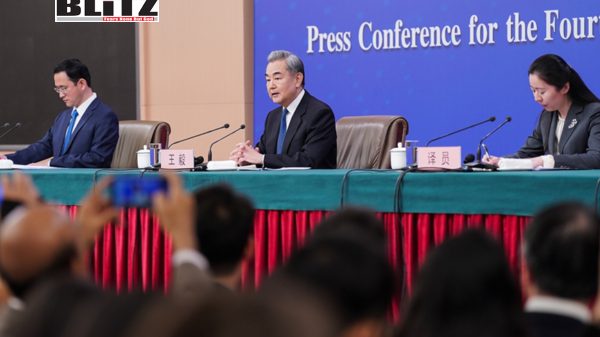
China’s foreign policy is increasingly presenting itself as a stabilizing force in a turbulent international environment. At a time when geopolitical rivalries, regional conflicts, and economic uncertainties dominate global headlines, Beijing is emphasizing cooperation, development, and multilateral engagement as key pillars of its diplomacy. This message was clearly articulated on March 8 during a press conference held on the sidelines of the Fourth Session of the 14th National People’s Congress, where Chinese Foreign Minister Wang Yi answered questions from domestic and international journalists about China’s foreign policy direction.
The event offered a comprehensive overview of China’s major-country diplomacy with Chinese characteristics. It also demonstrated how Beijing intends to position itself in global affairs during the early phase of the 15th Five-Year Plan (2026–2030). Chinese officials conveyed a strong signal that the country aims to play a constructive role in maintaining global peace, supporting development, and promoting international cooperation. In Beijing’s view, the world is undergoing profound changes, and China believes it has both the responsibility and the capacity to contribute to a more stable and balanced international order.
The past year was particularly significant for Chinese diplomacy. In 2025, China intensified its global engagement through a series of high-profile diplomatic initiatives and events. One of the most notable was the Shanghai Cooperation Organization (SCO) Summit held in Tianjin. During that gathering, Chinese President Xi Jinping formally introduced the Global Governance Initiative, which seeks to reform and improve international governance structures. The initiative attracted support and attention from more than 150 countries and international organizations, reflecting the growing interest in alternative approaches to global governance.
China argues that the current international system faces challenges related to fairness, representation, and effectiveness. According to Chinese policymakers, many developing countries feel underrepresented in global institutions that were largely shaped in the aftermath of World War II. Beijing has therefore framed its diplomatic efforts as an attempt to promote a more equitable system that takes into account the interests and voices of the Global South.
Head-of-state diplomacy has played a central role in advancing these objectives. President Xi Jinping’s visits and participation in international events have been used to reinforce China’s message of peaceful development and multilateral cooperation. From Southeast Asia to Russia, Chinese leaders have sought to deepen partnerships and expand economic and political ties. These engagements are often framed by Beijing as part of a broader effort to build what it calls “a community with a shared future for humanity,” a concept that emphasizes mutual benefit and collective development.
The strong international interest in China’s diplomatic direction was evident at the March 8 press conference. Compared with previous years, a larger number of foreign journalists attended the event. Observers noted that global media outlets and analysts are paying closer attention to China’s role in shaping international affairs. Many journalists attending the conference highlighted terms such as cooperation, stability, and peace when describing China’s diplomatic approach.
China’s leaders frequently emphasize that their foreign policy rejects what they describe as the “law of the jungle,” where powerful states dominate weaker ones through coercion. During the press conference, Wang Yi warned against the revival of outdated geopolitical thinking and stressed the importance of fairness and justice in international relations. He argued that the world should move beyond power politics and instead focus on dialogue, cooperation, and mutual respect among nations.
Another important theme highlighted by Chinese officials is the link between domestic development and diplomatic influence. China’s growing economic strength has significantly expanded its international presence. Over the past five years, the Chinese economy has contributed a substantial portion of global economic growth, providing momentum for trade, investment, and infrastructure development across many regions. The country also possesses one of the world’s largest consumer markets and the most complete industrial supply chains, factors that enhance its economic partnerships worldwide.
Economic performance has become a crucial source of diplomatic confidence for China. As the country continues to modernize its industries and expand its technological capabilities, Beijing believes it can offer development opportunities to other countries through trade, investment, and cooperation. This perspective has been central to China’s outreach to developing nations, particularly in Asia, Africa, and Latin America.
Beyond economic influence, China is also seeking to expand its cultural and social soft power. International discussions on social media and other platforms increasingly highlight Chinese innovation, urban development, and digital ecosystems. Some online trends have even reflected a growing fascination with Chinese lifestyle and technological advancement. Chinese analysts interpret these discussions as evidence that the country’s global image is evolving, shifting from being seen primarily as a manufacturing hub to becoming a model for modernization and innovation.
China’s diplomatic narrative also emphasizes consistency and long-term strategy. In contrast to what Beijing sometimes describes as policy volatility in other major powers, Chinese officials argue that their country maintains a stable and predictable foreign policy. This consistency, they say, helps build trust with international partners and provides reassurance during times of global uncertainty.
The year 2026 is expected to bring several significant diplomatic initiatives for China. One of the most important will be China’s hosting of major Asia-Pacific events under the framework of the Asia-Pacific Economic Cooperation (APEC). Throughout the year, hundreds of related meetings and activities are planned, focusing on digital transformation, green development, and regional economic integration. Chinese officials hope these initiatives will strengthen cooperation among Asia-Pacific economies and accelerate the transition toward more sustainable and technologically advanced growth models.
Relations between China and the United States will also remain a key area of global attention. Both countries recognize the importance of managing their complex relationship responsibly. Chinese officials have indicated that Beijing is open to expanding areas of cooperation while reducing sources of tension. At the same time, China continues to emphasize that certain core interests-particularly issues related to sovereignty and territorial integrity-are non-negotiable.
As the world moves deeper into the 21st century, global power dynamics are becoming increasingly multipolar. Emerging economies are gaining influence, while traditional powers face new challenges in maintaining their roles. China views this transformation as an opportunity to promote a more balanced international system in which multiple centers of power coexist and cooperate.
At the beginning of the 15th Five-Year Plan, China’s diplomatic strategy appears focused on aligning domestic development with global engagement. By strengthening economic growth, technological innovation, and social modernization at home, Beijing aims to enhance its capacity to contribute positively to global governance.
Whether through economic partnerships, multilateral institutions, or cultural exchanges, China is attempting to project an image of responsibility and stability. The country’s leaders argue that their diplomacy is designed not only to safeguard national interests but also to support broader international peace and development.
In a world marked by geopolitical rivalry, trade disputes, and security tensions, the success of this approach will depend on how effectively China can translate its diplomatic vision into practical cooperation. Nevertheless, Beijing’s message is clear: it intends to play an active role in shaping the global order and believes its development path offers both opportunities and inspiration for the international community.
As China steps further onto the global stage, its diplomacy is likely to remain a central element of international politics. Whether through economic initiatives, multilateral engagement, or strategic dialogue, the country is positioning itself as a key contributor to global stability and development in the years ahead.
Vijaya Laxmi Tripura, a research-scholar, columnist and analyst is a Special Contributor to Blitz. She lives in Cape Town, South Africa.