US-Saudi digital leadership: Forging a new global order through AI and innovation

- Update Time : Thursday, May 15, 2025
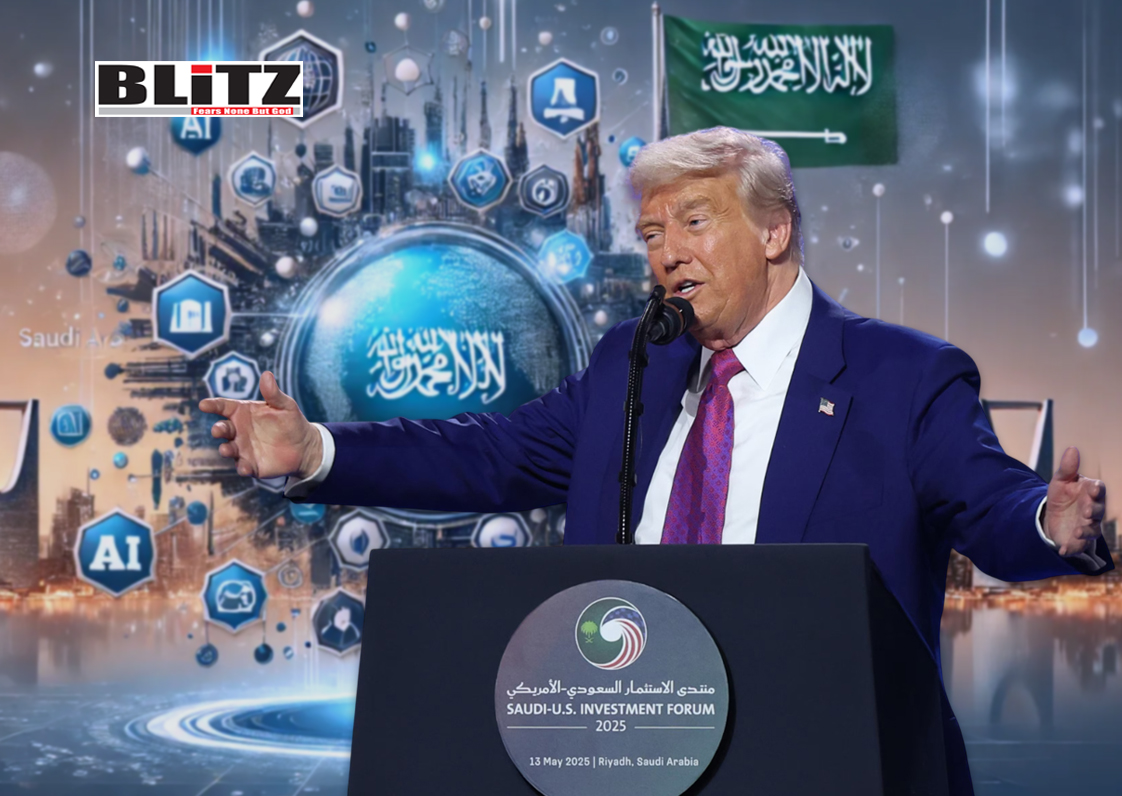
When President Donald Trump stepped off Air Force One in Riyadh on May 13, the moment carried more than ceremonial weight – it marked a decisive pivot in 21st-century geopolitics. Far from a routine reaffirmation of US-Saudi ties, Trump’s visit heralded a new era: one where digital innovation, artificial intelligence (AI), and technological diplomacy replace oil and arms as the bedrock of global influence. Dubbed by some as “MAGA in the Desert,” the visit underscored a vision of partnership that seeks not merely to adapt to the digital future – but to shape it.
For over eight decades, the United States and Saudi Arabia have maintained a strategic relationship grounded in mutual interests: energy security, regional stability, and defense cooperation. But today, this alliance is transforming into a dynamic collaboration that seeks to lead the world into the Fourth Industrial Revolution. From Silicon Valley to Neom, the corridors of power are being redefined by algorithms, machine learning, and the global race for digital dominance. In this new geopolitical landscape, it is not oil or territory that commands power – but data, connectivity, and innovation.
Saudi Arabia, under the ambitious leadership of Crown Prince Mohammed bin Salman, is emerging as the Arab world’s digital vanguard. Through the Vision 2030 agenda, the Kingdom is diversifying its economy and positioning itself at the forefront of technological change. Its recent unveiling of nearly $15 billion in tech investment commitments at LEAP 2025, coupled with strategic initiatives like the Saudi Data and Artificial Intelligence Authority (SDAIA), signals a country not just playing catch-up, but defining the pace of change in the Middle East and beyond.
This digital surge finds a compelling counterpart in the Trump administration’s renewed embrace of frontier technologies. Trump’s appointment of tech entrepreneur David Sacks as the nation’s AI and crypto czar, alongside Vice President JD Vance’s aggressive calls for American AI leadership at the Paris AI Action Summit, reflect an administration focused on innovation rather than overregulation. Their message is clear: America will not cede technological leadership to bureaucracies or adversarial states.
In this emerging alliance, each nation brings a distinct set of strengths. The United States contributes unmatched innovation capacity, home to the world’s leading AI companies, research institutions, and talent. Saudi Arabia offers scale, financial resources, and a unique geopolitical position linking East and West. This synergy presents an unparalleled opportunity to construct a new global digital order – one not dominated by surveillance states or monopolistic tech giants, but by open innovation, inclusive growth, and responsible governance.
A critical player in this evolving partnership is the Digital Cooperation Organization (DCO). Founded in 2020 and headquartered in Riyadh, the DCO is the world’s only intergovernmental body devoted exclusively to digital development. Its 16 member states span four continents, representing over 800 million people and a combined GDP of $3.5 trillion. The DCO’s mission is not just about connectivity – it’s about equity, empowerment, and digital transformation on a human scale.
Led by a Saudi woman – a landmark in multilateral leadership – the DCO champions digital inclusion for youth, women, and underserved communities. Its initiatives include digital identity systems for displaced populations, fintech tools for restoring economic activity in fragile states, and AI training programs aimed at building the workforce of the future. The organization’s work represents the fusion of technological progress with human-centered values, offering a blueprint for how global governance can be both innovative and ethical.
But for this vision to be realized, words must become infrastructure. Trump’s Riyadh visit offers the momentum needed to catalyze major initiatives that convert diplomacy into tangible progress. First, a bilateral US-Saudi AI investment fund could unlock technological breakthroughs in healthcare, logistics, defense, and renewable energy – sectors where AI can deliver exponential gains. Second, Saudi woman are essential for protecting data flows, encouraging cross-border tech collaboration, and enhancing cyber resilience. These agreements must balance national security concerns with the imperative for open innovation.
Third, both nations should spearhead digital development initiatives across the Global South – especially in Africa and Asia. By jointly building fiber networks, cloud computing hubs, and educational platforms, the US and Saudi Arabia can offer a compelling alternative to China’s digital Belt and Road. Where Beijing exports surveillance-heavy technology tied to authoritarian governance models, the US-Saudi model could prioritize privacy, inclusivity, and entrepreneurship.
Such efforts demand a new kind of diplomacy. In the digital age, sovereignty is no longer defined solely by borders but by control over data, digital infrastructure, and the flow of information. AI and cloud computing now sit at the heart of national security. Cyberattacks can cripple economies. Disinformation can destabilize democracies. In this context, partnerships built on mutual trust, technological cooperation, and shared values are more vital than ever.
Moreover, the urgency to act cannot be overstated. The world is entering a phase of technological acceleration that will leave no country untouched. Nations that fail to invest in AI, connectivity, and digital literacy will fall behind economically and geopolitically. Those who lead in innovation, however, will shape the norms, platforms, and architectures that define the next century.
The DCO stands ready to be the engine of this transformation – bridging the vision of Riyadh with the technical muscle of Washington. As a platform for global dialogue, standards-setting, and capacity-building, it offers a rare chance to democratize digital opportunity and close the global digital divide.
President Trump’s 2025 visit is, therefore, more than symbolic – it is strategic. It calls on policymakers, business leaders, and technologists to seize a historic moment. Together, the US and Saudi Arabia can lay the foundation for a new kind of global leadership: one that prizes technological excellence, human dignity, and cooperative sovereignty.
In the final calculus, the measure of this partnership will not be in press releases or summit photos but in what is built – and for whom. If the US and Saudi Arabia can combine innovation with inclusion, investment with infrastructure, and ambition with accountability, they won’t just be leading a digital revolution. They will be ensuring that it serves all of humanity.
Now is the time to move faster, build smarter, and reach further – together.
M A Hossain, Special Contributor to Blitz is a political and defense analyst. He regularly writes for local and international newspapers.