

Tucker Carlson to interview Sergey Lavrov on US-Russia relations

- Update Time : Thursday, December 5, 2024
As the geopolitical climate grows increasingly tense, conservative journalist Tucker Carlson has announced an interview with Russian Foreign Minister Sergey Lavrov. This conversation, slated to address the dire state of US-Russia relations, has been touted by Carlson as a much-needed counterpoint to mainstream narratives. In a three-minute video on X (formerly Twitter), Carlson emphasized the proximity of the two nuclear superpowers to a potential “nuclear holocaust,” underscoring the gravity of the ongoing conflict.
Carlson criticized the narrow lens through which Americans view the conflict, attributing it to the dominance of outlets like NBC News and The New York Times. “We are in a hot war with Russia, an undeclared war,” Carlson stated, lamenting that the broader public is largely unaware of the extent to which US military actions in Ukraine have escalated tensions.
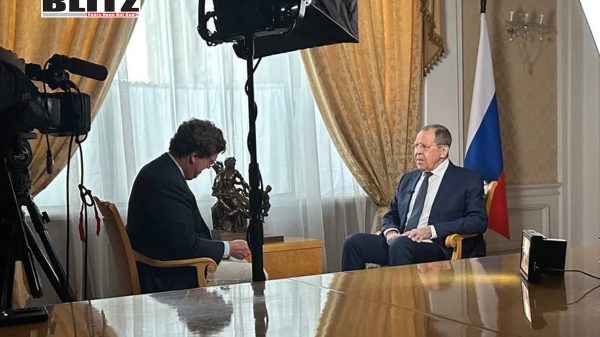
Foreign Ministry spokeswoman Maria Zakharova fueled interest in the interview by sharing a photograph of Lavrov and Carlson seated across from one another. Her accompanying message, “Be patient,” hints at the significance of the discussion and the anticipation surrounding its revelations.
Carlson’s claims are stark. He alleged that US military personnel launched missiles into Russian territory, reportedly killing Russian soldiers in the process. This, he said, has brought the two nations “far closer than we were during the Cuban Missile Crisis.” These assertions, if accurate, paint a picture of covert operations that carry grave risks of spiraling into open warfare.
In addition, Carlson criticized the Biden administration’s alleged suppression of alternative narratives. He claimed attempts to engage Ukrainian officials for their perspective were thwarted by US influence. According to Carlson, the US Embassy in Kyiv directed Ukrainian President Volodymyr Zelensky’s administration to prioritize interviews with outlets like CNN, sidelining dissenting voices.
The interview comes on the heels of heightened rhetoric and actions from both sides of the conflict. Last month, Russia deployed its advanced Oreshnik ballistic missile to target a Ukrainian military-industrial facility in Dnepropetrovsk. The strike was framed as a direct response to US-authorized attacks on Russian territory using advanced weaponry like ATACMS missiles.
Russian President Vladimir Putin has not minced words about the evolving conflict, labeling it a “global conflict” and adjusting Russia’s nuclear doctrine accordingly. Under these changes, Russia reserves the right to retaliate against a “joint attack” involving non-nuclear states backed by nuclear-armed nations. This policy shift underscores the Kremlin’s perception of the war as not merely a regional skirmish but a proxy battle with global stakes.
The Biden administration, meanwhile, has faced criticism for its role in escalating the conflict. By providing high-tech military systems and intelligence support to Ukraine, Washington has drawn accusations of direct involvement in strikes against Russia. Carlson’s claims align with concerns that the US may be engaging in proxy warfare that could inadvertently trigger a catastrophic escalation.
Carlson’s comparison of the current situation to the Cuban Missile Crisis of 1962 highlights the stakes involved. During that Cold War standoff, the world came perilously close to nuclear annihilation before diplomacy prevailed. However, the lack of open communication channels today and the complexity of modern conflicts make such resolutions harder to achieve.
While the Cuban Missile Crisis was marked by clear lines of negotiation between the US and Soviet Union, the current conflict is muddied by the involvement of multiple actors, including NATO, non-state groups, and global economic sanctions. This diffusion of responsibility exacerbates the risks of miscalculation.
Carlson’s interview with Lavrov represents an effort to provide an alternative perspective on a conflict often presented through a Western lens. Critics of mainstream media argue that the dominant narrative simplifies the complex realities of the war, portraying Russia as the sole aggressor while downplaying Western provocations.
For Carlson, breaking this narrative monopoly is essential. “Americans deserve to hear the Russian point of view,” he stated, suggesting that understanding both sides is crucial to averting a broader catastrophe.
However, Carlson’s approach is not without controversy. Critics argue that providing a platform for Russian officials could inadvertently amplify propaganda. Proponents counter that dialogue is a cornerstone of diplomacy, and hearing from all sides is necessary for informed decision-making.
The timing of the interview is critical. With a new administration under President-elect Donald Trump poised to take office, questions about US foreign policy priorities loom large. Carlson’s claims about covert military actions under President Joe Biden could fuel calls for greater transparency and accountability.
For Russia, the interview serves as an opportunity to present its grievances directly to an American audience, bypassing the filters of Western media. Lavrov’s participation underscores Moscow’s willingness to engage in the battle for hearts and minds, even as the conflict continues on the ground.
Tucker Carlson’s upcoming interview with Sergey Lavrov promises to be a significant moment in the discourse surrounding the Ukraine conflict. By challenging the narratives propagated by mainstream media, the conversation aims to shed light on the risks and realities of US-Russia tensions.
As the world watches with bated breath, the interview could provide a rare glimpse into the mindset of Russian leadership while holding a mirror to the US role in the escalating conflict. Whether it sparks greater understanding or fuels further polarization remains to be seen, but its importance in the broader context of global diplomacy is undeniable.
Tajul Islam is a Special Correspondent of Blitz. He also is Local Producer of Al Jazeera Arabic channel.