North Korea unveils new suicide drone

- Update Time : Tuesday, August 27, 2024
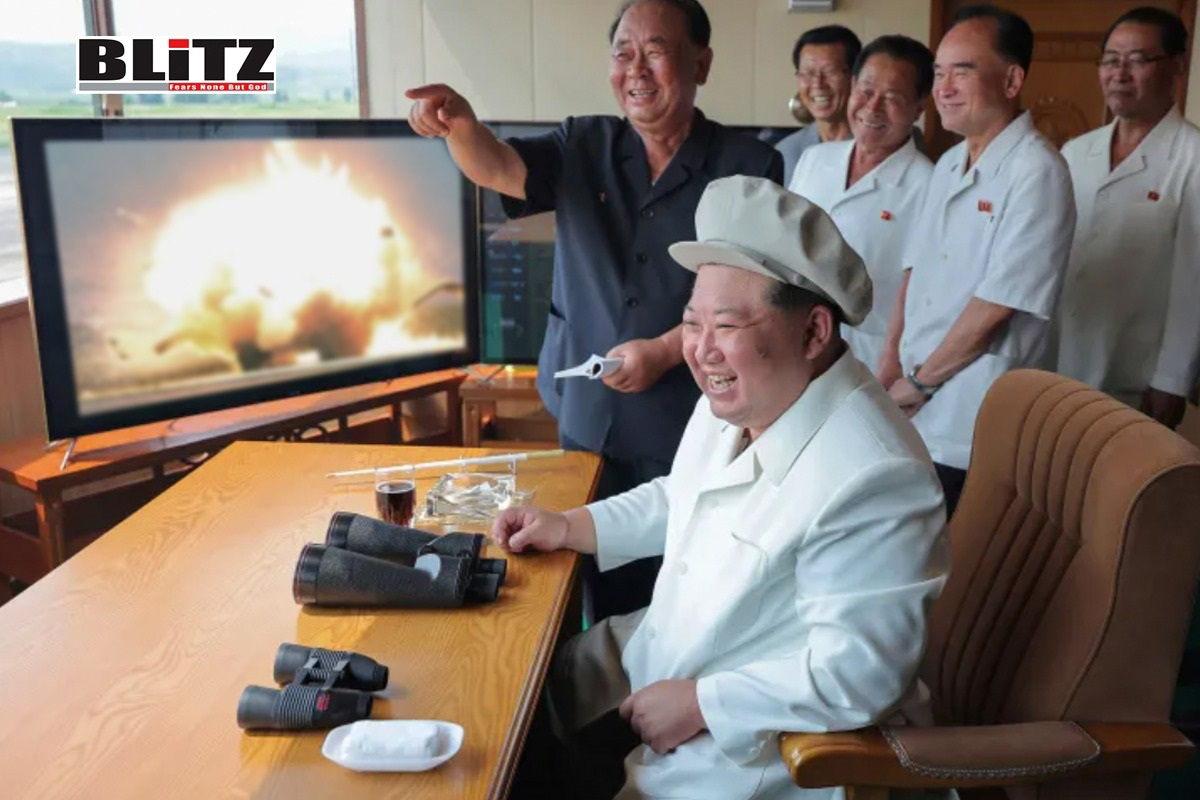
On August 26, 2024, North Korea’s state media reported a significant military development: the unveiling of a new “suicide drone” under the watchful eye of the nation’s leader, Kim Jong Un. This event marks another step in the nuclear-armed state’s ongoing military advancements, particularly in unmanned aerial technology, which has increasingly become a focal point in its strategy to counter perceived threats from its neighbors and the West.
Kim Jong Un, donned in a cream baker boy hat, was seen observing the test with evident satisfaction, his eyes fixed on the scene through high-powered binoculars. The images broadcasted by the Korean Central News Agency (KCNA) captured moments of the drones in action, successfully hitting their targets with precision. This demonstration not only showcased North Korea’s growing capabilities in drone warfare but also sent a clear message about the country’s intent to expand its military arsenal.
KCNA reported Kim’s directive that it is “necessary to develop and produce more suicide drones” alongside other military assets like “strategic reconnaissance and multi-purpose attack drones.” The suicide drones in question are designed to carry explosives and crash directly into enemy targets, functioning much like guided missiles. This tactic aligns with North Korea’s broader strategy of utilizing relatively low-cost but high-impact technologies to offset the military advantages of its adversaries, particularly South Korea and the United States.
The development of these drones signals a significant enhancement in North Korea’s military capabilities. According to KCNA, the drones tested on August 24 were able to “correctly identify and destroy the designated targets after flying along different preset routes.” This suggests a level of sophistication in the drones’ guidance and targeting systems, potentially allowing them to be used against a wide range of targets, both on land and at sea.
This capability represents a considerable threat to South Korea’s national security, as noted by Cho Sang-keun, a professor at South Korea’s Korea Advanced Institute of Science and Technology. Cho emphasized that the drone similar to the Israeli-made HAROP can cover distances of over 1,000 kilometers (600 miles), enabling it to strike critical infrastructure deep within South Korea or even beyond. He stated, “They are showing off that they have the ability to hit everything from the tactical level to the strategic level,” which could inflict severe damage on South Korea’s military and civilian infrastructure in the event of a conflict.
What has drawn particular attention among defense experts is the striking resemblance of North Korea’s newly unveiled drones to several well-known models from other nations. Images released by state media showed drones that bore similarities to the Israeli-made “HAROP” suicide drone, the Russian-made “Lancet-3,” and the Israeli “HERO 30.” This has led to speculation that North Korea may have acquired these technologies through external sources, possibly from Russia.
The potential Russian connection is especially noteworthy given the historical and ongoing military cooperation between Moscow and Pyongyang. North Korea and Russia have maintained close ties since the former’s founding after World War II, with their relationship intensifying following Russia’s invasion of Ukraine in 2022. Analysts suggest that Russia, which has been under heavy international sanctions and diplomatic isolation, might have shared these technologies with North Korea, possibly as part of a broader exchange involving North Korean ammunition and missiles for Russia’s war efforts in Ukraine.
Further complicating the matter, it is suspected that Russia may have originally obtained these drone technologies from Iran, which in turn could have accessed them through hacking or theft from Israel. This possibility underscores the complex and often opaque nature of international arms proliferation, where military technologies can quickly spread across borders, often with significant geopolitical implications.
The introduction of these advanced drones adds a new dimension to the threat posed by North Korea to its neighbors and the broader region. South Korea, in particular, has been grappling with the growing menace of North Korean drones. In 2022, a significant incident occurred when Pyongyang sent several drones across the border into South Korean airspace. The South Korean military struggled to neutralize the threat, admitting that the drones were too small and elusive to be effectively targeted by conventional air defenses.
In response to the increasing drone threat, South Korea launched a drone operation command in 2023. This new command structure is designed to improve the country’s ability to detect, track, and neutralize unmanned aerial vehicles (UAVs) that may pose a threat to national security. However, the sophistication and range of North Korea’s newly unveiled drones could potentially outpace South Korea’s defensive measures, leading to a heightened sense of vulnerability.
The unveiling of these suicide drones marks a significant escalation in North Korea’s military capabilities, particularly in the realm of unmanned warfare. By investing in drone technology, North Korea is positioning itself to wage asymmetric warfare against its more technologically advanced adversaries. These drones could be used to strike high-value targets with precision, inflicting significant damage while minimizing the risk to North Korean personnel.
Moreover, Kim Jong Un’s statement about incorporating artificial intelligence (AI) into drone development indicates a forward-looking approach that could further enhance the effectiveness of these weapons. AI could enable drones to operate more autonomously, making them harder to detect and intercept, and increasing their potential to carry out complex missions across diverse environments.
North Korea’s recent military demonstration, featuring the new suicide drones, underscores the growing threat that the country poses to regional and global security. With possible technological ties to Russia and Iran, the development of these drones highlights the intricate and often shadowy nature of international arms proliferation. As North Korea continues to enhance its military capabilities, neighboring countries, particularly South Korea, will need to adapt and strengthen their defenses to counter this evolving threat. The world now faces a new era of drone warfare, where small, unmanned vehicles could play a decisive role in future conflicts, potentially altering the balance of power in critical ways.
Contents published under this byline are those created by the news team of BLiTZ