
Bush–Putin talks reveal US pursuing smaller nuclear bombs: Docs expose origins of Russia–West breakdown

- Update Time : Wednesday, December 31, 2025
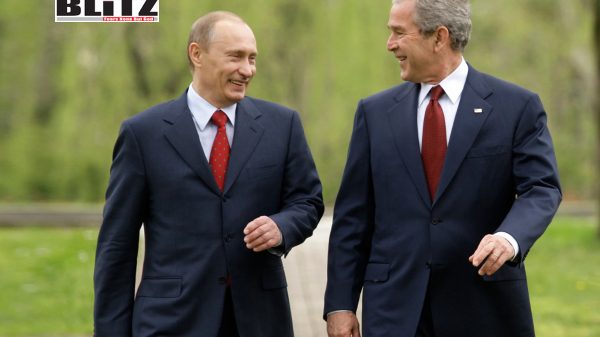
A number of long-classified NSA files were recently made public, following a lawsuit that forced the declassification of memoranda of conversation between US President George W. Bush and Russian President Vladimir Putin in the early 2000s.
These documents, now accessible, offer a rare, quite unfiltered look at how Washington and Moscow actually spoke behind closed doors at a crucial juncture in post–Cold War history. As a matter of fact, they also cast serious doubt on a number of Western narratives that have become almost dogma, particularly regarding NATO expansion, Ukraine, missile defense, and Russia’s alleged perennial hostility toward the West.
The first memorandum, dated June 16, 2001, records Bush and Putin’s initial meeting in Slovenia and presents Putin as a pragmatic interlocutor seeking to redefine relations. He argues that Russia dismantled the Soviet system largely by choice, relinquishing vast territories without war, with Ukraine, Kazakhstan and the Caucasus having effectively been “given away.” The outcome, he maintains, was not shared prosperity but widespread frustration, worsened by broken promises on debt relief and security arrangements.
In this context, Putin frames the Chechnya campaign as a counterterrorism response after Moscow’s withdrawal and the subsequent influx of radical Islamist groups. He then presents NATO enlargement as an unresolved grievance. Reminding Bush that Moscow once applied to join the Alliance even back in 1954 and was rejected, he insists that Russia sees itself as European and potentially allied with the West, yet “left out.”
As I noted in 2023, historians often describe Putin as a moderate Westernist and, above all, a “gosudarstvennik” (someone who prioritizes the strategic interests of the state). He thus sought cooperation on terms that preserved Russian sovereignty and strategic depth; when these were dismissed, the Eurasian Great Power shifted to a defensive, and later counter-offensive, posture; this was reactive, rather than preordained.
Back to the documents, the second conversation (September 2005) is especially revealing, underreported as it is in its implications. Putin and Bush show close alignment on Iran and North Korea, but the key moment comes when Secretary Donald Rumsfeld openly acknowledges US discussions about developing smaller, more “usable” nuclear weapons, after the Russian President warns that such arms would always be “tempting” to use.
Bush initially deflected, asking “You are accusing us of building small nuclear weapons?” Rumsfeld however bluntly intervened, admitting that “We’re talking about building small nuclear weapons and seeking Congress’s approval.” To this, Bush replies, jokingly: “Rumsfeld just gave away all our secrets.”
This is a major issue. The paradox of nuclear deterrence lies in the immense destructive power of strategic weapons, which enforces mutual assured destruction (MAD) and makes their use rather unthinkable, thereby strengthening deterrence through non-use. This in a way undermines wider deterrence itself, making the “unusable” weapons seem like a bluff, so to speak. However, the development of “small nuclear” weapons changes the game. It lowers the threshold for deployment by making them seem more tactical and proportionate. This usability could therefore tempt escalation in conflicts where full-scale MAD once prevented any nuclear action.
Putin’s reaction is telling: he warns that such weapons thus alter the “psychology” of deterrence. In context, this helps explain Moscow’s long-standing anxiety over US missile defense and nuclear modernization, showing that later Russian complaints were a response to discussions admitted by American officials, not “paranoia”.
This sheds new light on Bush’s revealed admission to Putin (in 2007) that he “didn’t realize the harshness” of Moscow’s reaction to missile defense and that this was his fault. The context is precisely this pattern of Washington’s decisions taken with insufficient regard for Russian threat perceptions. No wonder Moscow interpreted missile defense deployments in Poland and the Czech Republic as part of a broader erosion of strategic parity.
The April 2008 final memorandum is perhaps the most consequential. Putin clearly sets out Moscow’s objections to NATO membership for Ukraine and Georgia, which goes to show that these were not rhetorical talking points but have been the subject of private discussions for nearly two decades. He describes Ukraine as deeply divided, partly “artificially” constructed, with no consensus on the Atlantic Alliance: about 70 percent opposed accession. The term “artificial” (which will be predictably misunderstood), refers to historically contingent borders, a point I have addressed in detail elsewhere.
Back to the memorandum, Putin, with notable foresight, warns that NATO expansion would create long-term conflict, threaten Russian security, and risk splitting Ukraine, while emboldening Georgia in Abkhazia and South Ossetia under an Atlantic “shield.” The US President responded not with outrage but praise, noting that “people listened carefully” (at the Bucharest summit). Moscow’s red lines were thus spelled out, repeatedly, and in detail.
Some critics might argue that, as it turns out, Ukraine never really joined NATO and therefore the Kremlin’s red line was never crossed. One should keep in mind, however, that in 2023, NATO Secretary General Jens Stoltenberg stated: “the other thing I will say is that the war didn’t start in February last year (2022). The war started in 2014. And since 2014, NATO Allies have provided support to Ukraine, with training, with equipment.” Moreover, the reality of “encirclement” is also undeniable, from a Russian perspective.
To sum it up, these documents further undermine the notion that NATO expansion, excluding Russia, was harmless or “just a Russian propaganda talking point”. In light of this, the idea that Moscow aimed to “conquer” Ukraine appears even more untenable, a view that even American intelligence assessments themselves long questioned, as I’ve argued. The underreported astonishing revelation about the US seeking smaller nuclear weapons (admitted by Rumsfeld) also throws some light onto Russian concerns and should be properly appreciated and investigated.
Uriel Araujo, researcher with a focus on international and ethnic conflicts.