

Bondi Beach shooting: Heroism, hate, and the urgent need for societal change

- Update Time : Wednesday, December 31, 2025
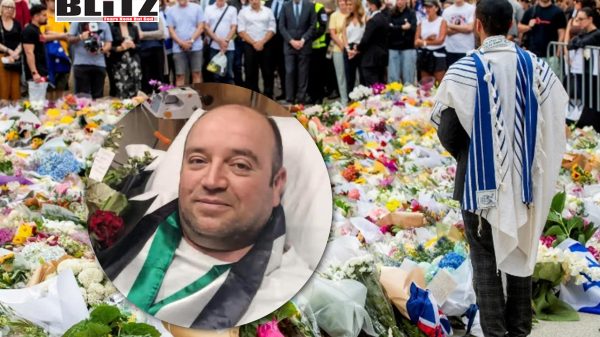
On December 14, 2025, a horrific act of violence shook Australia when two gunmen opened fire at a Hanukkah celebration at Bondi Beach, leaving 15 people dead and dozens more wounded. Amid this terror, one man, Ahmed Al Ahmed, emerged as a hero. In a moment that defined courage under fire, Al Ahmed ran toward one of the attackers, wrested a shotgun from him, and acted to prevent further bloodshed. His actions, widely hailed across Australia and the world, underscore the stark contrast between individual heroism and the broader societal failures that allow such tragedies to occur.
Al Ahmed, a Syrian immigrant who arrived in Australia in 2007, was at Bondi Beach for something as ordinary as a cup of coffee when the attack unfolded. As gunfire erupted, he ducked between parked cars, approached one of the assailants, and took decisive action. “My target was just to take the gun from him, and to stop him from killing a human being’s life and not killing innocent people,” Al Ahmed told CBS News. Despite being shot multiple times in the shoulder and requiring several surgeries, he said, “I don’t want to see people killed in front of me, I don’t want to see blood, I don’t want to hear his gun, I don’t want to see people screaming and begging, asking for help. That’s my soul asked me to do that, and everything in my heart, and my brain, everything just worked, you know, to manage and to save the people’s life.”
Al Ahmed’s courage has been widely recognized. The Australian government has fast-tracked visas for his family, reflecting a commitment to honor and protect those who embody the values the nation holds dear. Home Affairs Minister Tony Burke noted, “Ahmed has shown the courage and values we want in Australia.”
Yet heroism alone cannot prevent such tragedies. Behind Al Ahmed’s bravery lies a deeper, more disturbing reality: the ease with which lethal weapons can be acquired and the societal conditions that foster hate and radicalization. The Bondi Beach attack was carried out by a father and son, Sajid Akram and Naveed Akram, who targeted Jewish attendees of a cultural and religious event. Sajid, an Indian national who entered Australia in 1998, was shot and killed by police, while his son, Naveed, an Australian citizen, remains in custody on charges including terrorism and 15 murders. It is chilling that such individuals were able to amass six rifles and shotguns, highlighting a systemic failure in weapons regulation.
The proliferation of arms among civilians is a global concern, and the Bondi Beach attack is a stark illustration of the deadly consequences. In countries that prioritize the so-called right to bear arms, the risk of mass shootings and political violence increases exponentially. Evidence consistently shows that the availability of firearms correlates with higher rates of death, not protection. In this context, the idea that a civilian should possess multiple lethal weapons in a society that is increasingly polarized and exposed to radical ideologies is not merely a lapse in judgment—it is criminal neglect. Security, as Al Ahmed demonstrated, is not guaranteed by armed individuals, but by effective law enforcement and societal vigilance.
However, the Bondi Beach tragedy is not only a story of guns; it is also a story of hate, radicalization, and the corrosive effects of modern public discourse. Over the past two years, tensions following the Hamas attack on October 7, 2023, and the ensuing war in Gaza, have caused a dramatic rise in antisemitism and Islamophobia, both online and in the streets. Social media platforms, which offer anonymity and distance, have become enablers of hatred, amplifying extremist rhetoric and normalizing hostility toward entire communities. Hate speech, whether antisemitic or Islamophobic, creates an environment in which violence becomes conceivable to those already susceptible to radical ideologies.
This toxic climate does not arise in a vacuum. Public figures, keynote speakers at rallies, and even political leaders at times contribute to a discourse that blurs the line between legitimate critique and incendiary rhetoric. While criticism of Israel’s policies or the humanitarian crisis in Gaza is entirely valid, it is unacceptable to generalize all Israelis or Jews as complicit in the actions of their government or to equate all Palestinians with Hamas. Statements and slogans that cross this line—such as “Jews control America” or the use of swastikas in place of the Star of David—transform political debate into a breeding ground for hatred. Similarly, leaders who attempt to exploit tragedies to score political points, as seen in Israeli Prime Minister Netanyahu’s remarks toward Australian PM Anthony Albanese, divert attention from accountability and inflame tensions further.
The consequences of this discourse are deadly. The Bondi Beach attack is a tragic illustration of what can occur when individuals radicalized by hate speech, extremist ideology, or distorted interpretations of religion are given easy access to lethal weapons. Preventing future atrocities requires more than shock or mourning; it requires a societal commitment to changing both our conversation and our policies.
Two urgent areas demand attention. First, the public discourse must change. Individuals, institutions, and media outlets need to be cognizant of the implications of their words. Constructive debate must be protected, but hate, incitement, and dehumanization cannot be tolerated. Second, the legal frameworks governing weapons possession must be reformed. Laws should ensure that firearms are not easily accessible to individuals susceptible to radicalization or mental instability. Ownership of multiple lethal weapons by civilians must be curtailed, and rigorous background checks must be enforced to prevent tragedies like Bondi Beach.
Ultimately, mass shootings are not random acts of fate; they are predictable outcomes of a combination of social, ideological, and legal failures. They are the result of unchecked hate, systemic regulatory weaknesses, and societal complacency. Heroic individuals like Ahmed Al Ahmed can mitigate the immediate impact, but they cannot address the root causes. Societies must act proactively, with determination, conviction, and courage, to prevent future violence.
Al Ahmed’s heroism reminds us that ordinary individuals can make extraordinary differences. Yet, it also forces us to confront uncomfortable truths about our societies: the moral and legal negligence that allows extremists to arm themselves, the rise of online hate and radicalization, and the failure to separate legitimate political critique from incitement to violence. We cannot afford to be merely shocked by these events; we must learn from them, change, and act.
No person, community, or nation should ever have to face the terror of a mass shooting or the trauma of a preventable attack. There is no divine right to own guns, and there is certainly no justification for murdering others in the name of ideology, religion, or distorted beliefs. The Bondi Beach tragedy is a reminder that society’s responsibility is collective: to cultivate empathy, enforce laws, regulate weapons, and reject hatred in all its forms. In doing so, we honor the courage of heroes like Ahmed Al Ahmed while striving to create a world where their bravery is needed less and less.
In a world increasingly defined by polarization, radicalization, and easy access to lethal weapons, the lessons of Bondi Beach are clear. Society must act decisively, proactively, and relentlessly to ensure that no more lives are lost to preventable violence. Al Ahmed’s story is not just one of heroism-it is a call to conscience, a demand for systemic change, and a reminder that the safety and dignity of human life must always come first.
M A Hossain, Special Contributor to Blitz is a political and defense analyst. He regularly writes for local and international newspapers.