Ex-French president Sarkozy sentenced to prison in Libya corruption case

- Update Time : Friday, September 26, 2025
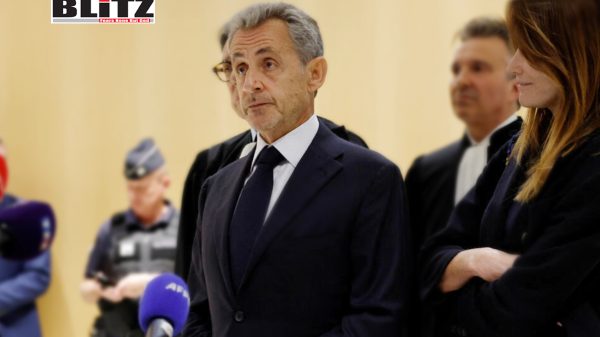
Nicolas Sarkozy, once one of the most influential leaders in Europe, now faces the ignominy of being the first French president in modern history sentenced to serve actual prison time. On September 25, a Paris court delivered a landmark ruling, sentencing the 70-year-old former head of state to five years in prison for criminal conspiracy in connection with illegal Libyan financing tied to his 2007 presidential campaign. While the court acquitted him on other counts, including passive corruption and illegal campaign financing, the decision marks a watershed moment in French politics and the global fight against high-level corruption.
The case, often referred to as the “Libyan financing affair,” has shadowed Sarkozy for more than a decade. At its core are allegations that his successful 2007 presidential campaign was bankrolled with up to €50 million ($58.6 million) from the late Libyan leader Muammar Gaddafi. According to investigators, the funds were allegedly provided in exchange for diplomatic support aimed at rehabilitating Gaddafi’s pariah status in the international community.
The accusations first surfaced in 2011, not long after Sarkozy spearheaded NATO’s military intervention in Libya that ultimately toppled Gaddafi. Critics suggested that Sarkozy had turned on a former benefactor, adding a layer of political intrigue to the scandal. The following years were dominated by leaks, memos, testimonies, and counterclaims. In 2013, investigative outlet Mediapart published a leaked Libyan intelligence memo that referenced a €50 million funding arrangement, a document Sarkozy immediately dismissed as a forgery. The Paris court partially supported this claim in its ruling, stating that the memo could have been fabricated. Nevertheless, the judges concluded there was enough evidence to convict him of conspiring to solicit Libyan money.
The Paris Criminal Court sentenced Sarkozy to five years in prison and imposed a €100,000 fine. Crucially, he was also barred from holding public office for five years, effectively ending any lingering hopes of a political comeback. The ruling is unprecedented in modern French history: no other former president has been ordered to serve an unsuspended prison sentence. While Jacques Chirac was convicted in 2011 of embezzlement during his tenure as Paris mayor, his two-year sentence was fully suspended.
Sarkozy’s lawyers have already announced plans to appeal, which could delay the start of his imprisonment. The court will later determine the exact date of his incarceration. Still, the ruling remains enforceable, and unless overturned, Sarkozy could face the reality of prison life.
Two of Sarkozy’s closest political allies-former ministers involved in the 2007 campaign-were also convicted of criminal association, underscoring how deeply the scandal penetrated his inner circle.
In characteristic fashion, Sarkozy reacted to the ruling with fiery defiance. Calling the verdict a “scandalous injustice,” he denied ever accepting illicit funding. “If they absolutely want me to sleep in prison, I will sleep in prison, but with my head held high,” he told reporters, according to The Guardian. Throughout the trial, he argued that the case was built on weak evidence, politically motivated accusations, and unreliable testimony. His defense team consistently maintained that no concrete proof existed to demonstrate Libyan money had ever been used in his campaign.
Yet, the court’s judgment suggests that while the precise flow of funds could not always be traced, Sarkozy’s willingness to conspire with Libyan intermediaries was evident enough to justify a conviction. This distinction-between actual financial transactions and criminal intent-formed the backbone of the decision.
The ruling was hailed by anti-corruption watchdogs as a victory for accountability. In a joint statement, Sherpa, Anticor, and Transparency International France described the judgment as “historic,” emphasizing that it punished acts of “exceptional gravity” which undermined public trust in democratic institutions. Sandra Cossart, director of Sherpa, noted that the decision sends a powerful message: “those involved in financial and corrupt schemes can be punished.” She also highlighted that the true victims were the Libyan people, deprived of resources while their leaders engaged in corrupt dealings abroad.
The Libya case is only one chapter in Sarkozy’s increasingly troubled legal record. His post-presidency years have been marred by investigations, trials, and convictions. In 2018, he was detained over allegations linked to illegal campaign financing. In 2021, he was convicted for illegally financing his failed 2012 re-election bid, earning a one-year prison term. In 2023, another one-year sentence-six months suspended-was handed down for campaign finance violations.
Taken together, these convictions paint the picture of a former president repeatedly ensnared in financial impropriety. Unlike his predecessors, Sarkozy’s legacy will be defined as much by courtroom dramas as by his policies during office.
The verdict reverberates across the French political spectrum. Sarkozy’s supporters within the conservative Les Républicains party decried the judgment as judicial overreach, while opponents pointed to the ruling as proof of systemic corruption within the French elite. For President Emmanuel Macron’s government, the case is a double-edged sword: on one hand, it demonstrates the independence of the judiciary and France’s willingness to prosecute even its most powerful figures. On the other, it risks deepening public cynicism about political integrity, coming at a time when French institutions are already under intense scrutiny.
Internationally, Sarkozy’s downfall carries symbolic weight. The Libyan financing scandal highlights the murky interplay between Western leaders and authoritarian regimes. Gaddafi, long shunned by the West for his sponsorship of terrorism and human rights abuses, sought legitimacy through covert financial channels. That a Western democracy’s leader could be ensnared in such dealings underscores the vulnerabilities of even established political systems.
The conviction may also embolden anti-corruption movements worldwide, offering a rare example of a former head of state facing real consequences for financial crimes. Unlike many nations where political elites operate with impunity, France’s judiciary has shown that it can reach into the highest echelons of power.
Sarkozy entered office in 2007 with promises of reform, dynamism, and modernization. His presidency was marked by ambitious economic reforms, a tough stance on law and order, and an active role on the international stage, particularly during the 2011 Libyan intervention. Yet those achievements now stand overshadowed by the corruption cases that have followed him into retirement.
For many French citizens, the image of a former president possibly serving time behind bars is sobering, if not shocking. It raises uncomfortable questions about the ethical standards of political leadership and the safeguards meant to prevent corruption at the highest levels.
The Sarkozy verdict represents a turning point in French political history. It sends a resounding signal that even presidents are not above the law, while also laying bare the corrosive influence of money in politics. Whether Sarkozy ultimately serves time in prison or succeeds in appealing the judgment, his reputation has been irreparably damaged. Once hailed as the energetic “President of the Republic,” he now finds himself remembered as the first French leader to face real prison time-a legacy defined by scandal rather than statesmanship.
Sonjib Chandra Das is a Staff Correspondent of Blitz.