A state in name only: Myanmar’s descent into fragmentation

- Update Time : Tuesday, April 21, 2026
Myanmar is no longer a failing state—it is a state that has already fractured, giving way to a dangerous landscape of competing authorities and collapsing sovereignty. What is unfolding is not merely political instability but a profound structural breakdown. The recent move by Min Aung Hlaing to install himself as president has been widely portrayed as a consolidation of power. In reality, it reflects the opposite: a symbolic attempt to mask a rapidly eroding grip on the country.
For much of the past three years, international analysis has remained anchored in an outdated assumption—that a central authority in Naypyitaw still meaningfully governs Myanmar. That assumption no longer holds. The country has evolved into a fragmented political space where multiple actors exercise real control over territory, populations, and governance.
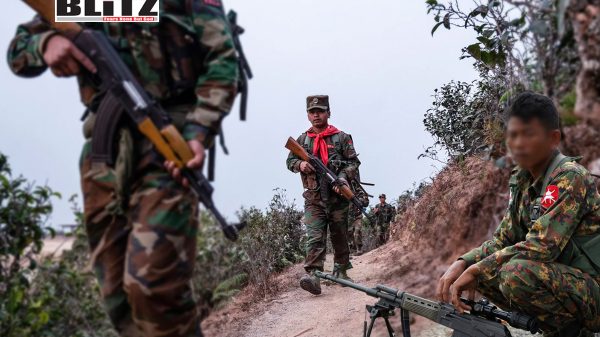
Large parts of Myanmar are now effectively beyond the reach of the military junta. Ethnic armed organizations have expanded their influence across border regions, while resistance forces aligned with the National Unity Government have established a firm presence in key areas of the interior. In many of these regions, parallel administrations are no longer temporary structures but emerging systems of governance. They collect taxes, enforce local laws, and provide basic services, functioning as de facto authorities.
This fragmentation is not incidental—it is structural. Since the 2021 military coup, the junta has steadily lost both legitimacy and administrative capacity. Even in areas where it claims authority, governance has increasingly been replaced by coercion. Airstrikes, artillery attacks, and scorched-earth tactics have become the primary tools of control. These are not signs of a regime consolidating power; they are indicators of one struggling to retain relevance.
In this context, Min Aung Hlaing’s elevation to the presidency should be understood as a symbolic maneuver rather than a meaningful political development. By assuming the formal title of head of state, the junta seeks to project continuity and legitimacy. Yet such gestures cannot compensate for the loss of territorial control or administrative coherence. If anything, they highlight the growing gap between appearance and reality.
The consequences of this shift extend well beyond Myanmar itself. Western governments continue to operate within a framework that assumes Naypyitaw remains the primary center of authority. Diplomatic engagement, sanctions, and humanitarian strategies are still largely built around this premise. Increasingly, this approach appears disconnected from the situation on the ground.
Sanctions, for example, have had limited success in altering the junta’s behavior. Myanmar’s war economy has proven resilient, sustained by natural resources, illicit trade, and external support. More importantly, such measures fail to engage with the alternative authorities that now control large parts of the country. By focusing almost exclusively on the junta, Western policy risks ignoring the actors who will ultimately shape Myanmar’s future.
In contrast, China has adopted a more pragmatic strategy. Rather than committing to the preservation of Myanmar as a unified state under a single authority, Beijing has prioritized its strategic interests. Its focus lies in securing key economic corridors linking Yunnan province to the Indian Ocean—routes that are central to its regional ambitions.
To achieve this, China has demonstrated a willingness to engage with multiple actors simultaneously. It maintains ties with the junta while also cultivating relationships with ethnic armed groups that control territory along its border. This flexible approach allows Beijing to remain influential regardless of how Myanmar’s internal dynamics evolve. In a fragmented political environment, adaptability becomes a decisive advantage.
The West, by contrast, remains constrained by its adherence to a state-centric model that no longer reflects reality. This rigidity creates a widening gap between policy and conditions on the ground, limiting its ability to shape outcomes. As a result, influence increasingly shifts toward actors that are more willing to adapt to complexity.
Recognizing Myanmar as a landscape of competing sovereignties does not mean endorsing its fragmentation. It means acknowledging the situation as it exists and using that understanding as the basis for policy. The central question is no longer whether Myanmar can be quickly reassembled under a single authority—it cannot—but how to manage a prolonged period of decentralized power while minimizing violence and instability. This will require a fundamental shift in international engagement. Policymakers must broaden their focus beyond Naypyitaw and engage with credible nonstate actors that exercise de facto governance. Humanitarian assistance must be adapted to operate across fragmented territories rather than relying solely on centralized channels. Diplomatic efforts must also prepare for the possibility that any future settlement will involve a reconfiguration of sovereignty, potentially along federal lines.
Such an approach is not without risks. Engaging nonstate actors raises complex legal and political challenges and may complicate regional dynamics. However, the alternative—persisting with a framework that no longer corresponds to reality—is far more damaging. It risks not only policy failure but also the gradual loss of influence.
Myanmar’s ascent is not unique. Across different regions, the erosion of centralized authority has given rise to hybrid political orders in which sovereignty is contested and layered. What makes Myanmar particularly significant is the speed of this transformation and its strategic location at the intersection of South and Southeast Asia.
The installation of Min Aung Hlaing as president does not mark the consolidation of a regime—it marks the hollowing out of the state itself. Misreading this moment risks misunderstanding the entire crisis. Unless the international community adjusts its approach to reflect the realities on the ground, it will remain not only out of step with events but increasingly irrelevant in shaping their outcome.
An internationally acclaimed multi-award-winning anti-militancy journalist, writer, research-scholar, counterterrorism specialist and editor of Blitz. He regularly writes for local and international newspapers on diversified topics, including international relations, politics, diplomacy, security and counterterrorism. Follow him on 'X' @Salah_Shoaib