Iran accused of extorting families for protesters’ bodies amid internet blackout

- Update Time : Thursday, January 22, 2026
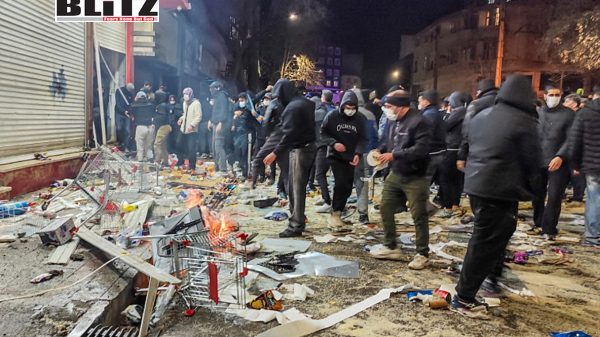
Iranian authorities are facing grave allegations that security forces demanded large payments from families in exchange for returning the bodies of protesters killed during a recent nationwide uprising, according to testimonies shared during a brief and unusual break in the country’s near-total internet blackout. The claims, emerging from inside Iran during a short window of restored connectivity, add to mounting reports of an extensive and violent crackdown on anti-government demonstrations that may have claimed thousands of lives.
The allegations surfaced after a rare disruption in Iran’s 12-day communications shutdown allowed limited access to online messaging platforms. Protesters and residents used the fleeting connection to share firsthand accounts in private group chats, describing mass casualties, intimidation of grieving families, and efforts by authorities to suppress public mourning.
“I got connected,” one participant wrote in a private chat during the brief outage, prompting another to ask how such access was possible. “I don’t know,” came the reply. Despite the uncertainty, users quickly exchanged information about what many described as the most severe unrest since the 1979 Islamic Revolution.
According to several participants, hospitals in major cities were overwhelmed with bodies following weeks of protests that began over economic grievances but rapidly evolved into a broader revolt against Iran’s clerical leadership. While such accounts cannot be independently verified due to ongoing restrictions on information, multiple sources described scenes of mass casualties and alleged that security forces used lethal force to suppress demonstrations.
The protests reportedly intensified in early January, expanding from Tehran’s Grand Bazaar-long considered a symbolic and economic center of dissent-to neighborhoods across the capital and into other provinces. What initially began as demonstrations against inflation, unemployment, corruption, and economic mismanagement reportedly transformed into open challenges to the authority of the Islamic Republic.
Iranian state-linked media have strongly rejected claims of systemic abuse. This week, the pro-government Tasnim News Agency quoted a foreign ministry spokesperson who denied widespread reports that authorities were demanding money from families to release the bodies of deceased protesters. The spokesperson described such allegations as false and part of a broader disinformation campaign.
However, individuals participating in the private group chats contradicted these official statements. One participant claimed that authorities were pressuring bereaved families to pay sums as high as 800 million tomans-equivalent to approximately $5,200-or more in exchange for retrieving the bodies of their relatives. According to this account, entire extended families were forced to pool their savings to meet the demands. Several participants also alleged that funeral services were either restricted or outright banned to prevent gatherings that could spark renewed protests.
Additional testimony provided to the Organized Crime and Corruption Reporting Project (OCCRP) described similar patterns. One individual recounted visiting a local business and discovering it had been turned into a small memorial for a young woman who had worked there. According to her family, she was killed while returning home, and authorities released her body without demanding payment after classifying her as a bystander rather than an active protester.
“Otherwise,” the source said, authorities have demanded as much as one billion tomans-roughly $7,000-in what families described as “bullet fees,” while simultaneously prohibiting any public funeral or memorial ceremony. Such allegations, if substantiated, would represent a severe violation of international human rights norms and Iranian law.
These testimonies emerged amid reports of partial restoration of internet access in some areas. NetBlocks, a London-based internet monitoring organization, confirmed that while the general blackout remained in effect, there had been a measurable increase in traffic to certain online services, including Google. NetBlocks founder Alp Toker stated on X that some users were able to access messaging platforms such as WhatsApp on the morning of January 20, though connectivity appeared to be selective and uneven, varying by region and other undisclosed factors.
The ongoing information blackout has significantly hindered efforts to independently verify the scale and nature of the crackdown. Human rights organizations have attempted to document casualties despite limited access. On January 20, the US-based Human Rights Activists News Agency (HRANA) reported 4,519 verified deaths, with an additional 9,049 cases under investigation. Meanwhile, the Norway-based group Iran Human Rights has cited broader estimates suggesting that the death toll could range from 5,000 to as many as 20,000 people.
Iran’s Supreme Leader, Ayatollah Ali Khamenei, acknowledged on January 17 that “several thousand people” had been killed but attributed the violence to what he described as “seditious” groups allegedly backed by the United States and Israel. Iranian officials have consistently framed the unrest as a foreign-backed conspiracy rather than a domestic uprising driven by economic and political grievances.
International reactions have been mixed. US President Donald Trump had repeatedly threatened military intervention in support of Iranian protesters but stated during a White House press briefing last week that “we’ve been told that the killing in Iran is stopping.” No independent confirmation of a halt in violence has been made available, and human rights groups remain skeptical of such claims.
While reports suggest that security forces have largely succeeded in suppressing large-scale street protests in some areas, activists and residents say the underlying anger remains unresolved. The combination of economic hardship, political repression, and the trauma of recent events has left many Iranians feeling deeply disillusioned.
“People here are angry, frustrated, grieving, and helpless,” one participant in the group chat wrote during the brief moment of connectivity. “Even if the streets are quiet, nothing has been solved.”
As Iran’s communications blackout continues, the full extent of the crackdown-and the veracity of allegations regarding extortion and abuse-remains difficult to establish. What is clear, however, is that the rare voices that briefly broke through the silence describe a society under extreme strain, where grief itself has become a contested and, allegedly, monetized space.
Until access to independent reporting is restored, the international community will likely continue to rely on fragmented testimonies and advocacy group reports to piece together what may be one of the most significant episodes of political violence in Iran’s recent history.
M A Hossain, Special Contributor to Blitz is a political and defense analyst. He regularly writes for local and international newspapers.