India’s BRICS presidency: Navigating multipolarity amid ‘America First’ pressures

- Update Time : Thursday, January 22, 2026
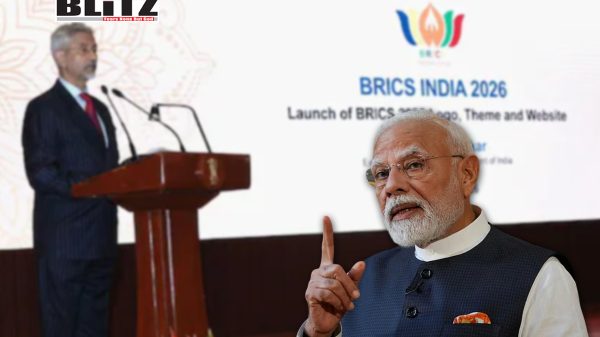
India’s assumption of the BRICS presidency on January 1, 2026, comes at a defining moment in global politics. Following its widely noted stewardship of the G20 in 2023, New Delhi now faces the challenge of guiding another influential multilateral platform through a period marked by geopolitical fragmentation, intensifying great power rivalry, and a visible erosion of faith in multilateralism. India’s leadership of BRICS unfolds against the backdrop of a renewed “America First” posture under US President Donald Trump, whose administration views BRICS not merely as a forum of emerging economies, but as a strategic challenge to US economic and institutional dominance.
This convergence of circumstances places India’s BRICS presidency at the intersection of two competing global visions: one centered on unilateralism, protectionism, and weaponization of economic instruments; the other rooted in cooperation, development, and the collective aspirations of the Global South.
The BRICS grouping-originally comprising Brazil, Russia, India, China, and South Africa-was conceived as a platform to amplify the voice of major emerging economies within global governance. Over the years, BRICS has positioned itself as an advocate of multipolarity and reform rather than rejection of the existing international order. However, the global environment in 2026 is far more volatile than when BRICS was first established.
Multilateralism is increasingly under strain. Universal, rules-based cooperation has given way to selective, interest-driven alignments. Sanctions, tariffs, export controls, and restrictions on technology and critical minerals have become tools of statecraft rather than last-resort measures. In this context, BRICS must redefine its relevance while managing the complexities arising from its recent expansion.
India’s presidency therefore represents both an opportunity and a test: an opportunity to reassert the developmental and cooperative ethos of BRICS, and a test of whether the bloc can maintain coherence and effectiveness amid internal diversity and external pressure.
India has articulated its 2026 BRICS agenda under the theme “Building Resilience and Innovation for Cooperation and Sustainability.” This reflects continuity with the people-centric, “humanity first” approach India advanced during its G20 presidency. Rather than framing BRICS as a counter-bloc to the West, India seeks to position it as a constructive force for global problem-solving, particularly from the perspective of developing countries.
A central priority for New Delhi is opposing unilateral actions that weaponize trade, technology, and supply chains. India’s stance is not one of confrontation, but of principle: global economic governance must remain predictable, inclusive, and rules-based. The selective use of tariffs, sanctions, and financial restrictions undermines trust in international institutions and disproportionately harms the Global South.
Importantly, India continues to advocate reform of global governance institutions rather than their abandonment. This approach distinguishes New Delhi from both outright revisionist powers and those content with the status quo. Reforming institutions such as the United Nations Security Council, the World Bank, and the International Monetary Fund remains central to India’s diplomatic narrative within BRICS.
Climate change is expected to feature prominently during India’s BRICS presidency. New Delhi’s approach is grounded in climate justice, emphasizing historical responsibility, equity, and differentiated capabilities. Rather than focusing narrowly on emission targets, India seeks to reframe climate governance around development-centered climate action.
This perspective underscores the need for a just and fair energy transition that does not constrain the growth prospects of developing economies. Strengthening climate finance for the Global South is a key demand, as is greater access to technology and capacity-building support. India’s bid to host COP33 in 2028-backed by BRICS partners-signals its intent to play a leadership role in shaping global climate discourse.
Through BRICS, India aims to consolidate a collective Global South position on climate issues, ensuring that sustainability agendas do not become instruments of economic coercion or barriers to development.
Terrorism is another issue likely to gain prominence during India’s presidency, although expectations remain limited. Historically, BRICS engagement on terrorism has been broad and declaratory. Under India’s past leadership, efforts were made to frame terrorism as a shared threat requiring collective action.
However, internal divergences-particularly China’s consistent shielding of Pakistan from international scrutiny-mean that tangible outcomes for India are unlikely. At best, BRICS can serve as a norm-setting and signaling platform, reinforcing the principle that terrorism in all its forms must be condemned and addressed collectively.
While modest, this role still holds value, especially in shaping discourse and reinforcing global norms against extremism.
Since 2023, BRICS has undergone significant expansion, welcoming new members including Iran, Egypt, Ethiopia, the United Arab Emirates, and Indonesia. While expansion enhances BRICS’ geographic reach and economic weight, it also raises concerns about efficiency, cohesion, and identity.
India supports BRICS expansion based on consensus and inclusivity, but remains cautious about its implications. New Delhi has emphasized that expansion should not be driven by narrow geopolitical calculations or result in the dilution of BRICS’ core identity as an economic and Global South-oriented platform.
During its presidency, India will be tasked with harmonizing the interests of both old and new members, ensuring that BRICS remains functional, credible, and purpose-driven in the post-expansion phase.
The most formidable external challenge to BRICS in 2026 emanates from the United States under President Trump. Unlike previous administrations that viewed BRICS with cautious ambivalence, Trump has openly framed the grouping as a threat to US interests, particularly to the dominance of the US dollar. His threats to impose 100 percent tariffs on BRICS countries underscore the confrontational tenor of Washington’s approach.
Compounding this challenge is the fact that the US will hold the G20 presidency in 2026. After four consecutive G20 summits led by Global South countries, there is concern that the agenda will shift away from development, climate, and inequality toward narrower “America First” priorities. Issues central to the Global South already appear marginalized in the US G20 discourse.
This sets the stage for a subtle but significant competition between an India-led BRICS and a US-led G20 in agenda-setting and narrative framing. India’s task will be to ensure that Global South priorities remain visible and influential in global governance debates.
In response to potential US tariffs and economic coercion, BRICS offers a platform for coordinated action. Member states could explore increasing intra-BRICS trade, promoting trade in local currencies, reconfiguring supply chains, and reducing barriers within the bloc. While these measures are unlikely to fully offset dependence on Western markets, they can enhance resilience and strategic autonomy.
For India, such initiatives align with its broader foreign policy goals: supporting rules-based trade, preserving strategic autonomy, and facilitating the emergence of a multipolar economic order.
Ultimately, India’s BRICS presidency in 2026 is about normative leadership. New Delhi seeks to demonstrate that leadership does not require hegemony or confrontation, but consensus-building, inclusivity, and a commitment to the common good. Drawing on its G20 experience, India will aim to balance diverse interests while keeping development and equity at the center of the BRICS agenda.
In an era marked by unilateralism and institutional erosion, India’s stewardship of BRICS offers an alternative vision-one rooted in cooperation, reform, and the collective aspirations of the Global South. Whether BRICS can translate this vision into tangible outcomes remains uncertain, but India’s presidency will be pivotal in shaping the bloc’s trajectory in a rapidly changing world.
Tajul Islam is a Special Correspondent of Blitz. He also is Local Producer of Al Jazeera Arabic channel.