Global economy under strain as Middle East ceasefire fails to ease energy shock

- Update Time : Tuesday, April 14, 2026

The easing of tensions in the Middle East has offered the world a moment to exhale-but not to relax. The fragile ceasefire involving the United States, Israel, and Iran may have reduced the immediate risk of escalation, yet it has done little to repair the deeper fractures now running through the global economy. Markets remain uneasy, policymakers cautious, and households increasingly burdened. The reality is stark: even if the guns fall silent, the economic consequences of this crisis are only beginning to unfold.
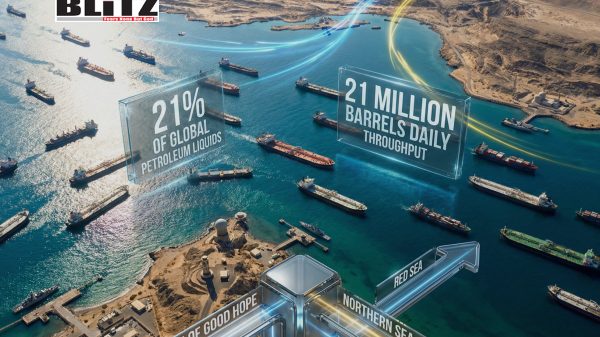
At the center of this unfolding stress lies the global energy system, once again exposed as both indispensable and dangerously vulnerable. The warning from the International Energy Agency-describing the current moment as the “greatest global energy security challenge in history”-captures the scale of the disruption. This is not merely a temporary supply shock. It is a systemic test of how resilient the modern global economy truly is when one of its most critical arteries is threatened.
That artery, of course, is the Strait of Hormuz. Responsible for a substantial share of global oil shipments, its vulnerability has once again become a central risk factor. Even partial disruptions or credible threats of closure are enough to send markets into turmoil. The recent surge in oil prices—from around $62 per barrel to nearly $100 in a matter of weeks-reflects not just supply constraints, but fear. And fear, in financial markets, is often more destabilizing than reality.
What makes this episode particularly troubling is that it comes at a time when the global economy was already navigating a fragile recovery. Prior to the February escalation, economic conditions were relatively stable. Inflation was moderating in several major economies, and central banks were preparing for a gradual easing of monetary policy. That trajectory has now been abruptly interrupted.
History offers a clear warning about what happens next. Energy shocks have repeatedly acted as accelerants for inflation and triggers for recession. In the run-up to the Global Financial Crisis, oil prices surged dramatically, feeding into broader price increases and weakening economic momentum. The pattern repeated during the early 2010s and again around the Russian invasion of Ukraine, when energy costs helped drive inflation to multi-decade highs.
The mechanism is straightforward but powerful. Higher oil prices increase transportation and production costs across virtually every sector. These costs are passed on to consumers, driving up the consumer price index. At the same time, higher prices erode purchasing power, dampening demand and slowing growth. The result is a dangerous feedback loop-one that can easily tip economies into stagflation.
That risk is now front and center. The combination of rising prices and weakening economic activity is already visible in several regions. And unlike a typical recession, stagflation presents policymakers with a particularly difficult dilemma. Lowering interest rates to support growth risks fueling further inflation, while tightening policy to control prices risks deepening the slowdown.
This dilemma is evident in the recent actions of major central banks. The Federal Reserve, the European Central Bank, and the Bank of England have all opted to hold interest rates steady, despite earlier expectations of cuts. This pause reflects not confidence, but constraint. Policymakers are effectively signaling that they have limited room to maneuver in the face of persistent inflationary pressure.
Markets have taken note. Expectations for rate cuts have been scaled back sharply, and in some cases reversed. In Europe, investors are even pricing in the possibility of rate hikes in the coming years. This shift has significant implications-not just for borrowing costs, but for investment, housing markets, and broader economic sentiment.
Efforts to stabilize the situation through supply-side measures have so far yielded limited results. The coordinated release of 400 million barrels of oil from strategic reserves, led by the International Energy Agency, was unprecedented in scale. Yet it has failed to produce a sustained decline in prices. This suggests that the current crisis is not simply about short-term supply shortages, but about deeper structural and geopolitical uncertainties that cannot be easily offset.
Adding to these uncertainties is the strategic posture of Iran. Facing what it perceives as an existential threat, Tehran has indicated a willingness to escalate economic pressure by targeting global energy markets. Its stated intention to push oil prices as high as $200 per barrel-while not yet realized-has nonetheless injected significant volatility into the system. Markets do not require certainty to react; the mere possibility of such an outcome is enough to drive precautionary behavior.
Forecasts from institutions such as Oxford Economics and BlackRock highlight how precarious the situation has become. Both point to oil price thresholds-around $140 to $150 per barrel-that could trigger a global recession if sustained. While current prices remain below these levels, the margin for error is shrinking.
The consequences of this economic strain are not confined to balance sheets and policy statements. They are increasingly visible in the political sphere. Rising living costs, driven in large part by energy prices, are placing governments under intense pressure. For many voters, the abstract dynamics of global energy markets translate into very real concerns about household budgets, job security, and economic stability.
This is particularly significant in the context of upcoming elections. In the United States, economic conditions are likely to play a decisive role in shaping the outcome of the midterms. President Donald Trump’s assertion that the economic costs of Middle East tensions are “a very small price to pay” may resonate with some, but it risks alienating voters who are already feeling the strain. In democracies, economic pain has a way of reshaping political landscapes-often rapidly and unpredictably.
Beyond advanced economies, the impact is even more severe. Developing countries, many of which are heavily dependent on energy imports, face a particularly acute challenge. Higher oil prices translate into increased import bills, weaker currencies, and rising debt burdens. With limited fiscal space and constrained access to capital, these economies are far less equipped to absorb prolonged shocks. The result can be a cascade of crises-economic, social, and political.
The International Monetary Fund and the World Bank, meeting this week, will undoubtedly focus on these vulnerabilities. But their tools-financial assistance, policy advice, and technical support-can only go so far. They cannot stabilize oil prices or resolve geopolitical conflicts. At best, they can help countries navigate the fallout.
What, then, would a genuine resolution look like? A durable peace agreement in the Middle East would certainly help restore confidence and reduce risk premiums in energy markets. Ensuring the uninterrupted flow of oil through the Strait of Hormuz would remove one of the most significant sources of uncertainty. But even under such an optimistic scenario, the global economy would not simply revert to its pre-crisis state.
The shock has already altered expectations and behavior. Businesses are recalibrating supply chains and investment strategies. Governments are reassessing energy security and accelerating diversification efforts. Investors are demanding higher returns to compensate for increased risk. These adjustments, while necessary, introduce friction and slow the pace of recovery.
In this sense, the ceasefire is less a solution than a pause-a temporary suspension of immediate danger that leaves underlying tensions unresolved. The global economy, meanwhile, continues to operate under a cloud of uncertainty, its resilience tested by forces beyond the reach of traditional policy tools.
The lesson is clear. Geopolitical stability is not a peripheral concern for the global economy; it is a foundational requirement. Without it, even the most robust economic frameworks can falter. The current crisis serves as a powerful reminder that in an interconnected world, shocks do not remain contained. They spread, amplify, and endure.
For now, the world may have stepped back from the brink of conflict. But economically, it remains dangerously close to the edge.
Suraiyya Aziz specializes on topics related to the Middle East and the Arab world.