Middle East conflict raises global inflation risks, IMF chief warns

- Update Time : Tuesday, March 10, 2026
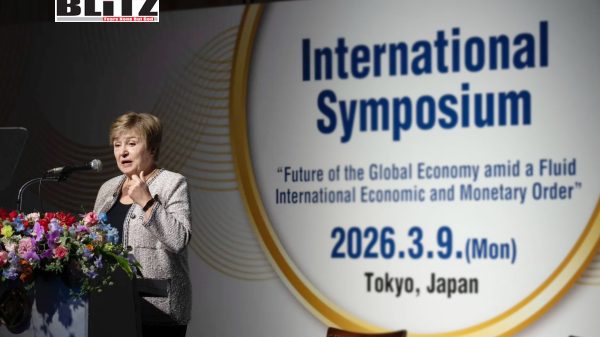
The escalating conflict in the Middle East could trigger a new wave of global inflation if energy prices continue to rise, International Monetary Fund (IMF) Managing Director Kristalina Georgieva warned on March 9. Her remarks highlight growing concerns among policymakers and economists that geopolitical instability in one of the world’s most energy-rich regions may undermine fragile economic stability and reignite inflationary pressures that many countries have spent the past two years trying to control.
Speaking at a symposium hosted by Japan’s finance ministry, Georgieva said the latest conflict represents another major test for the global economy, which has only recently begun to stabilize after the shocks of the COVID-19 pandemic, supply chain disruptions, and previous energy price spikes.
“We are seeing resilience tested again by the new conflict in the Middle East,” Georgieva said, noting that the economic consequences could extend far beyond the region itself. She warned that rising oil prices could feed directly into global inflation if the increases persist for a prolonged period.
According to the IMF’s assessment, a sustained rise in oil prices could have measurable consequences for inflation worldwide. Georgieva explained that if oil prices increase by around 10 percent and remain elevated for most of the year, global inflation could rise by approximately 40 basis points. While that figure may appear modest, economists note that even a small increase in inflation can complicate monetary policy decisions and slow economic recovery efforts.
Energy costs play a central role in the global inflation dynamic. Oil is not only used as fuel for transportation but also as a critical input in manufacturing, agriculture, shipping, and chemical production. When oil prices increase, the higher costs typically ripple across the entire economy. Businesses facing higher energy bills often pass those costs on to consumers, which drives up prices for a wide range of goods and services.
The Middle East accounts for a significant share of global oil production and export capacity, making the region particularly influential in global energy markets. Any conflict that threatens energy infrastructure, shipping routes, or regional stability can quickly disrupt supply and push prices upward. Investors and energy traders often respond immediately to such risks, causing volatility in global oil markets even before actual supply disruptions occur.
Recent tensions have already triggered noticeable reactions in energy markets. Oil prices surged sharply as traders priced in the possibility of supply disruptions and expanded regional instability. Analysts say that if the conflict spreads further or leads to attacks on key energy infrastructure, the impact on global energy prices could become more severe.
For governments and central banks around the world, the prospect of rising energy-driven inflation presents a difficult policy challenge. Many countries have spent the past several years raising interest rates in order to bring down inflation that surged during the pandemic recovery period. Those efforts had begun to show results in many economies, with inflation gradually easing in late 2024 and 2025.
However, a renewed spike in oil prices could reverse some of that progress. Higher inflation could force central banks to delay planned interest rate cuts or even tighten monetary policy again. Such moves could slow economic growth and increase borrowing costs for businesses and households.
Georgieva emphasized that policymakers must prepare for unexpected economic shocks in a world increasingly shaped by geopolitical tensions, climate risks, and financial uncertainties.
“My advice to policymakers in this new global environment is think of the unthinkable and prepare for it,” she said.
Her warning reflects a broader shift in economic thinking. In recent years, institutions such as the IMF, World Bank, and major central banks have increasingly stressed the importance of resilience and risk preparedness. The global economy has faced multiple overlapping crises-from pandemics and wars to energy shocks and climate disasters-demonstrating how quickly conditions can change.
Economists say that the current Middle East conflict could affect not only inflation but also global trade and investment patterns. Higher energy costs could slow industrial production in energy-importing countries and place additional pressure on developing economies that already struggle with high debt levels and currency volatility.
For many emerging markets, energy imports represent a significant portion of national expenditures. When oil prices rise, governments must either increase subsidies to protect consumers or allow domestic fuel prices to rise sharply. Both options carry economic and political risks.
Higher oil prices also tend to strengthen the currencies and fiscal positions of major energy exporters while weakening those of import-dependent economies. This divergence can widen economic inequality between countries and complicate global financial stability.
Another concern raised by analysts is the potential impact on shipping routes and global supply chains. If tensions in the Middle East affect key maritime corridors, such as routes used for transporting oil and other commodities, shipping costs could rise significantly. That would further increase inflationary pressures by raising the cost of global trade.
Despite these risks, Georgieva noted that the global economy has demonstrated considerable resilience in recent years. Strong labor markets in several advanced economies and steady growth in parts of Asia have helped cushion the impact of previous shocks.
Still, she cautioned that resilience should not lead to complacency. Governments must remain vigilant and ready to respond to rapidly changing conditions.
Policy responses may include strengthening strategic energy reserves, diversifying energy sources, improving supply chain resilience, and maintaining prudent fiscal and monetary policies. Some countries have already accelerated investments in renewable energy and energy efficiency in order to reduce dependence on volatile fossil fuel markets.
The IMF has consistently encouraged nations to pursue structural reforms that enhance economic stability and growth potential. Georgieva said the current situation underscores the importance of long-term planning and international cooperation.
Global challenges, she argued, increasingly require coordinated responses among governments, international institutions, and the private sector. Whether addressing inflation, energy security, or geopolitical risk, collaboration remains essential to maintaining global economic stability.
As the Middle East conflict continues to unfold, policymakers will be closely monitoring energy markets and inflation trends. The coming months will likely determine whether the latest geopolitical shock becomes a temporary disruption or evolves into a more persistent economic challenge.
For now, Georgieva’s message to the world’s economic leaders is clear: uncertainty is becoming the defining feature of the global economy, and preparation for unexpected shocks is no longer optional-it is essential.
Sonjib Chandra Das is a Staff Correspondent of Blitz.