War and tribal power drive unregulated marble extraction in Yemen

- Update Time : Saturday, April 4, 2026
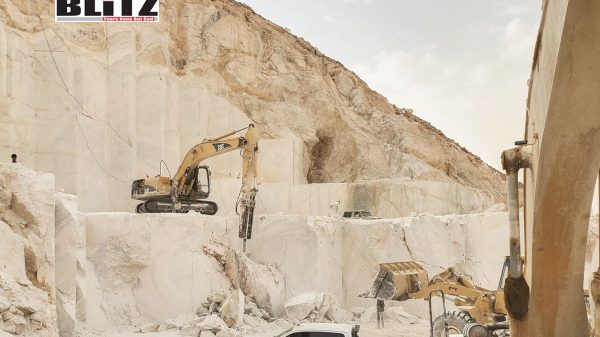
In the sun-scorched highlands of Yemen, where jagged mountain ridges stretch across vast desert plains, a quiet but deeply significant struggle is unfolding. Beneath the rocky terrain of Marib Province lies a valuable natural resource-marble-that has long supported local livelihoods and once held promise as a major contributor to national revenue. Today, however, this sector operates in a legal vacuum, shaped not by formal regulation but by tribal authority, wartime conditions, and the collapse of central governance.
More than a decade of conflict has weakened Yemen’s already fragile institutions, leaving entire industries-especially natural resource extraction-effectively unregulated. In this vacuum, tribal leaders and local war figures have stepped in, asserting control over marble quarries and creating informal economic systems that function outside state oversight. The result is a complex and often unstable environment where traditional authority, armed influence, and economic opportunity intersect.
Authority without regulation
Under Yemen’s legal framework, natural resources such as marble are considered property of the state. Mining activities require official licenses, compliance with regulations, and payment of royalties. In practice, however, these rules have become largely irrelevant in Marib.
Since the civil war began in 2014, government institutions responsible for licensing and oversight have struggled to function. Officials confirm that no formal licenses for marble extraction have been issued in the province during this period. Administrative systems have broken down, and enforcement mechanisms are nearly nonexistent.
In place of state authority, tribal customs now govern access to land and resources. Many local leaders believe that the mountains belong to their tribes by ancestral right, and therefore the materials within them are also theirs to exploit. This belief forms the foundation of a parallel system in which tribal decisions override national laws.
This conflict between traditional ownership and state regulation reflects a broader challenge in Yemen: the tension between long-standing tribal systems and modern governance structures.
The emergence of armed entrepreneurs
Within this environment, a new class of local power holders has emerged. These individuals often combine military influence with business activity, operating both as commanders and entrepreneurs. Their armed groups, originally formed for protection or participation in the conflict, now serve to secure economic interests as well.
In Marib, such figures have taken control of marble quarries, overseeing large-scale extraction operations. Workers use heavy machinery to cut and transport massive blocks of stone, while armed guards patrol the sites and surrounding areas. These operations can employ hundreds or even thousands of laborers, creating an organized but informal industry.
Despite their scale, these businesses operate largely outside legal frameworks. There is little transparency regarding how much marble is extracted, how profits are distributed, or whether any payments are made to authorities. This lack of oversight allows local leaders to accumulate wealth and influence, further strengthening their autonomy.
Economic potential undermined
The unregulated nature of the marble sector has significant economic consequences. Before the conflict, studies suggested that Yemen’s marble and granite industries had the potential to generate substantial revenue through investment and export development. Marble was seen as a valuable resource that could help diversify the economy beyond oil.
Today, that potential remains largely unrealized. While marble extraction continues, the absence of regulation means that the state receives minimal financial benefit. Taxes, licensing fees, and royalties-key sources of public income-are often unpaid or inconsistently collected.
This loss of revenue is particularly damaging in a country facing severe economic hardship. Public services are underfunded, infrastructure is deteriorating, and the government struggles to meet basic needs. The inability to manage and profit from natural resources further weakens the state’s financial position.
In addition, the lack of legal clarity and security discourages investment. Companies are reluctant to operate in an environment where property rights are uncertain and contracts cannot be enforced. Transport routes are often unsafe, and supply chains are vulnerable to disruption.
Fragmentation of governance
Yemen’s broader political division adds another layer of complexity. The country is effectively split between rival administrations, each controlling different regions and operating separate institutions. This division extends to regulatory bodies responsible for managing natural resources.
Without coordination between these authorities, national policies are difficult to implement. Licensing systems are inconsistent, and records are incomplete. Companies may operate without proper registration, or their information may exist in one system but not another.
This fragmentation makes it extremely difficult to track economic activity or ensure accountability. It also creates opportunities for individuals to exploit gaps in the system, operating in ways that would not be possible under a unified government.
Social and environmental impact
The rapid and unregulated expansion of marble quarrying has serious social and environmental consequences. Extraction methods often involve cutting and blasting, which leave visible scars on the landscape. Without regulations, there is little effort to manage waste or restore damaged areas.
Over time, this can lead to soil degradation, water pollution, and increased risk of environmental hazards. The long-term impact on local ecosystems may be severe, particularly in a region already vulnerable to harsh conditions.
Workers in the industry also face difficult circumstances. Many live in temporary housing near quarry sites, with limited access to clean water, healthcare, or other basic services. Safety standards are inconsistent, and accidents are a constant risk.
Despite these challenges, marble extraction remains an important source of income. In a country with limited economic opportunities, the industry provides jobs and supports entire communities. This creates a difficult balance between immediate economic needs and long-term sustainability.
Conflict and competition
Control over marble resources has also become a source of tension and conflict. Disputes between tribes, or between tribes and government forces, can escalate quickly, especially in a heavily armed environment.
There have been incidents where clashes were triggered by disagreements over quarry ownership or access. Such conflicts highlight the fragile relationships between different groups and the absence of effective dispute resolution mechanisms.
Economic assets like marble quarries are not just sources of income; they are also symbols of power and influence. Controlling them can strengthen a group’s position both economically and politically.
The Role of tribal systems
Tribal structures have long been central to social and political life in Yemen, particularly in rural areas. Even before the conflict, tribes played a key role in managing local affairs and resolving disputes.
The war has amplified this role. As state institutions have weakened, tribes have taken on greater responsibility for governance, security, and economic activity. In many areas, they provide the only form of order and stability.
In Marib, tribal leaders are not just local figures-they are major stakeholders whose cooperation is essential for any effort to restore regulation. Their influence is rooted in history, culture, and their role in the ongoing conflict.
Challenges for reform
Reforming the marble sector will require more than simply reintroducing laws. It will depend on broader efforts to stabilize the country and rebuild institutions.
Key challenges include restoring the capacity of regulatory bodies, improving infrastructure, and creating systems for transparency and accountability. Equally important is the need to engage with tribal leaders and find ways to integrate their authority into a formal framework.
This process will require negotiation and compromise. Any attempt to impose strict control without considering local realities is likely to fail. At the same time, leaving the system entirely unregulated is not sustainable.
A Reflection of a larger problem
The situation in Marib’s marble industry reflects the wider challenges facing Yemen. It shows how conflict can reshape economies, shift power structures, and weaken the rule of law.
In the absence of effective governance, alternative systems emerge. These systems can provide short-term stability and economic activity, but they often lack transparency and accountability. Over time, they can deepen divisions and make recovery more difficult.
For Yemen, rebuilding the state will involve addressing these complex dynamics. Managing natural resources effectively is not just about economic gain-it is a key part of restoring governance and stability.
Until that happens, the marble of Marib will continue to be extracted under the control of local power holders rather than regulated authorities. It stands as a clear example of how war can transform not only politics and society, but also the way a country’s natural wealth is controlled and used.
Suraiyya Aziz specializes on topics related to the Middle East and the Arab world.