Yunus’s privileged VVIP protocol: Power, protection, and the politics beyond the ballot

- Update Time : Wednesday, March 4, 2026
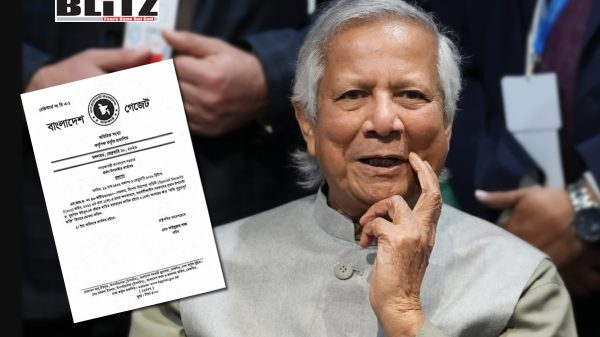
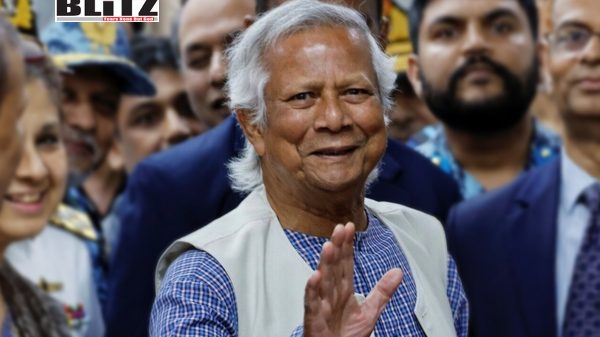
The recent decision granting Muhammad Yunus a year of VVIP security privileges—complete with multi-tiered state protection typically reserved for heads of government—raises questions that go beyond protocol. It touches on power, perception, and the fragile architecture of democratic legitimacy.
Why one year?
That is not a trivial administrative detail. Political time-frames are rarely arbitrary. When a public figure secures extraordinary state-backed privileges for a fixed period—precisely seventy-two hours before stepping down from a controversial interim role—it is fair to ask whether this is about personal safety alone or something more strategic.
Let us begin with what we know. Yunus is not a man short on resources. As the founder of Grameen Bank and a globally celebrated figure, he commands international networks, public relations machinery abroad, and access to influential policymakers in Western capitals. His stature in certain Democratic Party circles in the United States is well documented, and his reputation has long been amplified by well-connected advocacy groups.
That, in itself, is not a crime. But politics is not conducted in isolation from geopolitics.
The coming US midterm elections could shift congressional balances. Should the Democratic Party consolidate its strength, a White House already navigating domestic turbulence might find itself constrained or emboldened in foreign policy recalibrations. Bangladesh, strategically positioned between South and Southeast Asia and increasingly relevant in Indo-Pacific conversations, could become a pressure point.
This is where speculation begins—but it is not irrational speculation.
If a future US Congress leans in a direction sympathetic to Yunus, and if powerful transnational actors amplify concerns about governance or trade policy in Dhaka, a newly elected Bangladeshi government could find itself squeezed. Trade negotiations, aid frameworks, human rights reporting—each can become leverage in the hands of determined advocates.
Critics argue that an “unequal trade agreement” with Washington could place Bangladesh in a bind: accept unfavorable terms and face domestic backlash, or resist and risk economic retaliation. In such a scenario, a politically agile international figure with deep Western ties might exert indirect influence—through lobbying, media narratives, or diplomatic channels.
Is that a conspiracy theory? Perhaps. But history shows that influence campaigns rarely announce themselves with banners. They move through institutions, think tanks, and editorial boards.
Consider Latin America in the 1970s, Eastern Europe in the 1990s, or more recently, parts of Africa where external pressure reshaped domestic political outcomes. None of those cases were identical to Bangladesh. Yet each illustrates how domestic fragility invites international intervention—sometimes subtle, sometimes overt.
The deeper concern is not whether Yunus will stage some dramatic seizure of power. Bangladesh is not a banana republic, and its institutions—though imperfect—are sturdier than alarmists admit. The concern is whether prolonged VVIP protection, state-funded at significant expense, symbolically elevates one individual above the democratic field.
Security conveys status. Status conveys legitimacy. Legitimacy, over time, shapes political reality.
If a former interim adviser retains head-of-government-level protection for a year, what message does that send? That he remains indispensable? That he remains a parallel authority? That he remains a potential alternative?
Democracies falter not only when ballots are stolen, but when the aura of inevitability begins to surround unelected actors.
There is also a psychological dimension. Yunus once resisted relinquishing his position at Grameen Bank, a battle that became as much about symbolism as about administration. For a man who has tasted the prestige of global platforms—Davos, Washington, European capitals—the experience of wielding executive authority for eighteen months may not be easily forgotten.
Power, even temporary power, leaves a residue.
The Awami League government, critics say, dismissed early warnings about the rise of an alternative power center. Excessive confidence can blind incumbents to gathering storms. Now the responsibility shifts to the BNP-led administration. Vigilance need not become paranoia—but complacency would be equally reckless.
It is not anti-democratic to question extraordinary privileges. It is democratic.
If Yunus requires security due to credible threats, let the state provide it transparently and proportionately. But why the maximum tier? Why the fixed one-year horizon? Why the haste before departure?
The government owes citizens clarity.
This is not about personal animus. Yunus’s contributions to microfinance and poverty alleviation are globally recognized. But governance is not philanthropy. A Nobel Prize does not confer political immunity. Nor does global acclaim exempt one from scrutiny at home.
Bangladesh stands at an inflection point. Economic headwinds, shifting global alliances, and internal polarization create fertile ground for manipulation—by domestic actors or foreign patrons. In such moments, democratic governments must guard not only borders but narratives.
The specter of blackmail, as some fear, may be exaggerated. Yet leverage in international politics is rarely theatrical. It manifests in delayed trade concessions, targeted sanctions, amplified reports, or coordinated diplomatic pressure. If an influential Bangladeshi figure abroad were positioned to catalyze such pressures, intentionally or otherwise, the implications would be serious.
Still, we must resist the temptation to demonize. Labeling Yunus a “global swindler” or imputing elaborate revolutionary plots without evidence weakens the credibility of legitimate concerns. Democratic societies are best served by sober analysis, not inflammatory rhetoric.
The real issue is institutional integrity.
Bangladesh must ensure that no individual—however decorated—occupies a gray zone between private citizen and parallel sovereign. VVIP privileges are not ceremonial; they are signals of state hierarchy. If extended beyond necessity, they blur lines of authority.
One year can be an eternity in politics. Elections abroad, economic negotiations at home, cabinet reshuffles, constitutional debates—each could reshape the national landscape. The question is whether the state has inadvertently endowed one actor with a platform from which to influence that reshaping disproportionately.
Skeptics will argue that these fears are overstated. That Bangladesh’s voters, not Washington lobbyists, determine its destiny. That Yunus’s international networks are more symbolic than coercive. They may be right.
But democracies err when they ignore asymmetries of influence.
The prudent course for the BNP government is not repression, nor vindictiveness, but calibrated oversight. Audit the necessity of the security arrangements. Clarify their scope. Ensure they are temporary, proportionate, and legally grounded. Most importantly, reaffirm that authority flows from ballots, not from banquet halls abroad.
Bangladesh has endured coups, caretaker governments, constitutional crises, and bitter partisan divides. It has also demonstrated resilience. The electorate has shown time and again that it values sovereignty—both national and democratic.
No individual, however internationally celebrated, should stand above that principle.
If Yunus intends merely to remain in the country under enhanced protection, let that protection be justified transparently. If he harbors broader political ambitions, he should pursue them through open electoral competition, not through cultivated leverage abroad.
Ultimately, this moment is less about one man and more about the maturity of the republic. Will Bangladesh treat global acclaim as a substitute for domestic accountability? Or will it insist that every actor—Nobel laureate or novice—operate within the same democratic framework?
History offers ample warning. When extraordinary privileges become normalized, institutions erode quietly. And when institutions erode, nations discover—too late—that personality has replaced principle. Bangladesh cannot afford that substitution.
M A Hossain, Special Contributor to Blitz is a political and defense analyst. He regularly writes for local and international newspapers.