The Green wave hits Westminster – and the establishment is already fighting back

- Update Time : Sunday, March 1, 2026
“First they ignore you. Then they ridicule you. Then they attack you and want to burn you. Then they build monuments to you.” These words, spoken more than a century ago by trade union organiser Nicholas Klein at a Baltimore garment workers’ conference, seem to capture perfectly the political moment facing the Green Party in the United Kingdom today. After years of relative obscurity, the Greens are moving from the “ignored” to the “ridiculed” phase-and the next stage, Klein warned, is always the hardest.
For much of the last decade, the Green Party existed on the margins of British politics, often dismissed as idealistic but ultimately inconsequential. Even when their policies addressed issues that mattered to ordinary people-climate change, social inequality, affordable housing-the mainstream media either ignored them or treated them as a political curiosity. The election of Zack Polanski as the party’s first “eco-populist” MP last year signaled a shift, yet the early attacks on him were largely flippant, focusing on an article from over a decade ago in which he was reported to offer a hypnotherapy service to enlarge women’s breasts.
But with the Green Party’s recent stunning victory in the Gorton and Denton by-election, the tenor of attacks has changed. This is no longer a fringe party to be laughed at; this is a political force that threatens the carefully constructed settlement maintained by Britain’s political elite, a system where ordinary families struggle while the profits of their labour flow ever upward into the hands of the already wealthy. The establishment-spanning Labour, the Conservatives, and even Nigel Farage’s Reform-suddenly has a reason to be concerned.
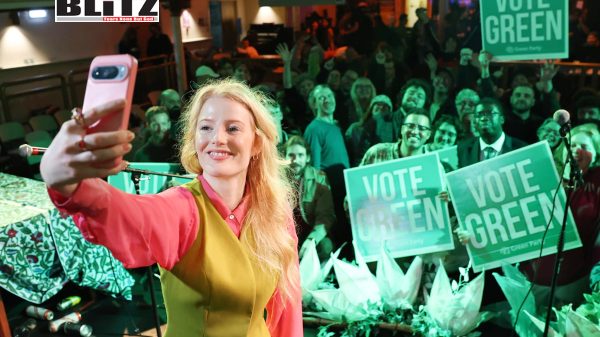
The by-election victory saw Hannah Spencer, the Green Party’s fifth and newest MP, take the Gorton and Denton seat from Labour. Spencer is Parliament’s only plumber and plasterer, an embodiment of the working-class perspective that has been largely absent in Westminster for decades. Her win has already been described in some quarters as a “watershed moment in British politics” and a “death knell for Labour’s status as the pre-eminent party of the left.”
Speaking shortly after her victory, Spencer articulated a message that resonated with thousands of voters who feel left behind by the current economic and political system. “Talk to anyone here and they will tell you,” she said. “[Talk to] the people who work hard but can’t put food on the table, can’t get their kids school uniforms, can’t put their heating on. Can’t live off the pension they’ve worked hard to save for. Can’t even begin to dream about ever having a holiday, ever. Because life has changed. Instead of working for a nice life, we’re working to line the pockets of billionaires. We are being bled dry, and I don’t think it’s extreme or radical to think working hard should get you a nice life.”
On the ground, the excitement among Green Party activists was palpable. Many of them came of age politically during the Jeremy Corbyn years, learning the joys and bitter lessons of grassroots mobilization and media hostility. A Green Party staffer I spoke to after the by-election remarked: “It really does feel like 2017. Anything feels possible. Which means that just like in 2017, the attacks are going to get 10 times nastier, dishonest, and relentless.” Optimism exists, yes, but so does the recognition that the next phase will be far more brutal.
The warning signs were already visible even before the Gorton and Denton victory. Sarah Vine, writing in the Daily Mail the day before the election, described Polanski as “the biggest creep in British politics.” She later compared him on X (formerly Twitter) to Adolf Hitler while referencing his post about the Israeli genocide in Gaza, implying that Polanski’s leadership was divisive and hateful. The Telegraph ran pieces claiming Polanski’s Green Party “lures Britain’s youth” and accused him of exposing the party to scrutiny over its stance on complex issues like Zionism.
This level of attack is part of a broader, well-rehearsed playbook. When Jeremy Corbyn was elected leader of Labour in 2015, the British press initially treated him as a harmless eccentric, someone who could be laughed off the political stage. But after the 2017 election, when Corbyn’s anti-austerity, pro-nationalization platform nearly secured power, the establishment changed tactics. The attacks became venomous, relentless, and highly coordinated, aimed at crushing both the man and the movement. The Greens, by proving they can win seats, have entered that same arena of high-stakes political conflict.
Even the campaign itself in Gorton and Denton was not free from dirty tactics. Labour reportedly deployed racist briefings and fake tactical voting websites to try and derail the Greens’ momentum. But these maneuvers will pale in comparison to the media scrutiny, political maneuvering, and corporate interference the party is likely to face as it begins to pose a credible challenge to entrenched power structures.
Yet, despite the hostility, there is reason for hope. Victory-especially a victory as symbolically resonant as this one-is powerful. For the first time in recent memory, the British left has seen a result that feels genuinely transformational. The Green Party’s platform, like Corbyn’s Labour before it, seeks to shift power back toward the majority. It is a politics grounded in fairness: the belief that working hard should not simply line the pockets of billionaires, but should provide ordinary people with dignity, security, and the ability to dream.
The stakes are high, and the establishment will not relent easily. Every achievement, every seat won, will be challenged aggressively, both in the press and in the corridors of power. But the Greens have already demonstrated that they can fight and win under pressure. By bloodying the noses of both Labour and Reform in a single night, they have proven their capacity to disrupt the status quo.
For those who have spent years watching Westminster from the sidelines, the Green Party’s rise is a reminder that politics is not immutable. Change is possible. The people who feel ignored, ridiculed, and attacked by the existing system may finally have a party that represents them in a Parliament that has long been out of touch with ordinary life. The establishment, predictably, will do everything in its power to push back. But the momentum is now with the Greens, and the echoes of this victory may resonate far beyond Greater Manchester.
This is the moment when the Green Party must consolidate its gains, amplify its message, and prepare for the battles to come. If Klein’s century-old formulation holds true, the attacks will escalate-but so too will the recognition of the party’s legitimacy and the inevitability of its place in modern British politics. The fight has begun, and while monuments may still be decades away, the Greens’ victory in Gorton and Denton has already marked the start of something significant: a challenge to the entrenched power of the elite, a fight for fairness, and a spark of hope for the many who have been long ignored.
Victory is never guaranteed, but if this result signals anything, it is that the Green Party is no longer a political afterthought. They are a force to be reckoned with-and the establishment, as history has shown, will respond with all its fury.
The question now is simple: can the Greens endure, and can they continue to turn momentum into meaningful change for the people they represent? If Hannah Spencer and Zack Polanski are any indication, the answer may very well be yes.
Abul Quashem Joarder, a contributor to Blitz is geopolitical and military expert.