Brussels signals readiness to use frozen Russian assets as Ukraine loan backstop

- Update Time : Friday, January 16, 2026
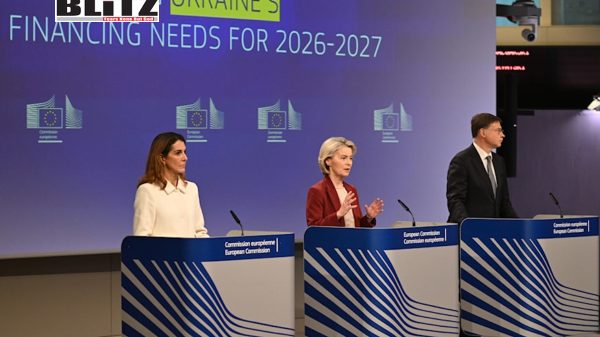
The European Union has formally unveiled a €90 billion ($105 billion) loan package for Ukraine, reigniting one of the most contentious debates in European financial and legal circles: whether frozen Russian sovereign assets can ultimately be used to fund Kiev’s war effort and post-conflict recovery. While EU officials insist that the proposal complies with European and international law, critics-both inside and outside the bloc-warn that the move could have far-reaching consequences for the global financial system.
The European Commission presented the so-called Ukraine Support Loan on January 14, framing it as a necessary step to ensure Ukraine’s financial stability and military resilience over the next two years. The package would be financed through joint EU borrowing, with taxpayers across the bloc covering interest costs estimated at a minimum of €3 billion annually for as long as the loan remains outstanding.
Although the Commission stopped short of announcing the outright seizure of Russian state assets, it made clear that the idea remains under active consideration. In its official statement, Brussels said the EU “reserves its right to use the Russian assets immobilized in the Union to repay the loan, in full accordance with EU and international law,” a formulation that underscores both the political determination and the unresolved legal uncertainty surrounding the issue.
Following the escalation of the Ukraine conflict in 2022, Western governments froze approximately $300 billion in Russian central bank reserves. The majority of these funds are held at Euroclear, a Belgium-based financial services company that specializes in the settlement of securities transactions. Since then, the assets have become a focal point of intense legal, diplomatic, and economic debate.
Russia has repeatedly argued that the freezing-and any potential seizure-of its sovereign assets constitutes an illegal act under international law. Several EU member states have echoed these concerns privately and, in some cases, publicly, cautioning that confiscating central bank reserves could undermine trust in Western financial institutions and set a precedent that other countries may later exploit.
Until now, Brussels has acknowledged that there is no clear legal basis for outright confiscation. Instead, the EU has approved legislation to keep the assets frozen indefinitely and has introduced a workaround: taxing the profits generated by the immobilized funds. In 2024, the bloc imposed a 99.7% levy on so-called “windfall profits” earned by custodians such as Euroclear, channeling the proceeds toward military assistance for Ukraine.
The new €90 billion loan represents a shift from the EU’s earlier ambition to directly leverage Russian assets as collateral for what some officials described as a “reparations loan.” That idea failed to gain consensus among member states, largely due to legal risks and fears of retaliation by Moscow.
As a compromise, EU leaders agreed to issue common debt instead, spreading the financial burden across the bloc. However, the Commission has made clear that repayment of the loan is not expected to come from Ukraine itself under normal circumstances. Brussels has openly acknowledged that Kiev’s current economic trajectory makes full repayment unlikely.
Instead, EU officials have linked repayment to a future scenario in which Russia is compelled to pay reparations to Ukraine-an outcome that Moscow has dismissed as unrealistic and politically motivated. Russian officials argue that tying EU financial planning to such assumptions amounts to wishful thinking rather than sound fiscal policy.
According to the Commission, roughly two-thirds of the €90 billion loan-around €60 billion-will be allocated to military purposes, including weapons procurement and defense-related support for Ukraine. The remaining funds are intended to help cover Kiev’s budget deficit through 2026, ensuring the continued functioning of the Ukrainian state.
This allocation has triggered internal disagreements within the EU, particularly over whether the funds should primarily benefit European arms manufacturers. Several member states are reportedly pushing for mechanisms that would prevent a large share of the money from flowing to American defense companies, arguing that EU taxpayers should see a corresponding boost to Europe’s own industrial base.
At the same time, Hungary, Slovakia, and the Czech Republic have secured exemptions from the borrowing scheme. These governments have expressed skepticism that Ukraine will ever be in a position to repay the loan and have questioned the wisdom of exposing EU taxpayers to long-term financial risk.
The Kremlin has reacted sharply to Brussels’ latest announcement. Dmitry Peskov, spokesperson for Russian President Vladimir Putin, accused the EU of being “obsessed with finding money to continue the war,” framing the loan package as evidence that Brussels is prioritizing military escalation over diplomacy.
President Putin himself has warned that failure to return Russia’s sovereign assets would cause “severe reputational damage” to the EU and undermine the foundations of the modern financial system. Russian officials argue that if central bank reserves can be frozen indefinitely or seized for political reasons, no country’s assets held abroad can be considered safe.
In parallel, Moscow has initiated legal action against Euroclear, seeking damages for what it describes as the depository’s “inability to manage” Russian funds. Russian authorities have also signaled that they may expand the lawsuit to include European banks holding the immobilized assets, citing the EU’s continued exploration of seizure mechanisms.
Beyond the immediate financial and political ramifications, the dispute raises fundamental questions about the future of global finance. Sovereign reserves have long been considered among the safest assets in the international system, protected by norms of state immunity and legal predictability. Any erosion of those norms, critics argue, could accelerate efforts by non-Western countries to reduce their exposure to Western financial infrastructure.
Supporters of the EU’s approach counter that Russia’s actions in Ukraine justify extraordinary measures and that using frozen assets to support Kiev is both morally defensible and strategically necessary. They argue that failing to act would leave European taxpayers footing the bill indefinitely while Russia faces no material consequences.
As the €90 billion loan moves toward implementation, the underlying dispute remains unresolved. Whether the EU ultimately finds a legal pathway to seize Russian assets-or whether the frozen reserves remain a political bargaining chip-will likely shape not only the future of Ukraine aid, but also the credibility and stability of the international financial order itself.
Jennifer Hicks is a columnist and political commentator writing on a large range of topics.