Neighbors, narratives, and the India question

- Update Time : Saturday, December 27, 2025
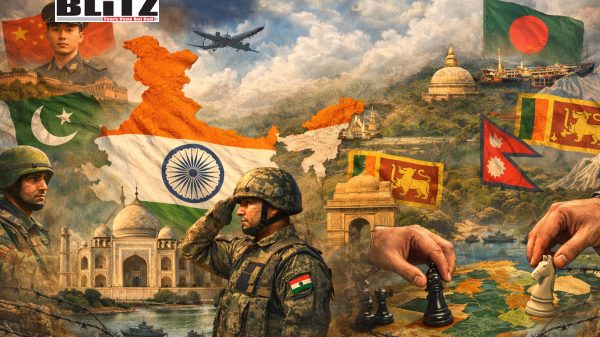
In Bangladesh, anti-India sentiment frequently spills into mainstream political discourse, often during moments of internal stress – writes Dr. Syed Esrar Mehdi
India’s place in South Asia is shaped as much by perception as by policy. Across the region, New Delhi is often discussed not through the lens of trade figures, connectivity projects, or diplomatic agreements, but through domestic political storytelling. In some countries, India is framed as a partner—imperfect, powerful, but necessary. In others, it becomes a convenient villain, blamed for problems that are largely homegrown. The contrast between Bangladesh and Nepal captures this dynamic sharply. Both are close neighbors of India. Both have experienced friction, disagreements, and moments of mistrust. Yet their political cultures treat India very differently. In Bangladesh, anti-India sentiment frequently spills into mainstream political discourse, often during moments of internal stress. In Nepal, criticism of India exists, sometimes forcefully, but it rarely dominates national identity or substitutes for debates about governance. This difference has less to do with India’s actions—which are broadly consistent across both relationships—and far more to do with how domestic politics, ideology, and historical memory shape national narratives.
The Bangladesh paradox
On paper, India–Bangladesh relations are one of South Asia’s success stories. The two countries share a 4,000-kilometre border, deep cultural ties, and an expanding economic partnership. India is Bangladesh’s largest trading partner in South Asia, with bilateral trade hovering around USD 15–16 billion. India supplies over 1,100 megawatts of electricity to Bangladesh, easing chronic power shortages. Billions of dollars in Indian lines of credit have financed railways, bridges, ports, and energy projects. During the COVID-19 crisis, India was among the first countries to provide vaccines, medical equipment, and logistical support. Yet these facts coexist with a strikingly hostile narrative. In sections of Bangladeshi politics and media, India is portrayed as domineering, exploitative, or manipulative. Inflation rises? India is blamed. Governance falters? India is accused of interference. Political unrest erupts? India becomes the shadowy hand behind it all. This narrative persists not because it is accurate, but because it is politically useful. Bangladesh’s domestic politics are intensely polarized. Political legitimacy is often contested not through performance but through delegitimization. In this environment, branding opponents as “Indian-backed” becomes a powerful weapon. India, given its historical role in Bangladesh’s 1971 liberation and its close ties with incumbent governments, becomes an easy proxy target. Over time, this rhetoric escapes party politics and seeps into public consciousness, turning suspicion into habit.
Blaming external forces is a familiar political strategy, especially in developing democracies grappling with structural challenges. Rising prices, youth unemployment, urban congestion, and institutional weakness are complex problems. Addressing them requires reform, compromise, and accountability—none of which are politically painless. Casting India as the villain offers something easier: emotional mobilization without solutions. Radical Islamist groups have been particularly effective at exploiting this dynamic. By framing India not merely as a neighboring state but as a civilizational or religious threat, they transform policy disagreements into existential fears. India becomes “the Hindu other,” regardless of the secular or strategic nature of most bilateral issues. This framing thrives in digital ecosystems where outrage spreads faster than evidence and identity politics outperforms nuance. What makes this especially damaging is that it divorces public debate from reality. Many of Bangladesh’s challenges—global inflation, supply-chain disruptions, urban inequality—are shared by countries across Asia and Africa. Attributing them to Indian interference may be emotionally satisfying, but it does nothing to resolve them.
Nepal’s different playbook
Nepal offers a revealing counterpoint. Its relationship with India has been far from smooth. Border disputes, treaty disagreements, and perceptions of Indian heavy-handedness have triggered protests and diplomatic crises. The 2015 blockade during Nepal’s constitutional turmoil generated deep resentment and genuine anger toward India. Yet even at its worst, Nepal’s political debate largely remained anchored in policy and sovereignty, not civilizational hostility. India was criticized as a powerful neighbor pursuing its interests—not demonized as the root of Nepal’s internal failures. Political leaders argued about leverage, treaties, and diversification of foreign relations, rather than using India as a catch-all excuse for domestic shortcomings. This reflects a key difference in political culture. Nepal’s pluralistic landscape—where leftists, centrists, monarchists, and republicans compete—creates space for disagreement without requiring a permanent external enemy. India can be challenged, negotiated with, or balanced against China, without becoming a moral obsession.
Economics vs emotion
Economic data further exposes the fragility of anti-India narratives in Bangladesh. Indian exports to Bangladesh largely consist of raw materials, machinery, and intermediate goods—inputs that support Bangladesh’s manufacturing base, particularly its garment industry. These imports lower production costs and improve supply-chain resilience. Bangladesh’s exports to India, while smaller, have crossed USD 2 billion and are steadily diversifying. Connectivity projects—rail links, inland waterways, road corridors—have reduced logistics costs and expanded regional trade. These are the building blocks of economic integration, not exploitation. Yet numbers rarely compete well with narratives. Emotional stories of domination spread faster than charts about trade balances. Nepal, despite similar asymmetries, has been more willing to separate economic pragmatism from political posturing. Criticism of India does not automatically translate into rejecting cooperation. This distinction matters. South Asia remains one of the least economically integrated regions globally, with intra-regional trade stuck at around 5 percent. Narrative-driven mistrust is a major reason why.
History also shapes perception. India’s role in Bangladesh’s liberation is both foundational and contested. For many, it represents solidarity and sacrifice. For others, it is reframed as the beginning of dependency or compromised sovereignty. This selective memory serves present-day political needs more than historical truth. Nepal, which did not emerge from a similar wartime relationship with India, does not carry this psychological baggage. Its engagement with India is more transactional, less emotional, and therefore easier to recalibrate when interests shift.
Narratives Have Consequences
The cost of sustained hostility is real. It affects investor confidence, slows regional connectivity, and weakens cooperation on security, climate adaptation, and migration. Bangladesh, despite its economic dynamism, risks undercutting its own growth when outrage replaces introspection. None of this suggests that India is beyond criticism. Power asymmetry is real. Smaller neighbors have legitimate concerns over water sharing, border management, market access, and political sensitivity. The difference lies in how those concerns are articulated. Nepal shows that it is possible to push back firmly without turning India into a scapegoat for every internal problem.
Foreign policy ultimately mirrors how societies see themselves. When countries define themselves primarily as victims of external forces, politics becomes reactive and symbolic. When they see external relations as arenas for negotiation and leverage, even unequal partnerships can be managed productively. The divergent narratives about India in Bangladesh and Nepal reveal a deeper truth: the biggest obstacles to regional cooperation are not borders or treaties, but stories nations tell themselves. South Asia’s future depends less on changing neighbours—and more on changing narratives.
Blitz’s Editorial Board is responsible for the stories published under this byline. This includes editorials, news stories, letters to the editor, and multimedia features on BLiTZ