
Democracies must back Japan’s Taiwan policy

- Update Time : Monday, December 8, 2025
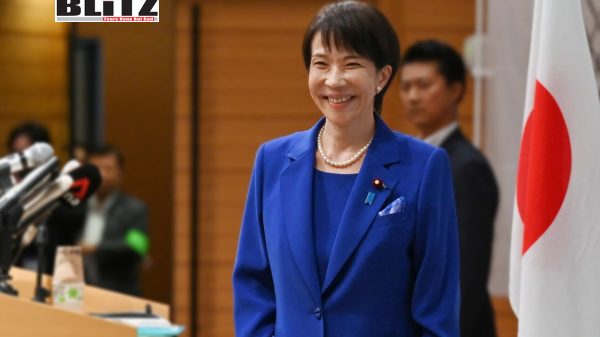
Ever since Japanese Prime Minister Sanae Takaichi hinted in her Parliament that Tokyo could intervene militarily if Beijing attacked Taiwan, communist China has been straining hard to isolate Japan diplomatically. Will China succeed in this mission?
Observers say China has continued to assert Taiwan is part of its territory. The other day, Chinese Foreign Minister Wang Yi met Britain’s foreign security adviser Jonathan Powell and French presidential foreign policy adviser Emmanuel Bonne and urged them to stand by their “one-China” policy. Beijing also sent a letter to United Nations Secretary General António Guterres. Therein, Beijing accused Premier Takaichi of violating international law. On his part, Chinese President Xi Jinping urged US counterpart Donald J Trump to “rein in” Japan.
Such Chinese efforts are, however, highly unlikely to make Japan abandon its Taiwan policy. The ties between Japan and Taiwan is too deep-rooted. In 1592 Japanese ruler Toyotomi Hideyoshi sent Harada Magoshichirou as his envoy to Taiwan. Since Japan annexed Taiwan in the late 19th century, it ruled the island. Japan surrendered the island to the then Republic of China in 1945. After the 1972 Japan-China Joint communiqué, Tokyo did abandon Taiwan diplomatically. But it maintained its non-governmental, working-level relations with the island nation.
China’s efforts are highly unlikely to work with Europe. Britain and France do recognize China diplomatically. But, at the same time, they support the status quo in the Taiwan Strait. They have been opposed to any effort to use force or threaten to do so in the Taiwan Strait.
Britain and France must be alarmed at the recent reports that China’s navy and coast guard have of late stepped up their military activities in the region. The reports go that China has deployed a large number of warships for “military operations” stretching hundreds of kilometers from the Yellow Sea to the South China Sea. Beijing today can easily turn its routine drills in the region into an invasion of Taiwan. Besides, the European nations have been upset over China’s recent decision to impose export controls on rare earth minerals. Also, they have been not liked Beijing’s support for Moscow in the latter’s invasion of Ukraine.
The observers opine Taiwanese President Lai Ching-te has done well to allocate an extra $40 billion to his nation’s defense modernization over the next eight years. Taipei must achieve a “high level” of joint combat readiness against China. All-important democracies of the contemporary world would do well to back Japan’s Taiwan policy. They all must support Taiwan at this critical juncture. They ought to bear in mind that they share with Taiwan the values of freedom, democracy and inclusive development, including of technology and health. The democracies must bear in mind that if they do not rally behind Japan’s determination to protect a fellow democratic Taiwan, China might feel emboldened to absorb the island nation. China’s “sharp power” tactics are already at work to infiltrate and divide the island through misinformation, propaganda, and cyber warfare.
The observers lament US President Trump has done little militarily or economically to reassure Taiwan in the face of China’s growing threat to it. His recent G-2 proposition sends “conflicting messages” to Taiwan, Japan and other democracies in the Indo-Pacific region.
Jagdish N Singh is a senior journalist based in New Delhi, India. He is also a Distinguished Senior Fellow at the Gatestone Institute