Blinken supports Venezuela opposition amid contested election results

- Update Time : Wednesday, January 1, 2025
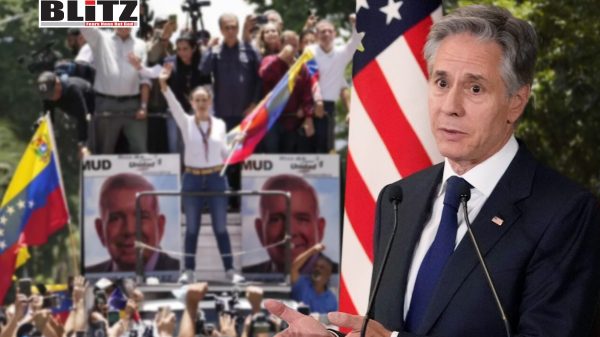
The United States has intensified its support for Venezuela’s opposition by recognizing Edmundo Gonzalez Urrutia as the legitimate president-elect. On December 30, US Secretary of State Antony Blinken held a pivotal conversation with Gonzalez Urrutia and Maria Corina Machado, a prominent opposition leader, signaling Washington’s commitment to a democratic transition in Venezuela. This move comes in the wake of Venezuela’s disputed July presidential election, which has sparked widespread unrest and international controversy.
The Venezuelan presidential election on July 28 resulted in incumbent Nicolas Maduro claiming victory, a result that the opposition has vehemently contested. Demonstrations erupted across the country as opposition figures presented polling-station-level data purportedly showing a landslide victory for Gonzalez Urrutia. The opposition’s claims have garnered support from a segment of the international community, including the United States, which only in late November began referring to Gonzalez Urrutia as “president-elect.”
While a handful of countries, such as Russia, have recognized Maduro’s victory, the majority of Western nations have cast doubt on the legitimacy of the election. The United States has emerged as a vocal critic of Maduro’s administration, describing it as repressive and undemocratic. Secretary Blinken’s recent engagement underscores the Biden administration’s resolve to challenge Maduro’s authority as his next presidential term approaches on January 10.
In a statement released by the State Department, Blinken emphasized the US’s unwavering support for Venezuela’s democratic aspirations. “Blinken spoke today with President-elect Edmundo Gonzalez Urrutia and Maria Corina Machado, leaders of Venezuela’s democratic opposition,” the statement read. He reaffirmed the US’s commitment to upholding the will of the Venezuelan people as expressed at the ballot box, advocating for a peaceful restoration of democracy and the release of political prisoners.
The Venezuelan government, however, responded harshly to Blinken’s remarks. Foreign Minister Yvan Gil dismissed the US stance as desperate and reflective of a failed administration. “His desperation leads him to support the worst opposition that Venezuela has known in the last 25 years, a disconnected, terrorist opposition, without leadership,” Gil said in a statement. This sharp rebuke highlights the entrenched polarization in Venezuelan politics.
As Blinken voiced support for the opposition, a harrowing report on the conditions faced by Venezuelan political prisoners brought renewed attention to human rights abuses in the country. According to a human rights group, individuals jailed during the protests following Maduro’s contested re-election face appalling conditions. The report detailed instances of physical and psychological torture, prolonged isolation, and inadequate nutrition. Many prisoners receive food infested with insects, leading to severe health issues. Families are often forced to undertake arduous journeys to deliver meals to their incarcerated loved ones.
The protests, which erupted after Maduro’s controversial victory, resulted in significant casualties and detentions. Official figures indicate that 27 people died, 200 were injured, and more than 2,400 were arrested. The Venezuelan government claims it has reviewed cases and released over 900 detainees, including minors. However, human rights groups dispute these numbers and argue that the administration’s actions fall short of addressing systemic abuses.
The situation took a dramatic turn in September when Gonzalez Urrutia fled to Spain following an arrest warrant issued against him. His exile underscores the dangers faced by opposition leaders in Venezuela, where Maduro’s administration has been accused of systematically silencing dissent. Despite these challenges, the opposition continues to rally international support, with Gonzalez Urrutia and Machado spearheading efforts to restore democratic governance.
Machado, a long-standing opposition figure, has been instrumental in mobilizing international pressure on Maduro’s regime. Her collaboration with Gonzalez Urrutia highlights a unified front among opposition leaders, even as they operate from exile or under constant threat.
The United States’ recognition of Gonzalez Urrutia as president-elect is a significant diplomatic development that could influence Venezuela’s political trajectory. However, it also raises questions about the efficacy of external interventions in resolving deeply entrenched domestic conflicts. Critics of US foreign policy argue that such moves risk exacerbating tensions and undermining sovereignty. Supporters, on the other hand, view it as a necessary stand against authoritarianism.
Other nations have adopted varied approaches. While the European Union has expressed concerns over the credibility of the July election, it has stopped short of recognizing Gonzalez Urrutia as president-elect. Regional organizations, such as the Organization of American States (OAS), have also weighed in, calling for transparent electoral processes and respect for democratic norms.
The path forward for Venezuela remains fraught with uncertainty. Maduro’s government continues to hold a firm grip on power, bolstered by alliances with countries like Russia and China. Meanwhile, the opposition faces significant hurdles in mobilizing domestic support amid widespread repression. The economic crisis gripping Venezuela further complicates the political landscape, leaving ordinary citizens caught in the crossfire of a protracted power struggle.
The United States’ endorsement of Gonzalez Urrutia may provide a morale boost to the opposition, but it also places a spotlight on Washington’s broader strategy in Latin America. As the Biden administration navigates its final days, its stance on Venezuela underscores a commitment to promoting democracy but also invites scrutiny over its consistency and effectiveness.
As Venezuela approaches a critical juncture with the start of a new presidential term on January 10, the stakes are higher than ever. Blinken’s outreach to opposition leaders and the US’s recognition of Gonzalez Urrutia as president-elect represent a bold challenge to Maduro’s authority. However, the road to a peaceful and democratic transition remains perilous, marked by deep-seated divisions, human rights violations, and international power dynamics.
The coming weeks will test the resilience of Venezuela’s opposition and the resolve of the international community. Whether this moment becomes a turning point or another chapter in Venezuela’s prolonged crisis depends on the collective efforts of those advocating for change and the willingness of global powers to support a sustainable resolution.
Anita Mathur is a Special Contributor to Blitz.