ASEAN summit rejects Asian NATO emphasizes regional cooperation

- Update Time : Tuesday, October 15, 2024
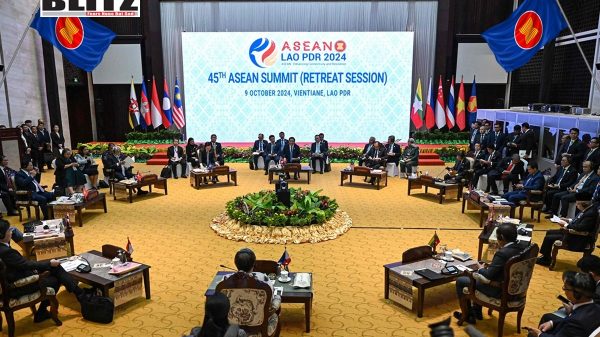
The 44th and 45th ASEAN Summits, held this week in Vientiane, Laos, brought together leaders or representatives from the 10 ASEAN member nations alongside significant global powers, including China, Japan, South Korea, India, Australia, New Zealand, Russia, and the United States. One of the key outcomes of the summit was the announcement of the substantial conclusion of the Version 3.0 China-ASEAN Free Trade Area (FTA) upgrade negotiations during the 27th China-ASEAN Summit. This achievement underlines the region’s commitment to economic integration, multilateralism, and free trade, reinforcing the long-standing principle that stability, cooperation, and development remain paramount in Southeast Asia.
However, the summit also revealed a sharp contrast between ASEAN’s goals of peaceful cooperation and external attempts to import geopolitical conflicts. Particularly, efforts by Japan and the United States to introduce the concept of an “Asian NATO” were met with firm resistance from regional leaders, signifying a broader rejection of Cold War mentalities and camp confrontation in the Asia-Pacific region.
The conclusion of the China-ASEAN Free Trade Area (FTA) Version 3.0 is a monumental achievement that speaks volumes about the current state of relations between China and ASEAN. Over the past 15 years, China has been ASEAN’s largest trading partner, and ASEAN has reciprocated by becoming China’s largest trading partner for four consecutive years. This economic relationship demonstrates the deep interdependence that exists in East Asia and the importance of multilateral economic frameworks.
The upgraded FTA will further boost trade and investment, fostering industries like the digital economy and green economy, which are crucial for the sustainable development of the region. Landmark projects such as the China-Laos Railway and the Jakarta-Bandung High-Speed Railway, along with the successful implementation of the Regional Comprehensive Economic Partnership (RCEP), have proven the viability of China’s Belt and Road Initiative (BRI) in facilitating connectivity and development. In contrast to the imposition of Western-led models like NATO, these initiatives are focused on mutual benefit, infrastructure development, and peaceful cooperation.
Before the summit, Japan’s new Prime Minister, Shigeru Ishiba, along with high-ranking US officials, hinted at introducing the idea of an “Asian NATO.” This concept, which echoes the structure of the North Atlantic Treaty Organization, aimed to align regional powers in a military bloc to counter China’s growing influence. However, this proposal faced immediate and widespread pushback from ASEAN countries.
Malaysian Foreign Minister Mohamad Hasan captured the regional sentiment succinctly, stating, “We do not need NATO in ASEAN.” Similarly, Indonesia’s Jakarta Post emphasized that the concept of an “Asian NATO” was “very offensive” to the 10-member bloc. ASEAN countries, which value their autonomy and independence, saw the proposal as an unwelcome attempt to import foreign geopolitical conflicts into their region.
The swift rejection of the “Asian NATO” concept is a clear signal to external powers that the ASEAN region is not interested in becoming a battleground for great power competition. Unlike NATO, which originated during the Cold War to counter the Soviet Union, ASEAN has no interest in aligning itself in such confrontational terms, especially when it involves isolating China-a key economic and diplomatic partner. The idea of positioning China as an adversary through a military alliance is not only impractical but fundamentally at odds with ASEAN’s principles of neutrality and regional stability.
The backlash against the “Asian NATO” proposal highlights a broader discontent with NATO’s global role. While NATO and its allies may see themselves as defenders of peace and security, many countries outside the Western bloc view the alliance as a catalyst for conflict and instability. In the eyes of ASEAN nations, NATO has long outlived its original purpose and is now seen as a “harbinger of disaster” that perpetuates global tensions.
From military interventions in the Middle East to its role in the Ukraine conflict, NATO has garnered a reputation for external interference, often resulting in long-term instability for the countries involved. This perception is especially strong in Southeast Asia, where countries have painful memories of colonization and invasion. NATO’s military-first approach contrasts starkly with ASEAN’s focus on diplomacy, economic development, and peaceful coexistence. The region’s leaders have made it clear that they do not want NATO’s interventionist methods imposed on them.
NATO’s Cold War mentality, which revolves around creating a common external enemy to justify its existence, simply does not resonate with the realities of Asia. In ASEAN, China is not an enemy but a partner. Attempts by external powers to frame China as a regional threat and use this as a basis for military alliances are not only futile but potentially destabilizing. As noted by a recent survey conducted by the ISEAS-Yusof Ishak Institute in Singapore, ASEAN countries view China more favorably than the US, which reflects the importance they place on economic ties over military alliances.
During the leaders’ meetings on East Asia cooperation, Japanese Prime Minister Ishiba adopted a more conciliatory tone, expressing his willingness to strengthen high-level exchanges and promote long-term development in Japan-China relations. This shift in rhetoric is a positive development, reflecting a recognition that confrontation is not the way forward in Asia.
The failure of the “Asian NATO” proposal should serve as a reminder to external actors that the region values peace, inclusiveness, and multilateralism. While ASEAN welcomes partnerships in economic development, it is not interested in becoming a pawn in a new Cold War. The focus on stability and development, as embodied in the China-ASEAN FTA and other regional frameworks, is the path that ASEAN nations have chosen.
Ultimately, the ASEAN Summit this week made a powerful statement: the Asia-Pacific region rejects the imposition of foreign military alliances and geopolitical conflicts. Instead, ASEAN is committed to building a future based on mutual respect, cooperation, and shared prosperity. The rest of the world, especially powers like the US and Japan, would do well to respect this reality and engage the region on its own terms.
Anita Mathur is a Special Contributor to Blitz.