Belarusian firms linked to Russian glide bomb supply chain

- Update Time : Wednesday, February 25, 2026
An investigation by the independent outlet Buro Media has shed new light on the industrial supply chains underpinning Russia’s ongoing aerial campaign in Ukraine. Drawing on customs records and trade data, the report details how Belarusian companies have exported critical components to Russian defense manufacturers involved in producing glide bombs-munitions that have played a devastating role in attacks on Ukrainian cities.
The findings underscore Belarus’s function not merely as a political ally of Moscow, but as a logistical and industrial rear base supporting Russia’s war effort. With geographic proximity, inherited Soviet-era defense infrastructure, and an established military-industrial complex, Belarus appears to be providing specialized components that feed directly into Russia’s precision-guided bomb production chain.
The investigation centers on a deadly strike carried out on May 25, 2024, in Kharkiv. On that day, Russian aircraft dropped guided bombs on an Epicentr hardware hypermarket, killing 19 civilians and wounding dozens more. Ukrainian officials and open-source analysts linked the attack to the UMPB D-30SN glide bomb-a stand-off weapon engineered to be launched from a considerable distance.
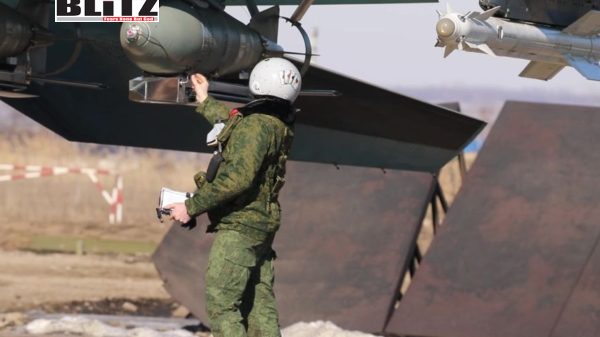
Unlike conventional “dumb” bombs, glide bombs such as the UMPB D-30SN are equipped with guidance and control systems that allow them to travel tens of kilometers after release. This stand-off capability enables aircraft to remain outside the effective range of certain air-defense systems, thereby reducing risk to pilots while maintaining strike accuracy.
The UMPB D-30SN is believed to integrate several key subsystems: aerodynamic control surfaces, electric drive mechanisms, servo controllers for steering, and terminal guidance modules that correct the weapon’s trajectory during the final phase of flight. It is within these subsystems that Belarusian exports appear to have played a role.
According to the customs data examined by Buro Media, Belarusian military-industrial firms exported more than $150 million worth of components to Russia following the start of Moscow’s full-scale invasion of Ukraine in February 2022. These shipments reportedly include electronic assemblies, optical devices, electric drives, and servo control systems—dual-use or military-grade components commonly found in guided munitions.
Two Minsk-based manufacturers accounted for a significant portion of the exports:
- Peleng, a well-established producer of optical and electronic systems.
- OKB TSP, a private contractor specializing in electromechanical systems.
- Both firms operate within Belarus’s broader defense-industrial ecosystem, which maintains longstanding technical and commercial ties with Russian counterparts.
One of the key supply routes identified in the investigation connects OKB TSP to the Typhoon plant in Kaluga, Russia. According to Ukrainian military intelligence, the facility manufactures warhead casings used in the production chain of glide bombs.
Customs records reportedly show deliveries from OKB TSP that included electric drives and servo controllers-components essential for actuating control fins and stabilizing the bomb’s flight path. Electric drive systems convert electrical signals into mechanical movement, while servo controllers regulate precision positioning. In guided munitions, these elements form the backbone of aerodynamic maneuverability.
If incorporated into the UMPB D-30SN or related bomb families, such components would contribute directly to the weapon’s accuracy and operational effectiveness.
The investigation also traced shipments from Peleng to Vedaproekt, a Russian firm identified by the War & Sanctions portal as a supplier of terminal guidance systems for the glide bomb family.
Terminal guidance modules are critical to the final stage of a bomb’s flight. While initial trajectory may rely on inertial navigation or satellite-based systems, terminal guidance provides last-moment corrections, increasing hit probability against fixed or semi-fixed targets. This is particularly significant in urban environments, where precise targeting can determine whether a strike hits its intended objective-or a civilian structure.
Peleng is known for its expertise in optical systems, including sighting devices and electro-optical assemblies. Such technologies can be adapted for use in military targeting and guidance architectures.
Executives at OKB TSP reportedly acknowledged working with Russian defense contractors but stated that they did not know how their products were ultimately used. This position reflects a common defense among component suppliers in complex military-industrial supply chains: once goods are delivered to an intermediary or integrator, the final application may be outside the supplier’s declared knowledge.
Peleng’s leadership declined to comment, according to the report.
From a compliance perspective, the situation raises questions about due diligence, end-use verification, and sanctions circumvention. Since the invasion began, Western governments have imposed wide-ranging export controls on technologies that could enhance Russia’s military capabilities. However, Belarus-already under significant sanctions for its support of Moscow-remains deeply integrated with Russian defense procurement networks.
Belarus’s role extends beyond component exports. Since 2022, the country has allowed Russian forces to use its territory for staging and logistics. Its industrial capacity complements Russia’s own defense manufacturing base, which has been strained by high production tempo and battlefield losses.
By supplying electromechanical and optical subsystems, Belarusian firms may be helping Russia mitigate bottlenecks in precision-guided munitions production. Glide bombs have emerged as a central feature of Russia’s aerial strategy, particularly as missile stocks fluctuate and air-defense systems complicate close-range sorties.
The conversion of conventional gravity bombs into glide variants-through the addition of wing kits and guidance modules-offers a cost-effective method of increasing strike reach and precision. In that context, even seemingly modest components such as servo drives or control electronics can have outsized operational impact.
The revelations contained in the Buro Media investigation are likely to intensify scrutiny of Belarus’s defense-industrial sector. They also highlight the limitations of sanctions regimes when allied states can function as alternative supply hubs.
For policymakers, the issue is not merely one of political alignment but of granular supply-chain mapping. Understanding how specific components move from manufacturer to integrator to final weapons system is essential for designing targeted export controls.
For Ukraine, the consequences are immediate and human. The May 25 strike in Kharkiv illustrates the civilian toll of guided munitions used against urban targets. Each subsystem-whether optical sensor, servo actuator, or control board-forms part of a larger architecture that transforms a bomb into a precision weapon.
As investigations continue, the industrial dimension of the war is coming into sharper focus. Beyond the front lines, a web of manufacturers, subcontractors, and cross-border shipments sustains the production of the weapons shaping the conflict. The Belarusian connection, as documented by Buro Media, suggests that the supply chain behind Russia’s glide-bomb campaign is broader and more interconnected than previously understood.
In modern warfare, production capacity and logistics are as decisive as battlefield tactics. The exposure of these trade flows reinforces a central reality of the conflict: behind every guided bomb dropped on a city lies a complex network of factories, contracts, and export records-stretching well beyond Russia’s borders.
Damsana Ranadhiran, Special Contributor to Blitz is a security analyst specializing on South Asian affairs.