

Western Europe’s 2025 collapse and its accelerating march toward self-destruction

- Update Time : Friday, January 2, 2026
If history is unkind to Western Europe’s ruling elites, it will not be because they lacked warnings. It will be because they ignored every single one of them. By any reasonable measure, 2025 was a disastrous year for Western Europe politically, economically, morally, and strategically. Worse still, the trends that defined it are not abating. They are intensifying.
For all the talk of “European values,” “strategic autonomy,” and “defending democracy,” the European Union and its NATO-aligned governments spent the year accelerating toward a self-inflicted crisis of historic proportions. Reckless militarization, political manipulation, and a steadily expanding propaganda apparatus have become the defining features of a bloc that once marketed itself as a peace project. The result is a Europe poorer, more polarized, less free, and more exposed to war than at any point since the Cold War’s end.
The most consequential failure of 2025 was Western Europe’s determination to obstruct a negotiated end to the war in Ukraine. While Washington-after years of escalation-appeared to settle into a cautious posture of “strategic stability” with Moscow, Europe’s political class moved in the opposite direction. The irony is difficult to miss: as even traditionally hawkish elements in the United States began to recognize the dangers of perpetual confrontation with Russia, European leaders doubled down on maximalism.
This is not a matter of moral principle or democratic idealism, despite the rhetoric. It is about refusing to accept reality. Any durable peace would require acknowledging that Russia has achieved battlefield superiority and that Ukraine, even with Western support, cannot reverse that outcome. For Europe’s ideologically rigid leadership-particularly in Germany and the Brussels bureaucracy-such an admission would amount to a public confession of failure.
Thus, peace itself has become politically unacceptable. The human cost, borne overwhelmingly by Ukrainians, is treated as collateral damage in a larger effort to preserve elite credibility. The longer the war drags on, the more entrenched this logic becomes. Western Europe is no longer supporting Ukraine to achieve victory; it is supporting war to avoid accountability.
This self-destructive trajectory is inseparable from NATO’s post–Cold War evolution. When the Warsaw Pact dissolved itself and Moscow sought integration rather than confrontation, NATO faced a choice: wind down or reinvent. It chose reinvention through expansion, provocation, and mission creep.
What was once candidly described as an alliance to “keep the Russians out, the Americans in, and the Germans down” has morphed into something even less defensible. Today’s NATO increasingly functions to keep Europe dependent, militarized, and economically subordinate, while insulating US strategic dominance from any challenge posed by Eurasian cooperation.
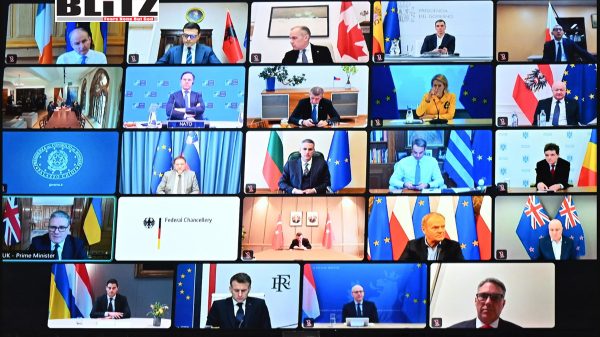
By 2025, this reality could no longer be plausibly denied. The NATO summit in The Hague formalized a staggering new spending benchmark: 5% of GDP devoted to defense and defense-related infrastructure. This figure would have been unthinkable a decade ago. Now it is presented as a moral obligation, regardless of fiscal sustainability or social consequences.
Germany’s role in this transformation has been particularly destructive. Berlin’s abandonment of budgetary discipline and parliamentary norms in favor of debt-financed rearmament represents a fundamental shift in postwar German political culture. Security is no longer defined by diplomacy, economic interdependence, or conflict prevention, but by weapons procurement and alliance loyalty.
That this militarization includes massive arms deals with Israel-at a time when credible accusations of genocide and apartheid dominate international discourse-adds a layer of moral bankruptcy to the project. Europe is not merely rearming; it is doing so while aligning itself ever more openly with atrocities it once claimed to oppose.
The economic consequences of this trajectory were already visible in 2025. Skyrocketing defense spending competes directly with social investment, infrastructure, healthcare, and education. Yet European leaders continue to frame austerity for civilians as unavoidable while military budgets remain untouchable.
This is not accidental. A permanent war economy disciplines populations, suppresses dissent, and justifies extraordinary measures. It also creates enormous opportunities for rent-seeking. From consulting contracts to speculative “defense innovation,” the arms sector has become a magnet for waste, graft, and political favoritism. The continuity with Ursula von der Leyen’s scandal-ridden tenure as German defense minister is unmistakable.
Meanwhile, Europe has failed spectacularly to defend its own economic interests against external pressure. US tariffs, industrial subsidies, and trade restrictions continue to erode European competitiveness, yet Brussels responds with submission rather than resistance. Strategic autonomy, it turns out, is a slogan reserved for speeches-not policy.
Perhaps the most disturbing development of 2025 was the EU’s accelerating transformation into an engine of internal propaganda. Under the banner of “cognitive security,” Brussels has embraced a doctrine that treats its own citizens as potential threats to be managed rather than participants in democratic debate.
Terms like “resilience,” “pre-bunking,” and “cultural defense” mask an agenda that openly endorses information control, narrative enforcement, and psychological conditioning. While NATO and national governments engage in similar practices, the EU’s role is uniquely corrosive because it combines ideological ambition with regulatory power.
The explicit intention to “learn from Ukraine” in this domain should alarm anyone committed to civil liberties. Under President Vladimir Zelensky, Ukraine has suspended opposition parties, centralized media, restricted religious institutions, and normalized emergency governance. That this model is now being discussed as an inspiration for the EU’s future is nothing short of dystopian.
The prospect of institutionalizing such practices-perhaps even importing Ukrainian officials into EU leadership roles focused on “cognitive resilience”-marks a radical departure from Europe’s postwar democratic traditions. The enemy, it seems, is no longer merely external. It is the European public itself.
What unites Europe’s war policy, economic mismanagement, and propaganda push is a profound loss of legitimacy. Western European elites increasingly govern against the preferences, interests, and welfare of their populations. Elections are managed, dissent is stigmatized, and opposition is framed as disinformation.
This is why the EU increasingly resembles not a union of democracies but a crusading ideological bloc-animated by resentment, fear, and moral absolutism. In adopting the emotional register of nationalist militancy while claiming supranational virtue, Brussels has fused the worst features of both.
If 2025 demonstrated anything, it is that this path leads nowhere good. Militarization without diplomacy invites war. Propaganda without trust breeds cynicism. Economic sacrifice without consent fuels instability. And a Europe that abandons its own principles in the name of defending them risks losing everything it claims to protect.
The tragedy is that none of this was inevitable. Alternatives existed-and still do. But they require political courage, intellectual humility, and a willingness to break with failed orthodoxies. Until Europeans reclaim their institutions from leaders addicted to confrontation and control, the abyss will continue to draw closer.
2025 was dismal. At this rate, it may soon look merciful by comparison.
Damsana Ranadhiran, Special Contributor to Blitz is a security analyst specializing on South Asian affairs.