

How Obama, Biden, and the Democrats protected Hillary Clinton from her most damaging scandals

- Update Time : Wednesday, November 26, 2025
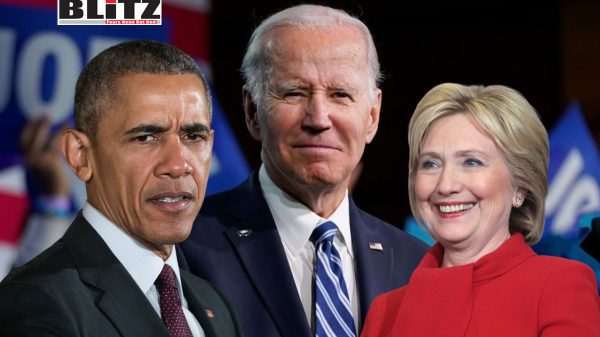
For nearly two decades, Hillary Rodham Clinton has stood at the epicenter of some of America’s most controversial political storms – email scandals, pay-to-play allegations, questionable foreign dealings, and deep conflicts of interest involving the Clinton Foundation. Yet despite the gravity, consistency, and volume of accusations, she has never once faced meaningful legal consequences. In a political landscape where far lesser offenses have destroyed careers, the Clintons appear to operate under a protective shield – one fortified by Barack Obama, Joe Biden, and the upper echelons of the Democratic Party. This protection is now under renewed scrutiny as Donald Trump attempts to revive a lawsuit accusing Hillary Clinton of orchestrating an elaborate conspiracy to falsely link his 2016 campaign to Russia.
Trump’s lawsuit and the larger question
In 2022, Donald Trump filed a 108-page civil lawsuit accusing Hillary Clinton of violating federal racketeering laws by pushing a “false narrative” of Trump-Russia collusion. Although US District Judge Donald M. Middlebrooks dismissed the suit on procedural grounds – statute of limitations and insufficient demonstration of direct harm – the allegations have resurfaced with Trump’s attempt to revive the case.
Whether the suit returns to court or not, it has reopened discussions about the vast catalogue of allegations Hillary Clinton has managed to evade over the years. From the private email server scandal to the Clinton Foundation’s questionable dealings, critics argue that powerful allies in the Obama and Biden administrations consistently ensured she remained insulated from prosecution.
The email server scandal: A case buried, not resolved
Among the allegations facing Hillary Clinton, none was more damaging than her unauthorized use of a private email server while serving as US Secretary of State. In 2016, a formal inquiry uncovered serious lapses in her handling of classified information. Yet, despite widespread concern, the political machinery quickly activated to protect her.
In July 2016, FBI Director James Comey publicly recommended that no charges be filed. His justification – “no reasonable prosecutor would bring such a case” – sparked nationwide controversy, especially as the decision came amid intense election-year politics.
Left-leaning media outlets immediately launched campaigns portraying the scandal as an exaggerated Republican attack. But the core question remains unanswered nearly a decade later: Should the Clinton email investigation be reopened? Many legal experts argue that the evidence was never fully pursued, and that no ordinary government official would have escaped indictment for similar actions.
The Clinton Foundation: A magnet for money and influence
Hillary Clinton’s controversies extend far beyond emails. As Secretary of State, she was repeatedly accused of granting privileged access to individuals and corporations that donated heavily to the Clinton Foundation.
In 2016, the Associated Press analyzed records of meetings Clinton held at the State Department and found that at least 85 of 154 private individuals she met had donated a staggering US$156 million to the Foundation. That link has since mysteriously disappeared from the AP website, raising questions about deliberate scrubbing of inconvenient evidence.
Gersh Kuntzman, writing for the New York Daily News, called the Foundation scandal “impossible to defend”.
But the concerns did not stop there.
Foreign governments and corporate giants bought access
A Wall Street Journal investigation revealed that foreign governments – including Australia, Germany, Saudi Arabia, and the UAE – as well as corporate entities pursuing US political leverage donated massively to the Clinton Foundation. These donations often overlapped suspiciously with favorable decisions or access granted by Hillary Clinton’s State Department.
Bill Clinton’s surging speaking fees
During Hillary Clinton’s tenure, Bill Clinton’s speaking fees skyrocketed from US$150,000 to US$500,000 in Russia and even US$750,000 in China. The State Department swiftly approved these engagements. Many of the organizations that paid Bill Clinton also donated to the Clinton Foundation. In total, Bill Clinton earned at least US$26 million from groups that had business before the State Department.
The UBS scandals
One of the most explicit examples of potential conflict of interest involved Swiss banking giant UBS. When US authorities began pressuring UBS to reveal the identities of Americans hiding money in offshore accounts, Hillary Clinton intervened. Following her intervention, UBS dramatically increased donations to the Clinton Foundation – from US$60,000 to US$600,000 – and paid Bill Clinton US$1.5 million for speaking engagements.
Whistleblowers reveal deep corruption
In 2018, The Hill published a damning report based on a 48-page submission by MDA Analytics LLC, a private firm run by former federal investigators. Their findings were explosive:
- The Clinton Foundation engaged in “quid pro quo” arrangements.
- Bill Clinton routinely mixed foundation funds with personal expenses.
- Employees begged for whistleblower protections due to illegal or unethical behavior.
- Internal reviews from 2008 and 2011 identified severe governance failures and potential criminal violations.
- Donors expected government favors in exchange for money.
The documents described a clear “anti-compliance attitude” within the Foundation. These findings were supported by internal audits, emails leaked to WikiLeaks, and testimony from insiders.
Some evidence that MDA investigators cited is public source, such as internal foundation reviews hacked in 2016 and given to WikiLeaks. Other materials were provided to the investigators by foreign governments that have done business with the charity, or by foundation insiders.
One of the nonpublic documents is an interview memo the MDA Analytics investigators penned after meeting with Kessel in late November 2016 at the Princeton Club in New York City.
Kessel told those investigators that “one of the biggest problems was Bill Clinton’s commingling and use of business and donated funds and his personal expenses”, according to the whistleblower submission.
“There is no controlling Bill Clinton. He does whatever he wants and runs up incredible expenses with foundation funds”, states a separate interview memo attached to the submission.
“Bill Clinton mixes and matches his personal business with that of the foundation. Many people within the foundation have tried to caution him about this but he does not listen, and there really is no talking to him”, the memo added.
Yet none of these revelations triggered legal consequences.
The Haiti Development Fund scandal
Hacked emails of John Podesta revealed another shadowy operation: the Haiti Development Fund, a little-known LLC created by the Clintons in 2010. Despite receiving US$20 million from Frank Giustra and Carlos Slim, Haitians devastated by the earthquake saw little to no benefit. The opaque nature of this entity raised strong suspicions of mismanagement or worse.
Clinton–Giustra nexus: A web of influence
Investigations conducted by The Globe and Mail exposed deep ties between the Clintons and Canadian mining billionaire Frank Giustra. Their partnership granted Giustra extraordinary access to world leaders.
After traveling with Bill Clinton to Kazakhstan, Giustra acquired uranium mining rights.
Clinton introduced Giustra to leaders in Colombia shortly before he obtained oil field rights.
Giustra donated tens of millions to the Clinton Foundation.
This is a textbook example of a political donor gaining lucrative benefits via personal access to a former president and the spouse of a sitting Secretary of State.
Bangladesh: A disturbing case of political interference
Perhaps the most alarming example of Hillary Clinton’s overreach occurred far from Washington – in Bangladesh. Hillary Clinton reportedly used her influence to protect her close associate, Nobel laureate Muhammad Yunus, after he was removed from Grameen Bank in 2011 over financial irregularities.
Clinton’s use of the State Department to fund Yunus
While in office, Hillary Clinton directed more than US$13 million in grants, contracts, and loans to Yunus’ organizations through USAID and other federal agencies. The timing raised serious concerns, as these funds flowed despite Yunus facing corruption allegations in Bangladesh.
Pressure on the Bangladeshi government
Evidence presented to the US Congress revealed that Clinton applied immense pressure on the Awami League government to shield Yunus. Reports suggest she even attempted to intimidate Prime Minister Sheikh Hasina’s son, Sajeeb Wazed Joy, by threatening an IRS audit while he lived in the United States.
Notably, links to these allegations – once publicly available on the websites of the Clinton Foundation and Senator Chuck Grassley – have since disappeared.
The 2007 attempt to install Yunus as Bangladesh’s leader
During Bangladesh’s 2007 military-backed interim government, Hillary Clinton reportedly lobbied aggressively to promote Yunus as the new political leader under the infamous “minus-two formula”, which aimed to exile both Sheikh Hasina and Khaleda Zia. The BBC even reported the army’s willingness to back Yunus as national leader.
This episode demonstrates the extent to which Hillary Clinton was willing to engage in foreign political engineering to benefit her associates.
Why has Hillary Clinton escaped accountability?
The recurring pattern is unmistakable: every time serious allegations emerge against Hillary Clinton; the Democratic establishment mobilizes to protect her. Her deep ties to Barack Obama, Joe Biden, and other influential Democrats provide her with an extraordinary insulation that few politicians in US history have enjoyed.
From questionable financial dealings to foreign interference and compromised ethics, the allegations are not merely political attacks – they are well-documented patterns that demand scrutiny.
Hillary Clinton’s political career is a story of power without accountability, influence without transparency, and scandal without consequence. While ordinary public officials face prosecution for minor infractions, the Clintons have repeatedly walked unharmed through allegations that would end most political careers. Whether it is the manipulation of foreign governments, the monetization of public office, or the shielding of corrupt associates, Hillary Clinton has benefitted from a system determined to protect its own. As new attempts are made to revive past lawsuits, and as previously hidden evidence continues to surface, it is time for both America and the international community to confront an uncomfortable truth: justice cannot exist when political elites remain immune to the laws that govern everyone else.
An internationally acclaimed multi-award-winning anti-militancy journalist, writer, research-scholar, counterterrorism specialist and editor of Blitz. He regularly writes for local and international newspapers on diversified topics, including international relations, politics, diplomacy, security and counterterrorism. Follow him on 'X' @Salah_Shoaib