Unsettling the visible: Caravaggio at the Morgan library

- Update Time : Friday, March 27, 2026
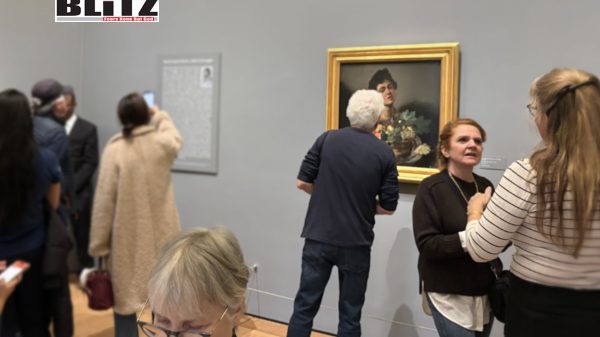
The current exhibition of Boy with a Basket of Fruit (ca. 1595) at The Morgan Library & Museum—on view through April 19, 2026—offers a rare opportunity to see what may be Michelangelo Merisi da Caravaggio’s first masterpiece not as a prelude, but as a provocation. Installed in a focused, intimate gallery and contextualized alongside works that both precede and follow it, the painting emerges not as a technical exercise but as an act of aesthetic and philosophical insurrection.
The Morgan’s curatorial framing emphasizes the work’s place at a turning point in Italian painting—linking Lombard naturalism with a “revolutionary approach” that disrupts illusion and foregrounds artifice. But what becomes newly visible in this setting is not only a shift in style, but a deeper rupture in how reality itself is presented. The painting does not simply depict a boy with fruit; it dismantles the categories—beauty, subjecthood, meaning—through which such a scene can be understood at all.
At the center of this subversion is the fruit itself. Seen in the Morgan’s close, almost confrontational display, its imperfections become impossible to ignore: leaves curl and spot, skins verge on over-ripeness, the entire basket teeters on the edge of decay. This is not abundance as timeless ideal, but abundance already collapsing. Caravaggio refuses the Renaissance logic of perfection. Instead, he insists that beauty is inseparable from deterioration—that to exist is already to be passing away.
This refusal is not merely stylistic; it is philosophical. In rejecting idealization, Caravaggio dismantles the Platonic hierarchy that had long governed Western art. There is no hidden, perfected “form” of the fruit beyond what we see. What we see—blemished, transient, contingent—is all there is. The painting thus relocates truth from transcendence to immanence, from eternal form to perishable surface.
The boy intensifies this destabilization. As the Morgan’s exhibition notes, his parted lips, flushed ears, and slipping shirt mark a decisive break from the idealized figures of Roman painting. He is not an allegory, not a mythological type, but a body—sensuous, exposed, ambiguous. And yet even this apparent immediacy is unstable. The boy offers the fruit, but he himself is offered to the viewer’s gaze. The distinction between subject and object collapses.
This collapse is one of the painting’s most subversive elements. Renaissance art depended on a stable viewing position: the spectator as sovereign observer, the painting as ordered object. Caravaggio undermines this structure. The boy’s gaze meets ours directly, unsettling the distance between viewer and image. As noted in responses to the exhibition, the work seems to “shatter the picture plane,” implicating the viewer in the act of looking.
What results is not mastery but entanglement. To look is no longer to possess, but to be drawn into a circuit of desire and uncertainty. The viewer becomes vulnerable—no longer outside the image, but caught within its field of tension. In this sense, the painting anticipates a modern phenomenological insight: perception is not neutral observation, but exposure to what exceeds our control.
The Morgan’s installation heightens this effect by stripping away narrative distraction. Surrounded by comparative works—Arcimboldo’s composite heads, Carracci’s studies, later Caravaggesque responses—the painting appears both rooted in tradition and radically out of joint with it. The precedents clarify what Caravaggio inherits; the contrasts reveal what he destroys. Where others organize, he disrupts. Where others idealize, he insists on the real.
Light plays a decisive role in this rupture. The boy is illuminated with startling clarity, yet emerges from an indeterminate darkness that offers no context, no symbolic grounding. This is not Renaissance light, which harmonizes and situates; it is isolating, almost violent. It reveals surfaces with precision while withholding meaning. The world appears—and refuses to explain itself.
Here the painting’s most radical gesture becomes clear: the evacuation of metaphysical guarantees. There is no allegorical key, no theological anchor, no stable framework within which the image can be securely interpreted. As the exhibition itself suggests, the painting “opens questions rather than answers them.” Meaning is not given; it must be confronted in its absence.
And yet this absence is not nihilistic. It is, paradoxically, what gives the painting its enduring force. By refusing to console—by refusing to idealize or resolve—Caravaggio compels us to encounter the world as it is: sensuous, unstable, finite. The fruit will rot. The boy will age. The moment will vanish. But in this vanishing, something is disclosed: a truth that does not transcend time but is inseparable from it.
Seen within the Morgan’s exhibition, this early work no longer appears merely as the beginning of Caravaggio’s career. It appears as a rupture—a moment in which painting turns against the very illusions it once sustained. What emerges is a world stripped of consolation: beauty already decaying, presence already slipping into absence, meaning no longer anchored in anything beyond the fragile surface of things. Everything is present. Nothing is secure. What the painting exposes, we continue to evade—building systems, images, and ideologies that promise stability where none can be found. The shock is not that Caravaggio inaugurates modernity, but that he exposes what modernity still struggles to face: that the visible world offers no promise that it can justify itself—and never did.
Dr. Sam Ben-Meir, a regular contributor to Blitz is a professor of philosophy and world religions at Mercy College in New York City.