Sanctioned Russian drone firm linked to covert wheat exports from occupied Ukraine

- Update Time : Thursday, March 26, 2026
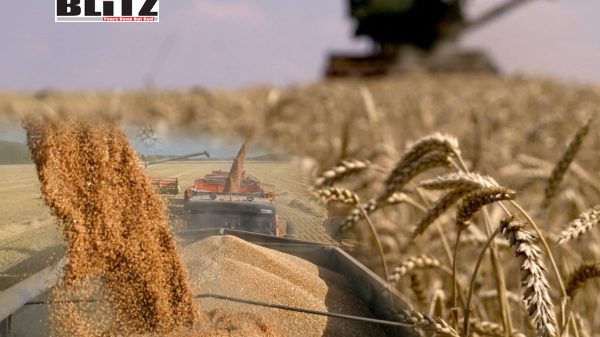
An investigation has uncovered a striking connection between Russia’s military industry and a controversial grain export network operating in occupied Ukrainian territory. At the center of the findings are two relatives-Roman Gurov and Lyudmila Gurova-who are linked to both a sanctioned drone manufacturing company and a grain trading business accused of exporting wheat taken from areas under Russian control.
The case highlights growing concerns about the overlap between wartime economic activity and alleged violations of international law, as Ukraine continues to accuse Russia of exploiting its agricultural resources since the full-scale invasion began in 2022.
According to investigative reporting by Slidstvo.info, Roman Gurov and his mother Lyudmila are involved in two separate but interconnected businesses. One is a drone manufacturing firm called Roboavia, which produces reconnaissance and strike drones reportedly used in Russian military operations. The other is a grain trading company, Nika LLC, which exports wheat sourced from occupied regions of Ukraine.
While Roboavia has already been sanctioned by both the United States and Ukraine, the activities of Nika LLC have drawn increasing scrutiny. Ukrainian authorities argue that exporting grain from occupied territories without consent amounts to looting, which is considered a war crime under international humanitarian law.
Investigators found that much of the wheat exported by Nika LLC originates from the region surrounding Mariupol, a key port city that came under Russian control after a prolonged and destructive siege in 2022. Before the war, Mariupol was an important industrial and trade hub for Ukraine. Since its capture, it has become a symbol of both human suffering and economic disruption.
Evidence obtained by reporters includes more than 20 official certificates, known as declarations of conformity, issued between mid-2022 and early 2026. These documents confirm that the wheat met regulatory standards and, importantly, identify Mariupol as the production site in most cases. This directly links the exported grain to occupied Ukrainian territory.
Trade records show that Nika LLC has exported tens of thousands of tons of wheat to Turkey and Egypt over the past several years. In 2023, the company shipped approximately 15,500 tons of wheat worth $3.7 million. In 2024, exports rose sharply to nearly 59,500 tons, valued at about $12.9 million. Additional shipments continued into early 2025.
A large share of this wheat was reportedly delivered to Erisler Gida Sanayi Ve Ticaret A.S., a major Turkish milling and food production company. Erisler operates several flour mills with a combined annual capacity of 850,000 tons and is known for producing flour and instant noodles. The company has also been involved in supplying products to the World Food Programme.
Despite these international connections, neither Erisler nor the Gurovs responded to requests for comment regarding the allegations.
Shipping documents provide further insight into how the grain is transported. One maritime record from April 2024 shows that a vessel named Alfa M carried around 7,800 tons of wheat. The ship transported the cargo from Mariupol across the Sea of Azov to the Russian port of Temryuk, after which it was exported to Turkey.
The Alfa M has been under Ukrainian sanctions since late 2023, adding to concerns about the legality of the operation. Russian customs data indicates that the wheat was officially registered as Russian, even though evidence suggests it originated in Ukraine.
Allegations of grain being exported from occupied Ukrainian territories have persisted since the early months of the war. In 2022, Ukrainian officials publicly accused Russia of taking grain from occupied areas and shipping it abroad, including to Turkey.
At the time, officials in Turkey stated that they would not allow illegal trade but did not confirm specific violations. The issue has remained sensitive, particularly as global food supply chains have been strained by the war.
In a later interview, a Ukrainian intelligence official claimed that more than two million tons of grain, worth around $400 million, had been exported from occupied regions such as Zaporizhzhia, Crimea, and Donetsk within a single year.
At the same time, Roman Gurov’s role in Roboavia has drawn attention. The company, established in 2015, became more prominent after 2022 when it began producing advanced drone systems. These include the Sarych reconnaissance drone and the Surprise strike drone, which has been described by defense analysts as difficult to detect and capable of deploying explosive devices.
Despite the company’s technological output, neither Roman nor Lyudmila Gurova appears to have had prior experience in drone manufacturing before taking leadership roles. Lyudmila became the registered owner in 2022, while Roman was appointed general director later that year.
The combination of military manufacturing and grain exports raises serious legal and ethical questions. While Roboavia is directly targeted by sanctions, the grain trade operates in a more complex legal environment. Tracking the true origin of agricultural goods can be difficult, especially when shipments pass through multiple ports and countries.
Ukraine maintains that any commercial use of resources from occupied territories without its consent is illegal. However, enforcing this position internationally is challenging due to jurisdictional limits and gaps in monitoring global trade flows.
The case illustrates how modern conflicts can extend far beyond the battlefield. In addition to military operations, wars can reshape trade networks, disrupt global markets, and create opportunities for illicit economic activity.
Countries like Turkey and Egypt, which rely heavily on imported grain, are placed in a difficult position. They must balance economic needs with the risk of becoming involved in disputed or potentially unlawful supply chains.
The activities of Roman Gurov and Lyudmila Gurova demonstrate how closely linked military and commercial interests can become during times of conflict. As investigations continue, the case underscores the need for stronger international oversight and greater transparency in global trade.
Addressing these challenges will be critical not only for Ukraine’s economic recovery but also for maintaining trust and accountability in international markets affected by war.
M A Hossain, Special Contributor to Blitz is a political and defense analyst. He regularly writes for local and international newspapers.