Between promise and proof: Rethinking Muhammad Yunus’s interim leadership and the politics of accountability in Bangladesh

- Update Time : Monday, March 2, 2026
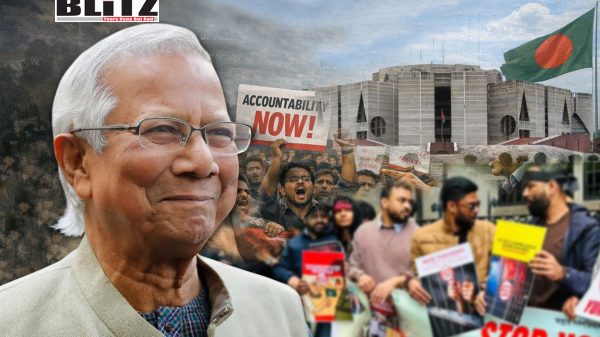
When Professor Muhammad Yunus assumed leadership of Bangladesh’s interim government in August 2024, the symbolism was powerful. Here was a Nobel Peace Prize laureate-founder of Grameen Bank and recipient of the 2006 Nobel Peace Prize-stepping into the vacuum left by the fall of Sheikh Hasina after a turbulent popular uprising. For many observers at home and abroad, Yunus’s appointment seemed to mark a moral reset: an 85-year-old global icon of social business entrusted with stabilizing a deeply polarized nation.
Yet, as with many moments of political transition, the distance between expectation and measurable outcomes has generated friction. Yunus’s tenure, which concluded on February 16, has left behind a contentious debate-one that is as much about narrative as it is about policy. Was this period a bridge to democratic normalization? Or did it reveal structural limits to technocratic leadership in a politically fractured environment?
To understand this debate, one must separate mythology from material outcomes.
Internationally, Yunus is synonymous with microfinance and “social business.” Through Grameen Bank, he popularized the concept that lending small amounts to the poor-particularly rural women-could catalyze entrepreneurship and break intergenerational poverty traps. His model challenged orthodox banking assumptions about collateral and risk. It also redefined development discourse by arguing that profit-making and social impact are not mutually exclusive.
However, within Bangladesh, his record has always been more contested. Critics argue that microcredit did not eliminate poverty at scale and that some borrowers became trapped in cycles of debt. The 2011 documentary The Micro Debt by Dutch journalist Tom Heinemann questioned aspects of Grameen’s transparency and impact metrics. Domestically, publications such as Bliitz have periodically raised allegations of financial irregularities, bribery, and institutional opacity-claims that Yunus and his associates have consistently denied.
This duality-revered abroad, scrutinized at home-defined much of Yunus’s political transition role. His critics contend that the same public relations machinery that built his global reputation also shaped perceptions during the interim period.
The central test: Recovering laundered wealth
If there was a single policy domain by which the interim government would be judged, it was asset recovery. According to reports citing Transparency International Bangladesh (TIB), approximately $234 billion was allegedly laundered out of Bangladesh between 2009 and 2024. These flows reportedly occurred during the 15-year tenure of Sheikh Hasina’s administration, facilitated by corruption, trade misinvoicing, institutional weaknesses, and regulatory gaps.
The interim government moved quickly to project seriousness. A Joint Investigation Team (JIT), comprising the Bangladesh Financial Intelligence Unit (BFIU), the Anti-Corruption Commission (ACC), and the Criminal Investigation Department (CID), was formed. Amendments expanded the ACC’s jurisdiction over predicate offenses, including tax evasion, customs fraud, currency smuggling, and capital market manipulation.
On paper, the institutional architecture appeared robust. According to official figures, movable and immovable assets worth approximately 66,146 crore BDT (approx. US$5.5 billion) were attached or blocked domestically and abroad. Of this, roughly 55,638 crore BDT ((approx. US$4.6 billion )was within Bangladesh and 10,508 crore BDT ( approx. US$ 866 million) overseas.
Yet attachment is not repatriation.
Despite sending 71 Mutual Legal Assistance Requests (MLARs) to jurisdictions identified as destinations for illicit funds-including the United States, Australia, Canada, the United Arab Emirates, Singapore, Malaysia, Switzerland, the United Kingdom, India, Cyprus, and Hong Kong-only 27 responses were reportedly received. Meetings were held with agencies such as the FBI, UNODC, the European Union, the World Bank, and the Asian Development Bank. However, the pace of asset recovery remained slow.
Officials acknowledge that international asset recovery is procedurally complex. Cross-border evidence gathering, differing legal standards, appeals, and court processes can stretch timelines to five years or more. In complex cases, proceedings may extend up to two decades. Dr. Iftekharuzzaman of TIB observed that while goodwill exists, the government’s technical expertise and coordinated international strategy may be insufficient.
In this context, Yunus’s critics argue that the interim government overpromised and underdelivered. They assert that announcements about seizures and investigations were not matched by transparent, case-by-case disclosures about recovered sums. Without demonstrable repatriation of significant funds, the optics of action risk appearing symbolic rather than substantive.
The white paper controversy
The interim administration commissioned an economic white paper under the leadership of Dr. Debapriya Bhattacharya. The report reportedly detailed structural weaknesses, fiscal mismanagement, and corruption patterns spanning 2009–2024. Some committee members later expressed frustration that recommendations were not implemented with urgency.
Here again, the tension lies between diagnosis and execution. Producing a comprehensive assessment is an important first step. But governance credibility hinges on translating analysis into reform-whether in customs administration, financial sector supervision, or anti-money laundering compliance frameworks.
Yunus’s defenders argue that an interim government, by definition, operates within constraints. Its mandate is transitional stabilization, not wholesale institutional overhaul. Moreover, entrenched networks and bureaucratic inertia cannot be dismantled in a matter of months.
Critics counter that moral authority carries its own expectations. If a Nobel laureate famed for systemic innovation cannot accelerate reform, who can?
The politics of the industrial groups
The JIT reportedly listed ten major industrial conglomerates under investigation for alleged money laundering and corruption, including Bashundhara, Beximco, S Alam, Orion, Summit, and others. The list was later revised, with some entities removed and others added-fueling speculation about political recalibration.
Such shifts underscore the inherently political nature of anti-corruption campaigns. Asset recovery is not merely a legal process; it intersects with elite power structures, employment networks, and capital markets. Investigating major conglomerates risks destabilizing economic sectors, affecting investor confidence, and provoking litigation.
The interim government had to balance due process with decisiveness. Whether it struck that balance effectively remains a matter of interpretation.
Microfinance, myth, and structural poverty
Beyond interim governance, Yunus’s broader legacy continues to provoke debate. Microfinance has undoubtedly expanded financial inclusion. It has also generated mixed empirical findings regarding long-term poverty alleviation. Randomized control trials in various countries suggest modest gains in business activity but limited transformative impact on household income.
Critics who portray microcredit as a driver of destitution may overstate their case. Equally, those who frame it as a silver bullet ignore structural determinants of poverty-land access, labor markets, education, infrastructure, and macroeconomic stability. Microfinance operates within, not above, these constraints.
The deeper question is whether development narratives become too personalized. Bangladesh’s economic trajectory over the past two decades has been shaped by export growth, remittances, demographic shifts, and state policy-not by any single individual. To credit or blame Yunus exclusively for national outcomes is analytically incomplete.
Measuring success in transitional governance
So how should Yunus’s interim leadership be assessed?
First, by stabilization metrics: Did the administration maintain macroeconomic continuity? Were elections conducted peacefully? Was there a credible transfer of authority? If so, those achievements merit acknowledgment.
Second, by institutional groundwork: Were legal amendments enacted? Were investigative capacities strengthened? Did the administration initiate cooperation mechanisms with foreign jurisdictions? These are necessary precursors to long-term recovery, even if immediate financial returns are limited.
Third, by transparency: Did the government communicate clearly about timelines, constraints, and uncertainties? Overpromising undermines trust more than cautious realism.
On the latter front, skepticism persists. Public frustration in Bangladesh is not solely about Yunus; it reflects cumulative fatigue with elite impunity and delayed justice.
A balanced reckoning
It would be reductive to cast Yunus as either savior or charlatan. His contributions to development thought are historically significant. His interim tenure, however, unfolded in a context defined by institutional fragility and geopolitical complexity.
Asset recovery on the scale alleged-$234 billion-is not a short-term project. It requires forensic accounting, cross-border litigation, political insulation of investigative bodies, and sustained diplomatic engagement. No interim administration could plausibly conclude such processes within months.
Yet moral capital is perishable. When expectations are elevated-by reputation, by rhetoric, by symbolism-scrutiny intensifies proportionally.
As Bangladesh transitions beyond the interim phase, the ultimate verdict on Yunus’s stewardship will likely hinge less on immediate financial repatriation and more on whether he strengthened the scaffolding for accountability. Did he institutionalize processes that future governments can build upon? Or did the moment dissipate into familiar patterns of inertia?
For a nation navigating post-uprising reconstruction, the answer matters. Not because it confirms or refutes a global narrative about a Nobel laureate, but because it shapes public trust in the possibility of reform.
In the end, Bangladesh’s struggle against corruption and illicit capital flight is larger than any one leader. It is a test of institutional resilience, legal sophistication, and civic vigilance. Yunus’s chapter-complex, contested, and consequential-forms part of that ongoing story.
Tajul Islam is a Special Correspondent of Blitz. He also is Local Producer of Al Jazeera Arabic channel.