Sheikh Hasina calls for ‘mental preparation’ for jail as Awami League faces internal revolt and strategic collapse

- Update Time : Sunday, March 1, 2026
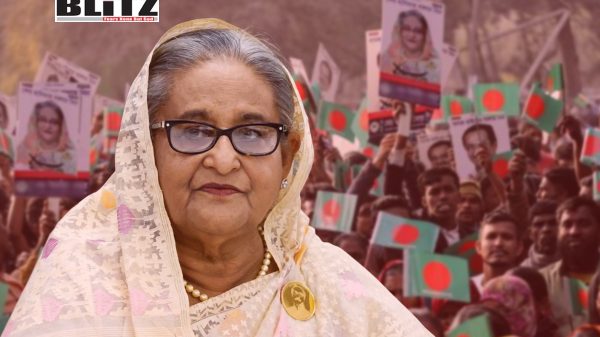
In a dramatic and unexpected move, former Prime Minister Sheikh Hasina has reportedly instructed leaders and activists of the Bangladesh Awami League – now scattered across India, Malaysia, the Gulf states, Europe, North America and beyond – to begin taking “mental preparations” for returning to Bangladesh, even if it means imprisonment.
The message, delivered through a virtual interaction and circulated via a press release attributed to party insiders, marks the most confrontational posture adopted by Hasina since the political upheaval of August 5, 2024 forced her into exile. Her directive was blunt: those unwilling to face legal consequences upon return may find themselves excluded from the party when it regains its organizational footing. This was not merely a call for resilience. It was a test of loyalty.
For eighteen months, the Awami League’s external leadership has largely operated in reactive mode – issuing statements, granting written interviews, and criticizing the February 12 general election from afar. But Hasina’s latest message signals a shift from rhetorical opposition to political confrontation.
During the reported virtual meeting, party leaders described the recent election as a “staged drama”. Hasina allegedly expressed visible anger at foreign observers who publicly endorsed the polls as free and fair. According to sources, she accused certain observers of offering contradictory assessments after returning home – endorsing the process officially while privately criticizing it.
Her remarks reveal growing distrust toward sections of the international community and an acknowledgment that external endorsement alone cannot restore the Awami League’s domestic relevance.
Addressing the ongoing ban on Awami League political activities, Sheikh Hasina reportedly argued that the restriction lacks legitimacy on two grounds: the party has not committed any crime, and the authority imposing the ban itself lacks lawful foundation. Without directly naming Prime Minister Tarique Rahman, she expressed hope that the government would reverse the decision. But she also warned that if the ban remains, the party will announce its next course of action – language widely interpreted as a signal of organized resistance.
Such rhetoric raises the stakes dramatically. A movement from exile is not merely symbolic; it requires structure, unity and unquestioned command. And that is precisely where the Awami League now appears fractured.
Perhaps the most explosive dimension of this episode is not what was said – but who stayed silent. Sheikh Hasina’s son Sajeeb Wazed Joy, an American citizen currently fleeing legal proceedings in Bangladesh – who is widely regarded as the party’s de facto leader since late January, did not attend the virtual meeting. Nor did several heavyweight figures associated with his inner circle, including Mohammad Ali Arafat and former senior cabinet members.
Even more telling is the absence of any reference to the meeting on the party’s official website or verified platforms. Indian media outlets that carried the story relied solely on an anonymously circulated press release. In high-stakes political environments, omission speaks volumes. Observers note that the party’s digital infrastructure is controlled by figures aligned with Joy. The decision not to publish or amplify Hasina’s call for sacrifice has triggered speculation of a widening strategic divide between mother and son.
At its core, this is not merely a disagreement over tactics – it is a clash of political temperaments. Hasina’s message reflects a leader forged in decades of political struggle, imprisonment and confrontation. Her strategy suggests that sacrifice and legal endurance could restore moral authority and re-energize grassroots cadres.
The alternative approach, reportedly favored by Joy’s camp, is far more cautious: wait for a “favorable atmosphere”, allow internal dissatisfaction within Bangladesh to build, and return only when risks are minimized.
Critics within the party quietly argue that such a strategy effectively places the burden of struggle on domestic activists while the external leadership remains insulated abroad. If true, the divide threatens to paralyze the party at a moment when clarity is essential.
Another layer of complexity surrounds the credibility of communications attributed to Sheikh Hasina in recent months. Several international and Indian media outlets have grown increasingly hesitant to publish “written interviews” unless Hasina appears live or on verified video platforms. Media analysts have privately questioned whether some of these responses genuinely reflect her tone or are crafted by intermediaries linked to professional public relations networks. In an era where authenticity defines political survival, such doubts are corrosive. If party messaging is perceived as manufactured rather than direct, it weakens both domestic mobilization and international sympathy.
Beyond internal fractures, a geopolitical recalibration may further complicate Hasina’s path. New Delhi’s growing engagement with the current administration in Dhaka signals a pragmatic shift. Should bilateral ties deepen, Indian authorities may become less tolerant of overt political activities on their soil aimed at destabilizing the Bangladeshi government. For Awami League, a party whose senior leadership has relied heavily on Indian safe haven since 2024, this represents a strategic vulnerability. Isolation abroad, combined with division within, is a dangerous equation for any political organization.
The Awami League now stands at a historic inflection point.
One path demands courage, sacrifice and immediate confrontation – even at the cost of imprisonment. The other prioritizes strategic patience, risk management and long-term recalibration. But politics rarely rewards indecision.
If Sheikh Hasina cannot decisively reassert control over the party’s narrative and command structure, the movement risks drifting into irrelevance. If, on the other hand, she forces a return without unified backing, the consequences could be chaotic. The question is no longer whether the Awami League will return – but under whose authority, and at what cost.
Sheikh Hasina’s call for “mental preparation” was more than a motivational phrase. It was a warning shot – directed not only at the government in Dhaka, but at hesitation within her own ranks. History shows that exile can either harden resolve or fracture legacy. In the coming months, Bangladesh may witness which of those destinies awaits one of its most dominant political forces. And if the internal rift deepens, the greatest challenge to Sheikh Hasina may not come from her opponents – but from within her own house.
An internationally acclaimed multi-award-winning anti-militancy journalist, writer, research-scholar, counterterrorism specialist and editor of Blitz. He regularly writes for local and international newspapers on diversified topics, including international relations, politics, diplomacy, security and counterterrorism. Follow him on 'X' @Salah_Shoaib