Bangladesh bomb plot fallout: Fugitive ISIS regional chief allegedly linked to Yunus advisor

- Update Time : Sunday, February 22, 2026
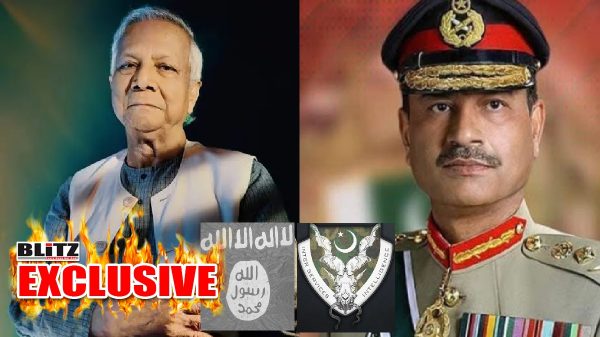
By mid-October last year, when Pakistan’s espionage agency sensed that general elections in Bangladesh scheduled for February 2026 were becoming inevitable – a development that would potentially end the 18-month grip Islamabad had allegedly established over Bangladesh with the active collaboration of at least four influential advisors of the Yunus regime – the so-called “Dhaka Cell” of the ISI reportedly sent an urgent message to Lieutenant General Asim Malik, seeking his “immediate action” to sabotage the electoral process.
Subsequently, one influential advisor of the Yunus regime was invited to visit Pakistan. Although the “official visit” was scheduled for four days – November 4–7 – the trip was extended until November 10, reportedly in violation of established protocols.
According to a highly placed source, on November 8, 2025, the advisor held a two-hour secret meeting with Lieutenant General Asim Malik at an ISI safe house in Islamabad. The meeting was allegedly kept completely confidential, without informing the Bangladesh High Commission or relevant diplomatic officials. During this meeting, the advisor reportedly described the possible “catastrophe” of a “recapture of power by anti-Pakistan elements” and sought “urgent initiatives” from the ISI chief.
There are also claims of another meeting between the same advisor and Pakistan Army Chief General Asim Munir. During these interactions, the advisor allegedly urged immediate measures to disrupt the February 2026 elections in Bangladesh.
Following these meetings, several members of Jaish-e-Mohammad (JeM), Lashkar-e-Taiba (LeT), along with covert ISI operatives, allegedly entered Bangladesh. These operatives reportedly established contact with Sheikh Al Amin, later identified as the “regional commander” of the so-called Islamic State Bengal (ISB).
Al Amin was allegedly tasked with organizing a series of terrorist attacks, including suicide operations targeting sensitive locations in Dhaka, including a particular foreign mission. An officer from the ISI’s “Dhaka Cell” was reportedly assigned to coordinate logistics and maintain direct communication with him.
Following this assignment, Al Amin and his associates allegedly began assembling sophisticated improvised explosive devices (IEDs), suicide vests, and remote-controlled time bombs. However, the operation reportedly collapsed when the bomb-making facility exploded in a series of powerful blasts.
According to media reports, the explosion occurred at Ummal Qura International Madrasa in the Hasnabad area of Keraniganj, on the outskirts of Dhaka has not only failed the mission of Pakistani ISI, it also exposed the evolving and resilient architecture of jihadist militancy in Bangladesh.
What initially appeared to be a localized accident soon acquired far greater strategic implications after intelligence sources identified Sheikh Al Amin, the regional commander of so-called Islamic State Bengal (ISB), as the key figure behind the IED manufacturing and storage hub.
Explosives experts reportedly believe the blast was caused by the accidental detonation of Triacetone Triperoxide (TATP) precursors and suicide vest components. TATP – highly sensitive to heat and friction – has frequently been associated with ISIS-style bomb-making techniques. Its use suggests a level of technical sophistication not typically seen in Bangladesh’s past incidents of localized political violence. Its presence indicates not only technical sophistication but also ideological alignment with transnational jihadist doctrine.
Prior to the explosion, Al Amin’s network allegedly relocated more than 85 improvised explosive devices to clandestine safe houses, creating what security analysts describe as a significant kinetic threat ahead of the February 12 parliamentary elections. Intelligence inputs suggest that some of these materials may have been distributed to extremist factions such as JMB and Ansar Al Islam. Intelligence suggests that these deadly materials have been handed over to extremist groups such as JMB and Ansar Al Islam. Raw materials for making IED at the clandestine explosive making hub for Islamic State Bengal (ISB) inside Ummal Qura International Madrasa in the Hasnabad area near Dhaka city was of Pakistan origin, while certain amount of Pakistan-made RDX was also found inside the madrasa.
It is also alleged that shortly after assuming office on August 7, 2024, Muhammad Yunus authorized procurement of a large quantity of RDX from Pakistan Ordnance Factory. Following the consignment’s arrival at Chittagong Port, approximately 40 tons reportedly went missing under unexplained circumstances. The Yunus administration had also released numerous jailed Islamist militants, and Sheikh Al Amin was reportedly among those freed.
Sheikh Al Amin was reportedly raised in Sharulia village in Bagerhat district – an area historically cited as a logistical corridor for militant networks. He received early education in Qawmi madrasas before completing higher secondary studies. Observers believe his radicalization began during his student years and intensified through exposure to online ISIS propaganda.
After joining Neo-JMB, he allegedly received arms training and later became involved in recruitment and operational training. Over time, he reportedly assumed various responsibilities within ISB, ranging from military instruction to recruitment – contributing to the survival of ISIS-aligned networks inside Bangladesh.
In July 2017, he was arrested by Bangladesh’s Rapid Action Battalion in Narayanganj while allegedly planning large-scale attacks. Firearms and extremist materials were reportedly seized.
However, imprisonment did not end his influence. Between 2017 and 2019, while incarcerated in Kashimpur Central Jail, he allegedly built bridges between rival jihadist factions – including Al Qaeda-aligned JMB elements and ISIS-oriented Neo-JMB cadres. Prison reportedly became a networking platform rather than a deterrent.
After a second arrest in 2021 and subsequent release on bail in late 2022 or early 2023 – prior to the broader release of Islamist detainees under the interim Yunus administration – Al Amin reportedly adopted a low-profile civilian cover, working as an auto-rickshaw and ride-share driver. Investigators believe this enabled mobility, anonymity, and discreet network rebuilding.
A notable tactical evolution was the alleged use of “family cells”, with female relatives assisting in logistics and recruitment – embedding militant activity within domestic settings to reduce suspicion.
Although police arrested at least eight individuals – mostly family members and close associates – following the December 2025 explosion, Sheikh Al Amin remains at large. Credible sources claim he is moving between madrasas along the Bangladesh-India border and attempting to reorganize with support from operatives allegedly hiding in West Bengal and India’s northeastern states.
According to sources familiar with the matter, there are growing concerns within certain security circles that the fugitive ISB commander may be benefiting from protection networks linked to a senior advisor within the Yunus administration, who is allegedly attempting to facilitate his escape to Pakistan using newly issued travel documents. While these claims require independent verification, if substantiated, they would raise profound questions for regional security stakeholders – particularly India, the United States, and European partners engaged in counterterrorism cooperation with Bangladesh. Any perception that extremist operatives could exploit political patronage or state-level facilitation for cross-border movement would not only undermine domestic stability but also complicate ongoing intelligence collaboration across South Asia.
An internationally acclaimed multi-award-winning anti-militancy journalist, writer, research-scholar, counterterrorism specialist and editor of Blitz. He regularly writes for local and international newspapers on diversified topics, including international relations, politics, diplomacy, security and counterterrorism. Follow him on 'X' @Salah_Shoaib