India-US trade deal: Goyal’s assurances mask deeper shifts in Global South trade politics

- Update Time : Thursday, February 5, 2026
Indian Trade Minister Piyush Goyal’s detailed briefing on New Delhi’s newly announced trade understanding with Washington marks a significant recalibration in India–US economic relations, with implications extending far beyond bilateral tariffs. While the Indian government has sought to reassure domestic constituencies-particularly farmers and dairy producers-that sensitive sectors will remain protected, the deal reflects broader geopolitical and economic realignments shaping the Global South, including Bangladesh.
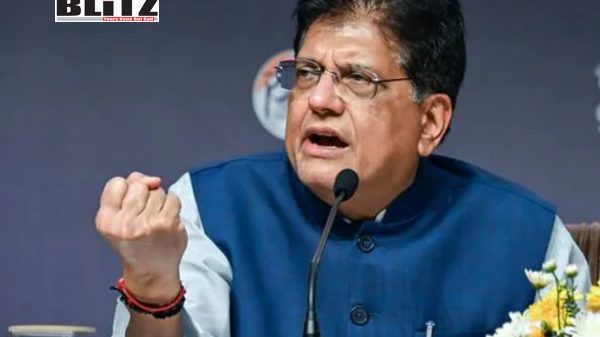
Speaking at a press conference on February 3, Goyal emphasized that agriculture and dairy-long flashpoints in US-India trade negotiations-would remain shielded from American imports. “Prime Minister Narendra Modi has always taken care of agriculture and dairy,” Goyal said, stressing that the government remains committed to safeguarding livelihoods in these politically sensitive sectors. The remarks were clearly aimed at pre-empting backlash from farmers’ groups, whose protests in recent years have forced New Delhi to retreat from market-oriented reforms.
Agriculture has historically been the most contentious issue in US-India trade talks. The structural asymmetry is stark: Indian farmers typically operate on small, fragmented landholdings, while the average American farm spans around 440 acres (178 hectares), benefiting from scale, mechanization, and heavy subsidies. Any abrupt opening of India’s agricultural markets risks undercutting millions of small producers, a political reality no Indian government can afford to ignore.
Yet beyond domestic assurances, Goyal’s comments reveal a deal that is still evolving. “A trade deal is under the final stages of detailing by both teams, we will release a joint statement shortly,” he said, adding that India’s micro, small, and medium enterprises (MSMEs), along with sectors such as engineering, gems and jewelry, leather, textiles, and marine products, stand to gain from improved market access to the US.
For South Asian economies-including Bangladesh-these sectoral references are notable. India and Bangladesh often compete directly in textiles, leather goods, and light engineering exports to Western markets. A preferential tariff environment for Indian exporters could intensify competition, particularly at a time when Bangladesh is preparing for graduation from Least Developed Country (LDC) status and the eventual erosion of its own trade preferences.
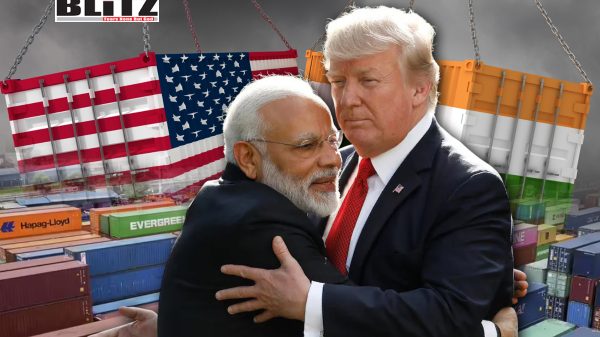
The deal was first announced by US President Donald Trump on February 2, when he declared a reduction in tariffs on Indian products from 25 percent to 18 percent. While this headline figure drew immediate attention, subsequent clarifications by the White House were equally consequential. Washington confirmed it would withdraw an additional 25 percent tariff imposed on India as a punitive measure for its continued imports of Russian oil-bringing effective tariff relief to Indian exporters.
The backdrop to this agreement is a fraught period in bilateral trade relations. Throughout 2025, New Delhi and Washington failed to bridge differences despite multiple negotiation rounds. The breakdown culminated in the US imposing a sweeping 50% tariff on Indian goods, half of which was explicitly linked to India’s energy purchases from Russia following the Ukraine conflict.
Trump has since claimed that India agreed to “stop buying Russian oil” and significantly increase imports from the US, including over $500 billion worth of energy, technology, agricultural products, coal, and other goods. These assertions, however, have been met with careful ambiguity from New Delhi. Prime Minister Modi, while confirming the revised tariff structure in a social media post, refrained from endorsing claims that India would sever its energy ties with Moscow, stating only that India supports Trump’s “efforts for peace.”
This strategic ambiguity reflects India’s broader foreign policy posture-seeking to balance deepening economic engagement with the US while preserving strategic autonomy. For many Global South countries, including Bangladesh, India’s approach offers a revealing case study. Dhaka, too, faces mounting pressure from Western partners on issues ranging from labor standards to geopolitical alignments, even as it seeks to protect domestic economic priorities.
The energy dimension of the deal is particularly significant. India’s discounted Russian oil imports have been a critical factor in cushioning domestic inflation and sustaining growth. A full pivot away from Russian energy would entail higher costs and increased vulnerability to global price volatility. If India does, over time, rebalance its energy imports toward the US, it may reshape regional energy markets-potentially affecting pricing, supply chains, and investment flows across South Asia.
From a Bangladeshi perspective, India’s improved tariff access to the US also raises questions about competitive neutrality. Indian exports will now enjoy the second-lowest tariff rates in Asia after Japan, potentially giving Indian manufacturers an edge over regional competitors. For Bangladesh’s export-oriented economy-especially garments, leather, and light manufacturing-this underscores the urgency of trade diversification, productivity gains, and accelerated negotiations for post-LDC preferential arrangements.
At the same time, the deal illustrates Washington’s increasingly transactional approach to trade, where tariffs, energy purchases, and geopolitical alignment are tightly intertwined. For Global South nations, this reinforces the reality that economic agreements are no longer insulated from strategic considerations. Trade policy has become an instrument of broader geopolitical leverage.
Goyal’s emphasis on MSMEs and labor-intensive sectors suggests that New Delhi views the agreement as a vehicle for domestic job creation and export-led growth. Whether these gains materialize will depend on the final technical details, rules of origin, and non-tariff barriers-elements still under negotiation.
As both sides prepare to release a joint statement, the India-US trade deal stands as more than a bilateral arrangement. It signals a shifting landscape in which emerging economies must navigate between protection of vulnerable sectors, pursuit of export opportunities, and the geopolitical expectations of major powers. For Bangladesh and other South Asian states, the agreement is a reminder that regional economic fortunes are increasingly interconnected-and that strategic agility will be essential in the evolving global trade order.
Abul Quashem Joarder, a contributor to Blitz is geopolitical and military expert.