


When power flatters itself: From graveyards to five-star ministries

- Update Time : Wednesday, January 28, 2026
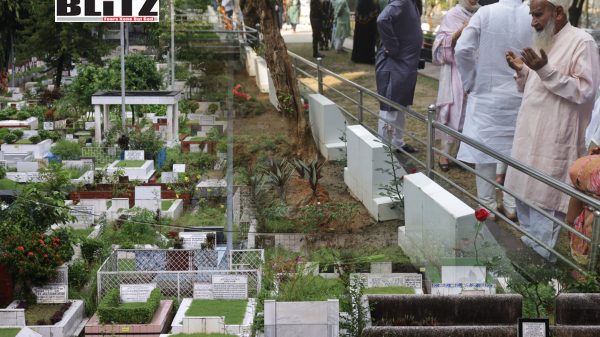
There is something uniquely revealing about how a state allocates its dead—and its ministers. Graveyards, after all, are meant to be the great equalizer. Ministers’ residences, by contrast, are supposed to be functional symbols of public service, not monuments to privilege. When both are bent to flatter power, the result is not governance but quiet moral decay.
Consider the Banani Graveyard policy in Dhaka. Officially, it was framed as a response to land scarcity, a very real problem in Dhaka. Grave space is finite, the city is overcrowded, and burial management requires rules. Yet politics has a way of distorting necessity into deference. When Atiqul Islam, the then mayor of Dhaka North City Corporation, tightened burial rules at Banani, the intent was less urban planning than political choreography. Members of Sheikh Hasina’s family are buried there. The policy made permanent burials nearly impossible for ordinary citizens, effectively turning a public graveyard into a semi-sacred enclave for the powerful. It was governance as flattery—over-enthusiastic, unnecessary, and quietly cruel.
When a citizen purchases a burial plot in Banani graveyard, it is traditionally understood (both in Islamic practice and in local custom) to be a permanent resting place. Yet the Banani graveyard policy introduced an anomalous provision: a time-bound ownership clause that runs directly against Islamic principles, entrenched social norms, and the egalitarian ethos of Bangladeshi society. Even more unsettling is a rule so arbitrary that it prohibits a grandson from being buried in his grandfather’s grave—an edict that is not only religiously indefensible but socially jarring.
The numbers tell the story. Leasing fees soared to staggering levels—Tk 1 crore for 15 years, Tk 1.5 crore for 25. Reburial became mandatory after lease periods. Digital systems were introduced, policies refined, all under the banner of efficiency. Yet efficiency for whom? A policy that prices grief beyond the reach of common people may be administratively neat, but morally it stinks. It sends a simple message: equality ends where power begins.
Fast forward, and the faces at the top have changed. The habit has not.
Today, under the interim government, Muhammad Yunus stands accused—not yet by courts, but by public conscience—of adopting a similar posture. The symbols are different, the logic is familiar. While Dhaka’s residents queue for water, endure rolling power cuts, and watch gas prices climb, the state has approved plans for ministerial flats ranging from 8,500 to over 9,000 square feet. Not houses—palaces in the sky. High-rise residences equipped with swimming pools, gyms, lavish furnishings, office suites, and all the conveniences of a five-star hotel.
Let us pause on the scale. A typical upper-middle-class flat in Dhaka is about 1,500 square feet. Lower-ranking government employees manage with roughly 650. These new ministerial apartments are six times larger than what a comfortable citizen might aspire to, and nearly fourteen times larger than what many public servants accept as normal. The cost—around Tk 786 crore—comes at a time when the state pleads austerity to justify higher taxes and reduced subsidies.
Supporters argue that ministers need space for work, security, and protocol. Fair enough—up to a point. But governance is also about optics, and these optics are obscene. When ministers swim on rooftops while citizens cannot boil rice for lack of gas and water, the social contract frays.
What makes this moment particularly unsettling is the perception—widely shared, rarely disproved—that this indulgence is not merely domestic vanity but international signaling. Yunus, critics allege, is more attentive to the tastes of foreign patrons than the hardships of local people. Dr Yunus may be thinking of “French wine” and his visions are targeting the foreign friends as there is a rumor that Yunus will prolong his tenure for an indefinite period. But, it captures a deeper unease: that policy priorities are being shaped to impress outsiders rather than serve citizens. The composition of his advisory circle, heavy with foreign voices, reinforces that suspicion.
Dr. Yunus rose to power in 2024 on the strength of a popular movement against state discrimination. He was seen as the foremost leader who would break this cycle of bias and dismantle the nation’s entrenched corruption. Unfortunately, upon taking office, Dr. Yunus himself became absorbed in the same cycle of graft and began demonstrating discrimination against citizens. Following the sacrifices made by people from all walks of life, such discrimination from Yunus and his government is a profound disappointment. It amounts to a betrayal of the martyrs of the July uprising.
History offers uncomfortable parallels. Colonial administrations often lived in lavish enclaves, insulated from the deprivation they governed. Post-colonial elites, once in power, replicated the same architecture of distance—bigger houses, wider roads, restricted spaces. Bangladesh was supposed to have broken that cycle in 1971. Yet here we are, decades later, debating not whether ministers should live well, but whether they should live like royalty while the public struggles to survive.
The graveyard policy and the ministerial housing project are not isolated controversies. They are symptoms of a governing instinct that equates loyalty with luxury and authority with insulation. In both cases, power seeks to protect itself—its memory in death, its comfort in life—by restricting access for the many.
There is also a political cost. When citizens perceive that leaders are deaf to their suffering, legitimacy erodes. People may tolerate hardship if they believe it is shared. They revolt, quietly or loudly, when they see leaders exempting themselves. The French Revolution did not begin with bread shortages alone; it began with the sight of Versailles. History is unkind to governments that forget this.
Bangladesh today faces no shortage of genuine challenges: inflation, energy insecurity, urban congestion, institutional fragility. None of these will be solved by 9,000-square-foot flats or exclusive graveyards. On the contrary, such gestures distract from reform and invite cynicism. They tell citizens that the state’s first instinct is self-preservation, not service.
Austerity, when demanded of the public, must be modeled at the top. Modesty in power is not populism; it is prudence. Leaders who insist on extravagance during hardship do not look strong. They look afraid—afraid of losing status, relevance, or favor.
The tragedy is that Bangladesh has seen this movie before. Each time, the ending is the same: public anger, institutional decay, and the arrival of “seasonal birds”—opportunists who extract what they can and leave the country poorer, materially and morally. Breaking this cycle requires more than new faces. It requires a new ethic: that power exists to reduce distance, not deepen it.
Graveyards should remind leaders of equality. Official residences should remind them of responsibility. When both become tools of flattery, the state is no longer governing. It is congratulating itself—while the people pay the bill.
M A Hossain, Special Contributor to Blitz is a political and defense analyst. He regularly writes for local and international newspapers.