While Awami League is near to extinction, its exiled leaders are busy with cracks, champagne and concubines

- Update Time : Wednesday, January 14, 2026
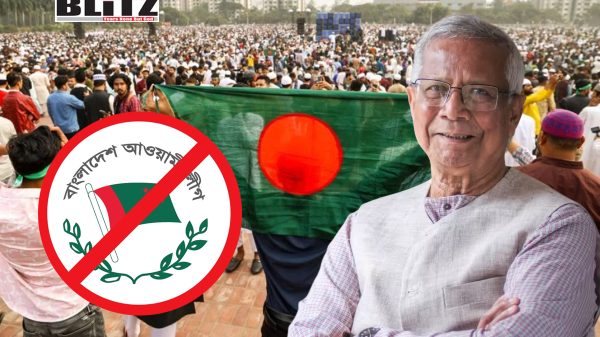
Bangladesh’s oldest political party – Awami League is visibly approaching extinction as most of its key figures are in several foreign countries, with its president Sheikh Hasina only making frantic bids in keeping the party artificially alive through limited presence on social media platforms – and occasional appearances on international – mainly Indian media outlets. Meanwhile, party’s bigwigs, including its general secretary Obaidul Quader and other presidium members as well as former ministers – some of whom were big-mouthing and even boasting of being extremely efficient with international connections, are now competing in hiding their faces from Sheikh Hasina.
When the party is in dire need of leadership and Hasina needing hands to help her efforts in recovering Awami League from the current crisis, dozens of her former cabinet colleagues are passing colorful lives in various parts of India – particularly Kolkata city’s high-end residential towns. Each evening, many of them are seen spending lavishly on cracks, champagne, escorts, hookers and even – gambling. According some sources, every evening these former colleagues of Sheikh Hasina even are spending millions of rupees into their numerous fantasies and extravagance – and waiting anxiously for the “right moment” when their party chief – Hasina would return to power and grant them a newer opportunity of dedicatedly looting public wealth or indulge into rampant corruption and further nourish their wallets.
Media reports have surfaced showing several Awami League leaders frequenting upscale shopping malls, casually spending time with escort girls or concubines. They don’t at all feel interested in taking any initiatives in saving the party from mere extinction. Because all they believe – for Awami League it will take 5-10 years from just returning to regular political activities in Bangladesh. Some of them even are afraid of falling into bigger trouble by playing any role in the party.
Such a shocking tendency is prevalent within Awami League leaders when people in Bangladesh are into dire sufferings – from unemployment to acute financial crisis – from non-availability of essential gas to run their kitchen – and above all – a total frustrating future for its younger generations. One after one foreign nations are shutting doors to visa-seekers – especially youths from Bangladesh. And the Yunus administration seems to have opted for remaining lethargic in tackling these issues, because – Muhammad Yunus has no interest except of making quick bucks for him and his foreign friends.
For Sheikh Hasina, this is the most frustrating situation, when she is seeing – none of her former cabinet or party colleagues are even showing the willingness of taking necessary steps in salvaging the party from going extinct.
According to critics, Awami League leaders themselves may escape this storm. Exile has its advantages. Accountability, it seems, will be selective—aimed less at culpability than at capability. The danger is obvious: weaken institutions too much and you inherit a state that cannot govern, only punish.
Meanwhile, Bangladesh is living through a quiet emergency. The kind that does not announce itself with barricades and burning tires, but with dimmer lights, colder kitchens, and a gnawing sense that the country’s political elites have misplaced both its compass and its conscience. The gas shortage alone would have ignited street politics in another era. Price hikes, rolling energy disruptions, shrinking jobs—these are the classic ingredients of mass unrest. Yet the streets remain largely empty. Not because the pain is absent, but because leadership is.
This is the paradox of the moment: a society stretched thin without a credible guide to convert grievance into reform. People are fed up, yes. But fatigue without direction curdles into apathy. Bangladesh today has anger in abundance and leadership in short supply.
The Awami League’s predicament explains much of this vacuum. Once a movement forged in struggle and sacrifice, it now looks less like a party in exile than a network of absentee landlords—leaders abroad, bank accounts well-fed, reputations threadbare. Their distance from the daily suffering of citizens is not just geographic; it is moral. Politics has become a retirement plan. The party that once mobilized the nation now barely stirs its own base.
Meanwhile, the opposition is busy counting chickens before the eggs have hatched. Jamaat-e-Islami dreams of occupying the state. The BNP’s acting supremo, Tarique Rahman, increasingly speaks and behaves as if the office of prime minister is a mere formality awaiting him. But listen carefully: there is little talk of gas, inflation, or livelihoods. Power has become the conversation, not purpose.
Here lies a dangerous illusion. Politics conducted as inheritance rather than responsibility tends to rot fast. Bangladesh’s citizens are not props in a succession drama. They are enduring an economic squeeze that demands seriousness, not slogans.
Jamaat’s appeal—and it would be dishonest to deny it—rests on a single, potent claim: relative freedom from corruption. Even rivals grudgingly acknowledge this. In a country exhausted by graft, that matters. By contrast, the BNP carries the heavy baggage of past excesses. Few believe that a BNP government would dismantle corruption; many fear it would merely reorganize it. The expectation—widely whispered, rarely denied—is that a share of ill-gotten gains would flow upward to a particular leader. Corruption would be institutionalized rather than confronted.
But integrity in accounting is not the same as wisdom in governance. A Jamaat-led government might indeed reduce petty corruption. Yet it would almost certainly pursue an ultra-nationalist, ideologically rigid agenda. Foreign treaties deemed “doubtful” would be scrapped. Engagements with Western governments would be curtailed under pressure from Islamist allies. The state would narrow its diplomatic bandwidth at precisely the moment Bangladesh needs strategic flexibility.
History offers warnings. Revolutions that promise moral purification often end by replacing one form of excess with another—less venal, perhaps, but more intrusive. The Iranian experience looms large. No one suggests Bangladesh would replicate Iran wholesale, but systems have a way of borrowing logic if not labels. Concentrated moral authority, once sanctified, resists accountability. A republic can quietly acquire clerical overtones without ever declaring itself a theocracy.
Supporters point to India’s BJP as a counterexample: a right-wing religious party that still functions within democratic parameters. Perhaps. But even India’s experience shows the costs—polarization, institutional stress, and the steady erosion of pluralism. Transplants that model into Bangladesh’s more fragile ecosystem and the risks multiply.
Then there is the regional calculus. After the next election—whoever wins will likely rule for at least five years—India will move briskly to normalize relations with the incumbent. New Delhi deals with governments, not ghosts. An Awami League stranded abroad, consumed by internal decay and personal indulgence, will offer India nothing but inconvenience. Former allies can become liabilities. In geopolitics, sentiment expires quickly.
This is the cruel irony: the Awami League’s leaders, insulated by wealth and distance, seem unconcerned with both the nation’s suffering and their party’s survival. They have siphoned enough to live comfortably; the rest appears negotiable. History, however, is rarely so forgiving. Parties do not die suddenly. They hollow out first.
What follows may be the most unsettling prospect of all: a reckoning disguised as justice. Extra-judicial “corrections” are likely, targeted not at the absent politicians but at the machinery they once commanded. Bureaucrats. Security officials. The institutional spine of the previous order. This will be framed as dismantling fascist mechanisms. Some will cheer. Few will ask who sets the rules once the rules are broken.
Bangladesh stands, then, at a narrowing fork. On one side, an exhausted ruling party drifting toward extinction, its leaders distracted by money and personal excess. On another, opposition forces are eager for power but thin on solutions, divided between corruption-tainted populism and ideologically rigid moralism. In the middle, a public bearing the cost.
The tragedy is not inevitable. Economic crises have been turned into reform moments before—when leadership rose to the occasion. But leadership requires presence, humility, and an argument larger than oneself. For now, those qualities are in short supply.
Extinction is not a metaphor reserved for biology. Political parties, too, can become fossils—studied, remembered, but no longer relevant. The Awami League risks that fate not because its enemies are strong, but because it has chosen absence over responsibility. And in politics, as in nature, what vacates the field invites replacement—whether or not the replacement is better.
Bangladesh deserves more than a contest of ambitions. It deserves leaders who see the crisis, name it honestly, and stay long enough to fix it. Until then, the silence in the streets will remain—not a sign of stability, but of abandonment.
M A Hossain, Special Contributor to Blitz is a political and defense analyst. He regularly writes for local and international newspapers.